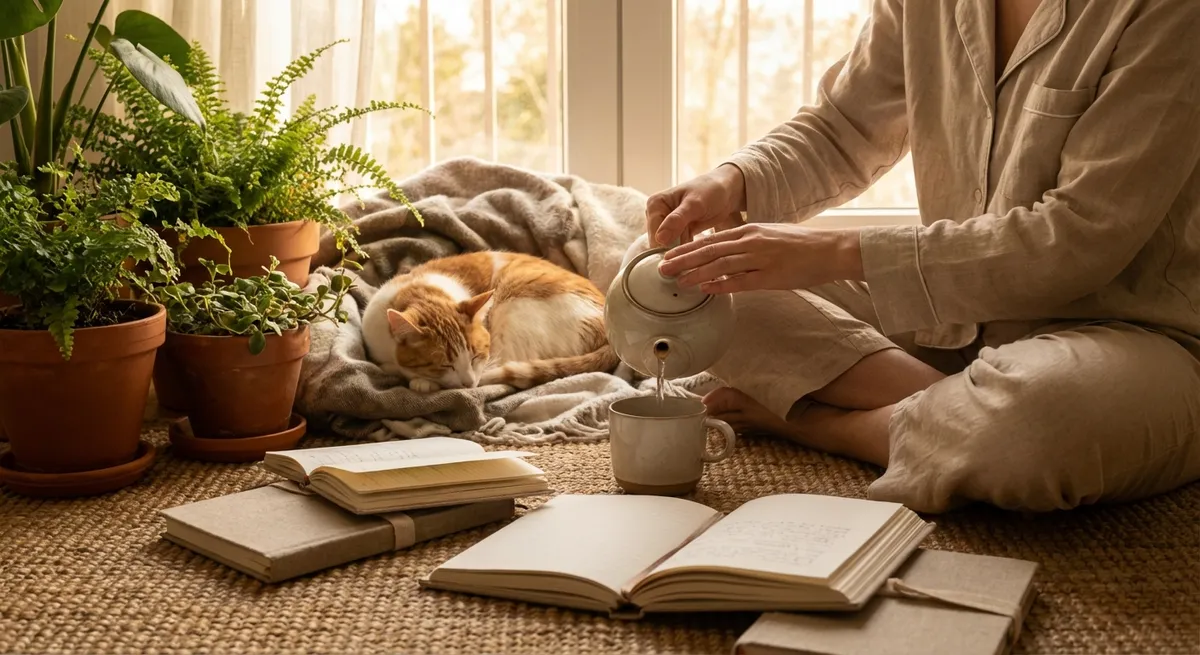
This guide offers five calming, tender ways to ease stress and invite more ease into your everyday life—no big changes, no complicated routines, just quiet shifts that meet you right where you are.
Meeting Your Stress With Kindness, Not Resistance
Stress often convinces us that we must push harder, rush more, and keep up at all costs. Yet the body and mind usually need the opposite: a pause, a breath, a kind word. Instead of fighting stress or judging yourself for feeling it, you can begin by simply acknowledging it.
Notice where stress lives in your body right now. It might be a tight jaw, a fluttering chest, or a heavy stomach. Rather than trying to “fix” it, you can softly say to yourself, “I see you. It makes sense to feel this way.” This simple recognition can reduce the extra layer of guilt or frustration that often accompanies stress.
Research suggests that self-compassion—treating yourself with the same care you’d offer a close friend—can lower stress levels and support emotional resilience. You might practice this by placing a hand over your heart or on your chest and taking a slow breath. Each time you exhale, you’re gently telling your nervous system: it’s safe to soften, even just a little.
Calming Tip 1: A Three-Breath Pause to Reset the Moment
When stress rises, long meditations can feel out of reach. A three-breath pause is a tiny practice you can use anywhere—at your desk, in your car (safely parked), or standing in the kitchen.
- First breath: Notice.
Inhale slowly through your nose and gently exhale through your mouth. Use this breath to notice: “This is a stressful moment.” No judgment, just recognition.
- Second breath: Soften.
As you breathe in again, see if you can release a small bit of tension—drop your shoulders, unclench your hands, loosen your jaw. Exhale as if you are letting the air carry a fraction of your stress away.
- Third breath: Support.
On the last breath, silently offer yourself a kind phrase: “May I be gentle with myself,” or “I’m doing the best I can right now.”
This simple pattern takes less than a minute, yet it can interrupt the rush of stress chemicals and give your mind a moment of rest. Practiced regularly, it becomes a quiet anchor throughout your day.
Calming Tip 2: Creating a Mini Sanctuary in Ordinary Spaces
You don’t need a special room or a meditation cushion to feel calmer. A “mini sanctuary” can be a small corner of your existing life—a section of your desk, a chair by a window, a part of your bedside table—devoted to stillness and softening.
Choose a spot that feels even slightly comforting. Add one or two objects that make you feel grounded: perhaps a small plant, a favorite book, a smooth stone, or a candle you light only when you want to slow down. This visual cue reminds your body, “Here, I can breathe a little more deeply.”
When stress builds, visit this space for a short ritual: sit for two minutes, look at something calming, and let your gaze soften. You might rest your feet on the floor and feel the support beneath you. Over time, this place becomes associated with safety and calm, helping your nervous system relax faster each time you return.
Calming Tip 3: Using Gentle Movement to Melt Mental Tension
Stress doesn’t live only in your thoughts; it settles into the body. Gentle movement can be a soothing way to release pent-up tension without demanding intense effort.
You might try:
- Slow shoulder rolls, forward and backward, to ease tightness in the neck and upper back.
- Soft neck stretches, tilting one ear toward your shoulder, then the other, breathing deeply as you go.
- Standing stretches, reaching your arms overhead and then letting them fall by your sides on a long exhale.
Even two or three minutes of this unfussy movement can lower physical arousal and quiet the mind. Research shows that light activity, such as walking or stretching, can help reduce stress hormones and lift mood. Think of it not as exercise, but as a way of kindly wringing out the day’s tension from your muscles.
You can pair movement with music that soothes you or natural sounds like rain or ocean waves, turning these moments into a gentle moving meditation.
Calming Tip 4: Softening Your Inner Voice During Difficult Moments
Stress often invites a harsh inner narrator—the part of you that says, “You should be coping better,” or “Why can’t you handle this?” This voice can quietly amplify anxiety and exhaustion.
To soften it, begin by noticing the tone of your self-talk. Is it rushed? Critical? Demanding? Then, ask yourself: If a dear friend were feeling this way, what would I say to them? The phrases that come to mind—“It’s okay to be overwhelmed,” “You don’t have to do everything perfectly,” “Take this one step at a time”—can become your new inner dialogue.
You might even write a short note to yourself on a piece of paper or in your phone: three or four reassuring sentences you can read when stress is high. Over time, shifting to a kinder inner voice helps your mind feel safer and less under attack, which can reduce the intensity of your stress response.
Calming Tip 5: Ending the Day With a Gentle “Release” Ritual
Stress often follows us into the night, replaying the day’s events or rehearsing tomorrow’s worries. A short “release” ritual at the end of the day can help signal to your body that it’s time to let go.
You might:
- Write down what you’re carrying. List a few worries, tasks, or lingering thoughts. Then, beneath them, write: “I’ve acknowledged you. For tonight, I set you down.”
- Name three small things that were okay or good. They don’t have to be big—a warm drink, a kind message, a quiet moment. This gently shifts your focus away from stress toward balance.
- Take a closing breath. Sitting on the edge of your bed or by a window, inhale slowly and exhale with a whispered sigh, imagining the day leaving your body like a gentle tide.
These small acts don’t erase challenges, but they create a boundary between “the day” and “this moment of rest,” making it easier for your mind and body to settle into sleep.
Conclusion
Stress may be a constant visitor, but it doesn’t have to be the loudest voice in your life. Through tiny, compassionate practices—a three-breath pause, a quiet corner, gentle movement, kinder self-talk, and a soft nightly ritual—you can carve out pockets of peace, even on demanding days.
You don’t need to do all of these at once. Choose one that feels most accessible today and let it be enough. Calm is not a destination you reach in one step; it’s a series of small, kind choices that slowly teach your body and mind a new way to move through the world—with a little more softness, and a little less strain.
Sources
- [American Psychological Association – Stress in America](https://www.apa.org/news/press/releases/stress) - Overview of how stress affects health and well-being and current trends in stress levels
- [National Institutes of Health – Chronic Stress Puts Your Health at Risk](https://newsinhealth.nih.gov/2014/10/stress) - Explains the physical impact of ongoing stress and benefits of stress management
- [Harvard Health Publishing – Exercising to Relax](https://www.health.harvard.edu/staying-healthy/exercising-to-relax) - Describes how gentle physical activity can reduce stress and improve mood
- [Greater Good Science Center, UC Berkeley – How Self-Compassion Reduces Stress](https://greatergood.berkeley.edu/article/item/how_self_compassion_reduces_stress) - Discusses research on self-compassion as a buffer against stress and burnout
- [Cleveland Clinic – Deep Breathing: What You Need to Know](https://health.clevelandclinic.org/deep-breathing-exercises) - Provides guidance on simple breathing exercises to calm the nervous system