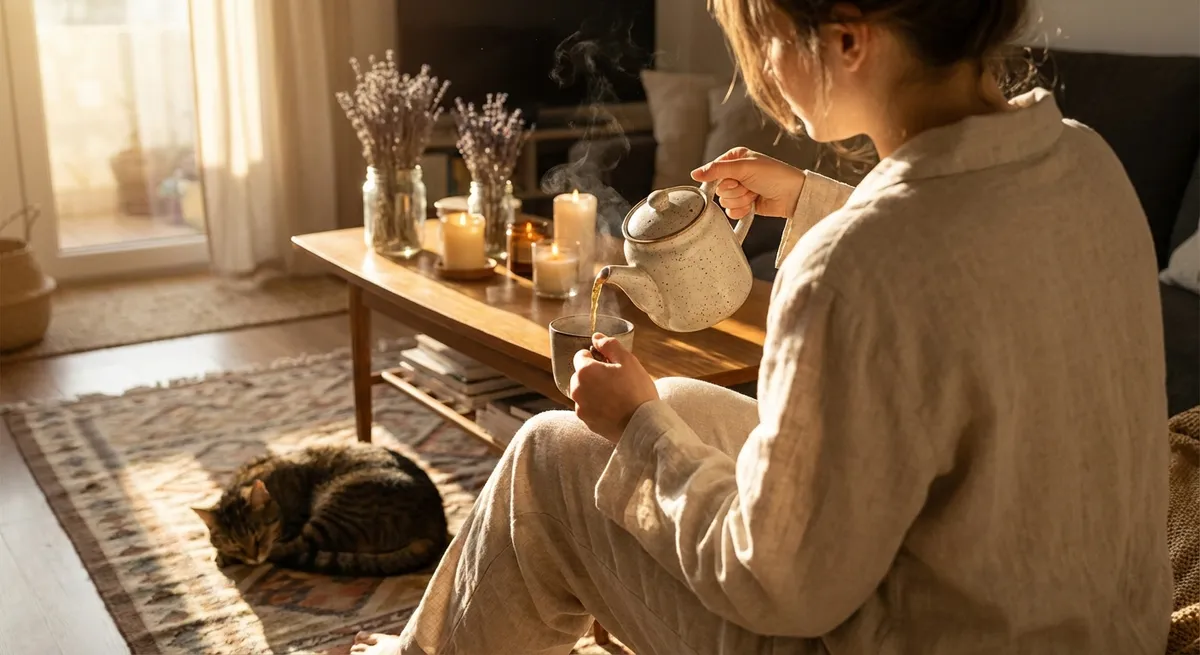
This gentle guide offers five calming tips for stress relief—simple, humane practices that help your body and mind remember what ease feels like. None of them require perfection or a special morning routine. They are meant to fit into real lives, just as they are, with all their noise, mess, and beauty.
1. The “Three-Deep-Breaths” Pause
When stress rises, the mind tends to race ahead, but the breath can quietly bring you back to steadiness. A full, slow breath tells your nervous system, “You are safe enough in this moment.” Even three intentional breaths can soften a tense day.
Try this gentle practice:
- Notice your exhale first. Breathe out slowly through your mouth, as if you are fogging up a window.
- Let the next inhale arrive through your nose, filling your lungs without forcing it. Aim for 3–4 seconds in.
- Pause briefly at the top of the breath, just for a comfortable moment.
- Exhale longer than you inhaled, maybe 4–6 seconds, letting your shoulders drop.
- Repeat this for three breaths, or stay longer if it feels good.
This tiny pause can be slipped into almost any moment: before opening an email, stepping into a meeting, responding to a text, or walking into your home at the end of the day. It is not about “fixing” your stress, but about offering your body a small island of ease.
2. Creating a Small “Safe Space” for Your Senses
Stress often feels louder because our senses are overloaded—too much light, sound, information, and urgency. Calming your senses, even for a few minutes, can send a comforting signal to your whole system.
You might create a simple sensory “safe space”:
- Sight: Dim a light, light a candle, or face a window. Let your eyes rest on something gentle—clouds, a plant, a favorite photo.
- Sound: Put on soft instrumental music, nature sounds, or simply sit in quiet if it’s available. Even two minutes with gentle sound can shift your mood.
- Touch: Wrap yourself in a blanket, hold a warm mug, or rest a hand over your heart or belly. Feel the contact and weight.
- Smell: Use a calming scent, like lavender or chamomile, if it feels soothing to you, or simply open a window for fresh air.
- Taste: Sip water slowly, herbal tea, or another warm drink—taking time to notice the sensation rather than rushing.
You do not need a separate room or special equipment. Even a corner of your couch, a parked car, or a quiet end of a hallway can become a soft refuge if you approach it with the intention to soothe your senses.
3. Letting Thoughts Pass Like Weather
When we feel stressed, thoughts can become harsh and crowded: “I should be handling this better,” “I’m so behind,” “What if I fail?” Trying to completely stop these thoughts often creates more tension. It can be gentler to simply notice them and let them move through, like changing weather.
A simple way to practice:
When you notice a stressful thought, silently say, “I’m noticing the thought that…”
- For example: “I’m noticing the thought that I’m failing,” instead of “I’m failing.” 2. Imagine the thought as a cloud passing across the sky of your mind. 3. You don’t have to fight it or believe it fully—just acknowledge and let it drift. 4. If it comes back (and it probably will), repeat the same phrase and letting-go.
This small shift creates a bit of space between you and your thoughts. You begin to see that you have thoughts, but you are not defined by them. Stress may still be present, but it doesn’t have to be the only voice you hear.
4. Gentle Movement to Release Quiet Tension
Stress often settles quietly in the body—tight jaw, hunched shoulders, clenched hands, stiff hips. Movement does not have to be intense or lengthy to be healing. A few mindful stretches can gently tell your muscles, “You can soften now.”
Try a short calming sequence:
- Shoulder Melt: Inhale and lift your shoulders toward your ears. Exhale and let them drop, imagining the weight sliding off. Repeat 3–5 times.
- Neck Softening: Slowly tilt your right ear toward your right shoulder, then your left ear toward your left shoulder. Move kindly, without forcing.
- Hand Release: Make a gentle fist, then open your fingers wide. Shake your hands out softly, letting go of tension.
- Slow Fold: While seated or standing, roll your spine forward a little, letting your head and arms hang comfortably. Take a few slow breaths, then rise back up, stacking your spine one vertebra at a time.
These movements can be done at your desk, on your bed, or in your kitchen while waiting for the kettle. The aim is not exercise or productivity, but a brief reunion with your body—a reminder that your muscles are allowed to rest.
5. A Soft Evening Ritual to Close the Day
How you end the day can gently shape how you meet the next one. An evening ritual does not need to be elaborate; it only needs to be kind and repeatable. Think of it as tucking your nervous system into bed.
You might try:
- One small “closing act”: Turn off one bright light, close your laptop, or tidy a single surface. Let this gesture signal that the working part of the day is over.
- Gratitude in simple words: Write down one moment from the day that felt even slightly okay, comforting, or kind. It may be as small as a smile, a cup of tea, or a quiet minute alone.
- Screen softening: If possible, give yourself a short, screen-free pocket of time before sleep—5 to 20 minutes to read, stretch, or simply sit quietly.
- Kind self-talk: Just before bed, gently say to yourself, “I did what I could today. It’s enough for now.” You do not have to fully believe it at first; over time, your heart may begin to soften around these words.
Even on difficult days, this small nightly ritual can be a thread of continuity—a familiar path back to calm, even when the world feels uncertain.
Conclusion
Stress is not a sign that you are failing; it is a sign that you are human, responding to a life that asks a lot of you. You do not need to transform your entire schedule or personality to feel calmer. Small, consistent gestures—a few deep breaths, a softened space for your senses, a gentler way of relating to thoughts, a bit of movement, and a simple evening ritual—can gradually reshape how stress lives in your body and mind.
You are allowed to slow down, even for a moment. You are allowed to be tender with yourself. With each small act of gentleness, you are quietly teaching your whole being that peace is not something you must earn; it is something you can return to, one soft step at a time.
Sources
- American Psychological Association – Stress Effects on the Body – Overview of how stress impacts various systems in the body and why calming practices matter
- National Institutes of Health – Relaxation Techniques – Evidence-based review of relaxation practices such as deep breathing and their benefits
- Harvard Health Publishing – Controlled Breathing for Stress Reduction – Explains how slow, controlled breathing can calm the stress response
- Mayo Clinic – Stress Management – Practical guidance on everyday strategies to ease stress
- Cleveland Clinic – Benefits of Stretching – Describes how gentle movement and stretching can relieve muscle tension and support relaxation