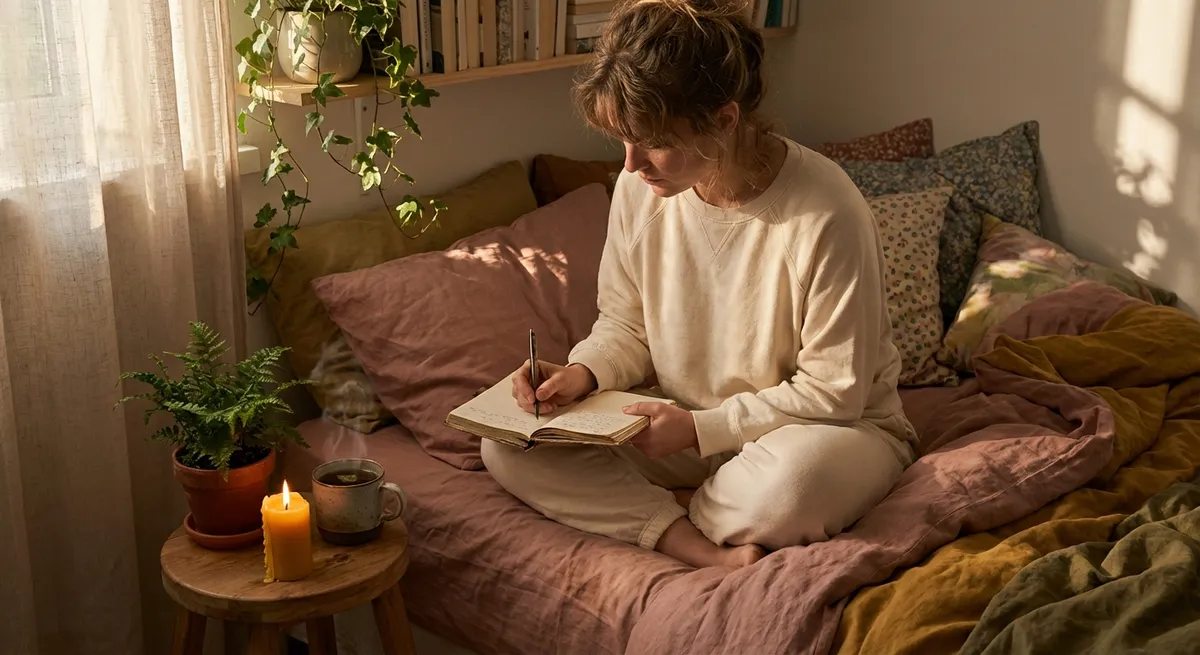
Below you’ll find five calming tips for stress-free living, offered as simple, human-sized rituals. You can try them as they are, adjust them to your needs, or simply let them inspire your own softer way of being with yourself.
Tip 1: Begin the Day With One Unhurried Moment
Before the demands of the world reach for you, give yourself one small pocket of stillness. It might be two minutes sitting on the edge of your bed, feeling your feet on the floor, or quietly sipping a warm drink without checking your phone. Let your eyes rest on one simple thing—a plant, the light on the wall, the steam rising from your cup. Notice your breath without trying to change it, like watching gentle waves arriving on a shore. This unhurried moment doesn’t need to be perfect; its power lies in its simplicity. By starting your day with softness instead of rushing, you send a quiet message to your nervous system: today, we move more gently.
This steadying pause at the beginning of the day can reduce the feeling of being “behind” before you’ve even begun. Over time, your body may start to recognize this small ritual as a signal of safety and calm. You might find your shoulders dropping a little, your jaw unclenching, your thoughts moving more slowly. Even if the rest of the day becomes busy, you’ll have offered yourself an anchor—a soft first note that lingers in the background of everything that follows.
Tip 2: Practice a Simple Breathing Pause When Stress Rises
When stress appears, it often shows up first in the body: a tight chest, a clenched stomach, shallow breaths. Instead of pushing through, you can meet this tension with a quiet breathing pause. Try this gentle pattern whenever you feel your mind racing: breathe in through your nose for a slow count of four, hold the breath for a count of four, then breathe out through your mouth for a count of six. Repeat this for three to five cycles, allowing your exhale to be just a little longer than your inhale.
This small shift in breathing can send a calming signal to your nervous system, helping to ease the fight-or-flight response and invite the body into a more restful state. You don’t need to find a special place to do it—it can be done at your desk, in a parked car, or while waiting in line. If counting feels stressful, simply imagine your breath as a soft tide: filling you up on the inhale, gently retreating on the exhale. Let each out-breath carry away a little tension, as if you are quietly setting heavy stones down, one by one.
Tip 3: Create a Gentle “Transition Ritual” Between Parts of Your Day
One tender way to care for yourself is to mark the transitions in your day with a small, calming act. Many of us move from work to home, from one role to another, without giving our minds time to shift gears. A transition ritual can be as simple as washing your hands with warm water when you arrive home and imagining the day’s stress rinsing away. You might change into softer clothing, step outside for a few breaths of fresh air, or play one peaceful song while you sit and do nothing else.
These brief rituals tell the body, “That part of the day is over; we are somewhere new now.” It helps reduce the feeling that everything is blending into one endless task. Over time, these rituals can become small islands of safety that you look forward to. Even if you are very busy, giving yourself two or three minutes to acknowledge, “I am leaving one thing and entering another,” can soften the emotional weight of constant doing. Let these moments be imperfect and real—no performance, no pressure, just a quiet turning of the page.
Tip 4: Let Your Senses Lead You Back to Calm
Your senses can gently guide you back to the present when your thoughts feel scattered. You might try a simple grounding practice: pause and silently notice five things you can see, four things you can feel, three things you can hear, two things you can smell, and one thing you can taste. There is no need to hurry—move slowly, letting your attention rest briefly on each sensation. Perhaps it’s the texture of your clothing, the sound of a distant car, the faint smell of coffee or soap.
Engaging the senses in this way helps your mind return from worries about the past or future and settle into what is here, right now. You may notice that as your attention widens to include your body and surroundings, your inner tension eases just a little. You can also create tiny sensory comforts throughout your day: a soft blanket within reach, a cup of herbal tea, a drop of calming scent on your wrist, or gentle music in the background. These are simple signals of kindness to your nervous system—a reminder that it is safe to soften.
Tip 5: End the Day by Setting One Gentle Intention
As you move toward the end of your day, try offering yourself a soft closing instead of slipping straight from wakefulness into sleep. You might turn down the brightness of your lights, set your phone aside, and take a few slow breaths. Then, quietly set one gentle intention for the next day—not a list of tasks, but a feeling or quality you’d like to invite. It could be “I will move more slowly,” “I will speak kindly to myself,” or “I will pause when I feel overwhelmed.”
Writing this intention down in a notebook or whispering it to yourself can bring a sense of clarity and comfort. You don’t need to achieve it perfectly; it’s more like a guiding star than a strict rule. This small act helps your mind feel a bit more settled, knowing that tomorrow has a soft container waiting for it. As you lie down to rest, let yourself release the day, reminding yourself that you have done enough for now. Your body is allowed to be tired. Your mind is allowed to be quiet. You are allowed to rest.
Conclusion
You don’t have to transform your life overnight to feel more at ease. Gentle change often begins with tiny shifts: one calm breath, one intentional pause, one small ritual that honors your own needs. These five calming tips are simply invitations—ways to move through your day with a little more softness and a little less pressure.
As you experiment, notice what feels natural and comforting, and let the rest fall away. Your path to a more peaceful, stress-free life doesn’t need to look like anyone else’s. It can be as unique and tender as you are, unfolding one quiet moment at a time.
Sources
- [National Institute of Mental Health – 5 Things You Should Know About Stress](https://www.nimh.nih.gov/health/publications/stress) – Overview of what stress is, how it affects the body, and basic coping strategies
- [American Psychological Association – Stress Management](https://www.apa.org/topics/stress) – Evidence-based information on stress, relaxation techniques, and building resilience
- [Harvard Health Publishing – Relaxation Techniques: Breath Control Helps Quell Errant Stress Response](https://www.health.harvard.edu/mind-and-mood/relaxation-techniques-breath-control-helps-quell-errant-stress-response) – Explains how breathing exercises can calm the nervous system
- [Mayo Clinic – Stress Management](https://www.mayoclinic.org/healthy-lifestyle/stress-management/basics/stress-basics/hlv-20049495) – Practical advice on recognizing stress and adopting healthy coping practices
- [Cleveland Clinic – Grounding Techniques for Anxiety](https://health.clevelandclinic.org/grounding-techniques-for-anxiety/) – Describes sensory-based grounding methods that help bring attention back to the present moment