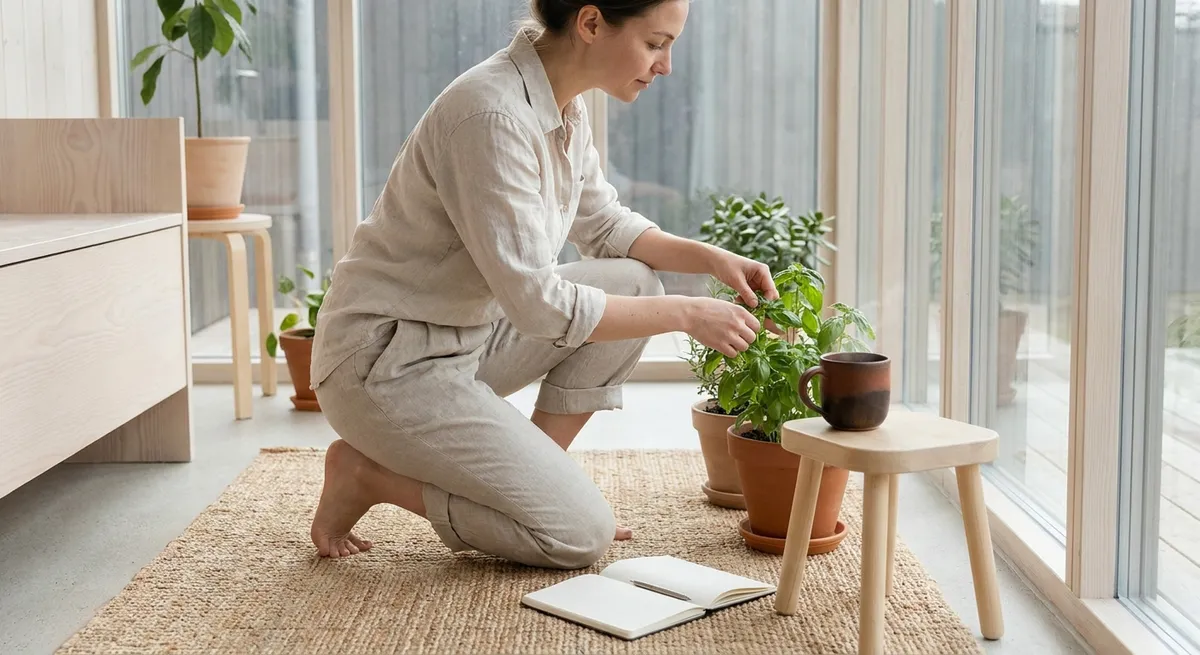
This gentle guide offers five calming practices to help you live with more ease. You don’t need special tools or long stretches of free time. You only need a willingness to slow down, even for a moment, and meet yourself with kindness.
Reclaiming a Quiet Inner Pace
Modern life often invites us to move faster than our hearts are ready to go. Our minds skip ahead to the next task, the next worry, the next notification. Over time, this constant forward-leaning pace can leave us feeling frayed and distant from ourselves.
Peaceful living begins with reclaiming a quieter inner rhythm. This doesn’t mean abandoning responsibilities; it means tending to the way you move through them. You might start by simply noticing: how does your body feel when you rush? How does your breath change when you feel pressured? Awareness gently loosens the urgency.
When you choose to slow your internal pace, even slightly, you create space for clarity. Decisions become a bit steadier. Emotions feel a little more manageable. You begin to trust that you don’t have to sprint through your days. Instead, you can walk—awake, present, and kind to yourself along the way.
Tip 1: Begin the Day with One Soft, Intentional Moment
Before the day fully begins, give yourself a small pocket of softness. It can be as simple as sitting at the edge of your bed, placing a hand on your heart, and taking three slow breaths. Let your exhales be a little longer than your inhales, signaling to your body that you are safe enough to soften.
You might quietly ask yourself, “How can I be gentle with myself today?” There is no right answer. Sometimes it may mean taking more breaks; other times, setting clearer boundaries or speaking to yourself with kinder words. This simple question helps orient your mind toward compassion rather than criticism.
If you enjoy writing, keep a small notebook nearby and jot down a calming intention, such as: “Today, I will pause before reacting,” or “Today, I will move at a pace that feels kind to my body.” These gentle promises don’t have to be kept perfectly; they are simply lanterns, guiding you back to yourself when the day grows loud.
Tip 2: Anchor Your Breath During Stressful Moments
When stress rises, your breath often becomes shallow and quick, feeding the feeling of overwhelm. One of the simplest ways to invite peace into your day is to return, again and again, to your breathing. Your breath is a quiet companion, always available, asking for nothing in return.
Try this when you feel tension building: gently inhale through your nose to a soft count of four, hold for a count of two, then exhale slowly through your mouth for a count of six. Repeat this a few times, noticing how your shoulders may lower and your jaw might unclench. You’re not forcing relaxation; you’re simply giving your body a gentle reminder that it can release some of its guarding.
This kind of breathing is not about “fixing” your emotions. It is about offering yourself a small island of steadiness when the waves rise. Even 30 seconds of mindful breathing can shift your nervous system toward calm, helping your mind feel clearer and more spacious.
Tip 3: Create Tiny Rituals of Pause in Ordinary Moments
Peaceful living is less about dramatic changes and more about small, repeatable pauses woven into ordinary life. These tiny rituals can transform familiar routines into moments of quiet care.
You might choose a few natural pauses in your day—before opening your email, while waiting for the kettle to boil, or each time you wash your hands. During these moments, gently slow down. Feel your feet on the floor. Notice the temperature of the water on your skin. Let your shoulders drop away from your ears.
These rituals don’t need to be long; even 10–20 seconds can be enough. What matters is your quality of presence. Over time, these brief pauses become little stepping-stones of calm, helping you feel less like you’re being pulled through your day and more like you are walking through it with awareness.
Tip 4: Speak to Yourself in the Tone You Reserve for Loved Ones
Many people carry a harsh inner voice, especially when they feel stressed or imperfect. This quiet stream of self-criticism can strain the heart, making peaceful living feel far away. One of the most powerful, gentle shifts you can make is in the way you speak to yourself.
Begin by listening. When you feel you’ve made a mistake, notice the first words that arise in your mind. Would you say those same words to someone you love who is having a hard day? If not, consider softening your inner tone. You might try phrases like, “This is hard, and I’m doing the best I can,” or “It makes sense that I feel this way.”
Self-kindness does not excuse responsibility; instead, it offers courage and clarity to meet life as it is. When your internal language is more loving, your body can relax a little. You are no longer fighting yourself; you are walking alongside yourself, with patient companionship.
Tip 5: Gently Protect Your Energy with Boundaries of Care
Peaceful living is not just about what you add to your life, but also what you gently limit. Constant availability—to messages, requests, and obligations—can quietly drain your sense of ease. Healthy, compassionate boundaries protect the soft spaces within you.
You might start with small steps: turning off nonessential notifications during certain hours, declining an invitation when your body feels exhausted, or taking a short walk alone to recalibrate after a busy interaction. Each boundary is a way of saying, “My well-being matters too.”
When you set limits from a place of care rather than guilt or defensiveness, peace grows more sustainable. Your “yes” becomes more genuine, your presence more wholehearted. Boundaries are not walls; they are gentle edges that help you stay connected to yourself while relating to the world.
Conclusion
Peaceful living is not a destination you arrive at once and for all. It’s a quiet practice of returning—again and again—to your breath, your body, and the soft truth that you are allowed to move more slowly than the world around you.
With a tender morning moment, a calming breath, a tiny pause, kinder self-talk, and gentle boundaries, you begin to weave ease into the fabric of your days. There will still be busy hours and difficult seasons, but you don’t have to meet them with a hardened heart.
You can choose, in small and steady ways, to live softly grounded: present, kind, and quietly at peace with yourself.
Sources
- [National Institute of Mental Health – 5 Things You Should Know About Stress](https://www.nimh.nih.gov/health/publications/stress) - Explains how stress affects the body and offers evidence-based coping strategies
- [American Psychological Association – Mindfulness Meditation: A Research-Proven Way to Reduce Stress](https://www.apa.org/topics/mindfulness/meditation) - Summarizes research on mindful breathing and its impact on stress and well-being
- [Harvard Health Publishing – Relaxation Techniques: Breath Control Helps Quell Errant Stress Response](https://www.health.harvard.edu/mind-and-mood/relaxation-techniques-breath-control-helps-quell-errant-stress-response) - Describes how controlled breathing can calm the nervous system
- [Mayo Clinic – Setting Boundaries: How to Draw the Line, Set Limits, and Prevent Burnout](https://www.mayoclinic.org/healthy-lifestyle/stress-management/in-depth/boundaries/art-20460357) - Discusses the role of boundaries in protecting mental and emotional health
- [Greater Good Science Center, UC Berkeley – How Self-Compassion Reduces Stress](https://greatergood.berkeley.edu/article/item/how_self_compassion_reduces_stress) - Reviews research on self-compassion and its effects on stress and resilience