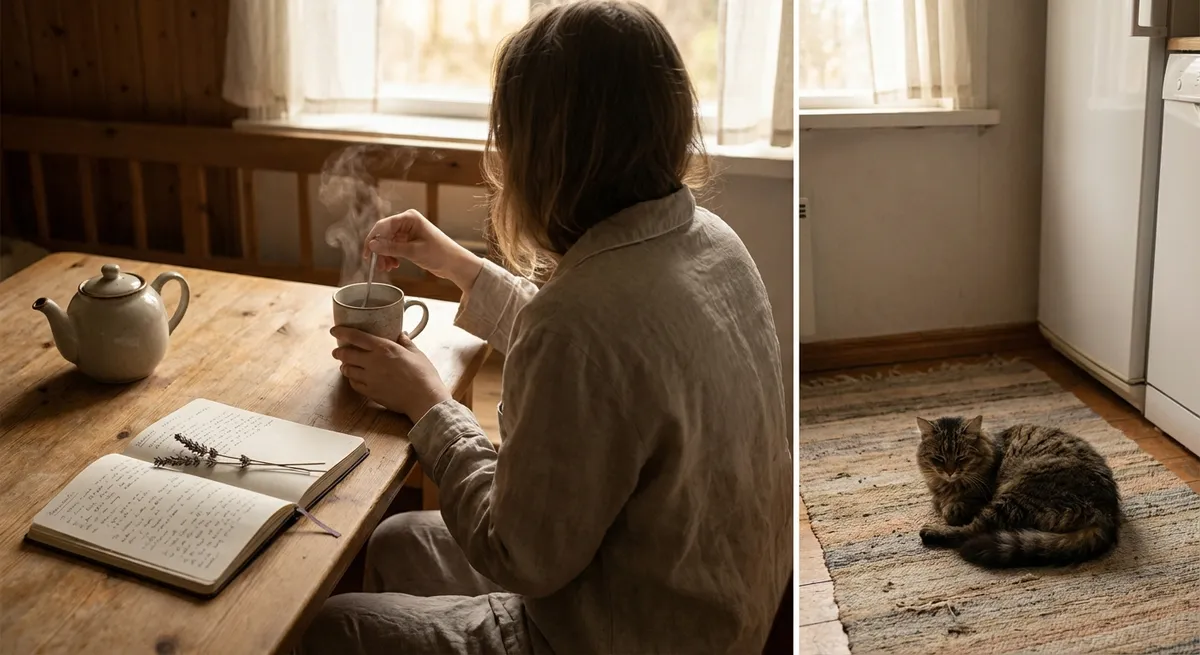
Below are five calming, tender practices to weave into your life. They are simple, gentle, and meant to be adapted to your own rhythm.
1. Begin the Day in Silence, Not in Scroll
Many of us wake up and immediately reach for our phones. Before we have even taken a full breath, our minds are flooded with messages, headlines, and to‑do lists. This sets a tone of urgency for the entire day.
Instead, try giving yourself the first five minutes in quiet. Sit on the edge of your bed or by a window. Let your eyes rest on something still—a tree, the sky, a familiar corner of your room. Notice three things: the temperature of the air, the feeling of your feet on the floor, and the soundscape around you, even if it’s just the hum of a refrigerator.
This tiny pause lowers the “emotional volume” of the morning. You are telling your body that you will ease into the day, not be pulled into it. Over time, this becomes a gentle anchor: your day begins with you, not your notifications.
2. Practice One-Task Living for a Few Precious Moments
Stress often grows not from what we do, but from how many things we try to do at once. Multi‑tasking scatters our attention and quietly exhausts us. Peaceful living invites a different rhythm: one small thing at a time.
Choose one ordinary activity each day to do with full presence. It could be washing a single cup, drinking a glass of water, brushing your hair, or folding one shirt. For that short moment, let your attention rest solely on what your hands are doing and what your senses notice—the warmth of the water, the scent of soap, the sound of fabric being folded.
Even 30–60 seconds of single‑task focus can lower stress and gently support the nervous system. You are reminding yourself that you don’t have to hold everything all at once. Some things can be done slowly, and that slowness is not a failure; it is medicine.
3. Create a Soft Landing Spot at Home
Our bodies relax more easily when they have a familiar, comforting place to return to. You do not need a whole room—just a small “soft landing spot” where your system learns, over time, to exhale.
Choose a chair, a corner of the couch, a spot on the floor with a cushion, or a place by a window. Add two or three gentle elements: a soft blanket, a favorite mug, a plant, a candle (only if safe to use), or a comforting photo. This is not about perfection or décor; it’s about creating a sensory signal of safety and rest.
When you feel tense, sit in this spot for a few minutes. Feel the support beneath you. Take three slow breaths, letting your exhale be just a little longer than your inhale. You might place a hand on your chest or abdomen to soothe your nervous system. Over time, your body will begin to recognize: “When I sit here, I can soften.” This becomes a tiny sanctuary in the middle of everyday life.
4. Use Gentle “Release Phrases” to Quiet Self‑Pressure
Often, our stress is fueled less by what is happening and more by what we say to ourselves about it: “I should be doing more,” “I’m so behind,” “I can’t handle this.” These thoughts tighten the body and speed up the heart.
You can meet this inner pressure with soft, simple release phrases—short sentences that offer kindness rather than criticism. Some examples:
- “For this moment, I can lay this down.”
- “It’s okay to move slowly right now.”
- “I’m allowed to be human, not perfect.”
- “One small step is enough for today.”
When you notice tension rising, pause and quietly repeat one phrase to yourself, like a gentle hand on your own shoulder. You are not denying the challenge; you are giving your nervous system a softer narrative to hold. Over time, this practice can shift your inner dialogue from harsh to healing, which is a core part of peaceful living.
5. Close the Day with a Gentle “Unwinding Ritual”
How we end the day matters as much as how we begin it. Many of us slide straight from bright screens and mental planning into sleep, asking our bodies to switch off instantly. A short unwinding ritual signals to the brain that it is safe to relax.
Choose a simple practice that takes 5–10 minutes and can be repeated most nights. Ideas include:
- Light stretching or slow, mindful movements to release the day from your muscles
- Writing down three small things that felt okay or comforting (not extraordinary—just okay)
- Listening to a calming song with your eyes closed
- Running warm water over your hands and imagining the day’s tension washing away
The ritual itself does not have to be elaborate—its power lies in repetition. As you continue, your body begins to understand: “When I do this, rest is coming.” Sleep often arrives more gently when we are not leaping toward it, but easing ourselves in.
Conclusion
Peaceful living is not about building a perfect, endlessly calm life. It is about learning to lace your days with softness—short pauses, kinder words, slower breaths, and tiny places of refuge. Stress will still visit, but it does not have to rule.
By beginning your day in quiet, doing one thing at a time, creating a soft landing spot, using release phrases, and closing the evening with a small ritual, you slowly teach your body and mind a new rhythm: steady, tender, and just a little more spacious.
You do not have to change everything at once. Choose one gentle practice and let it become familiar. Peace often arrives not in grand moments, but in these small, repeated acts of kindness toward yourself.
Sources
- [National Institute of Mental Health – 5 Things You Should Know About Stress](https://www.nimh.nih.gov/health/publications/stress) - Overview of how stress affects the body and evidence‑based ways to cope
- [American Psychological Association – Mindfulness Meditation: A Research‑Proven Way to Reduce Stress](https://www.apa.org/topics/mindfulness/meditation) - Explains how present‑moment awareness and single‑task focus support stress reduction
- [Harvard Health Publishing – Relaxation Techniques: Breath Control Helps Quell Errant Stress Response](https://www.health.harvard.edu/mind-and-mood/relaxation-techniques-breath-control-helps-quell-errant-stress-response) - Describes the physiological impact of slow, controlled breathing
- [Mayo Clinic – Sleep Tips: 6 Steps to Better Sleep](https://www.mayoclinic.org/healthy-lifestyle/adult-health/in-depth/sleep/art-20048379) - Highlights the importance of bedtime routines and wind‑down rituals for restful sleep
- [NIH News in Health – The Power of Social Support](https://newsinhealth.nih.gov/2017/12/power-social-support) - Discusses how emotional support and self‑kindness can ease stress and improve well‑being