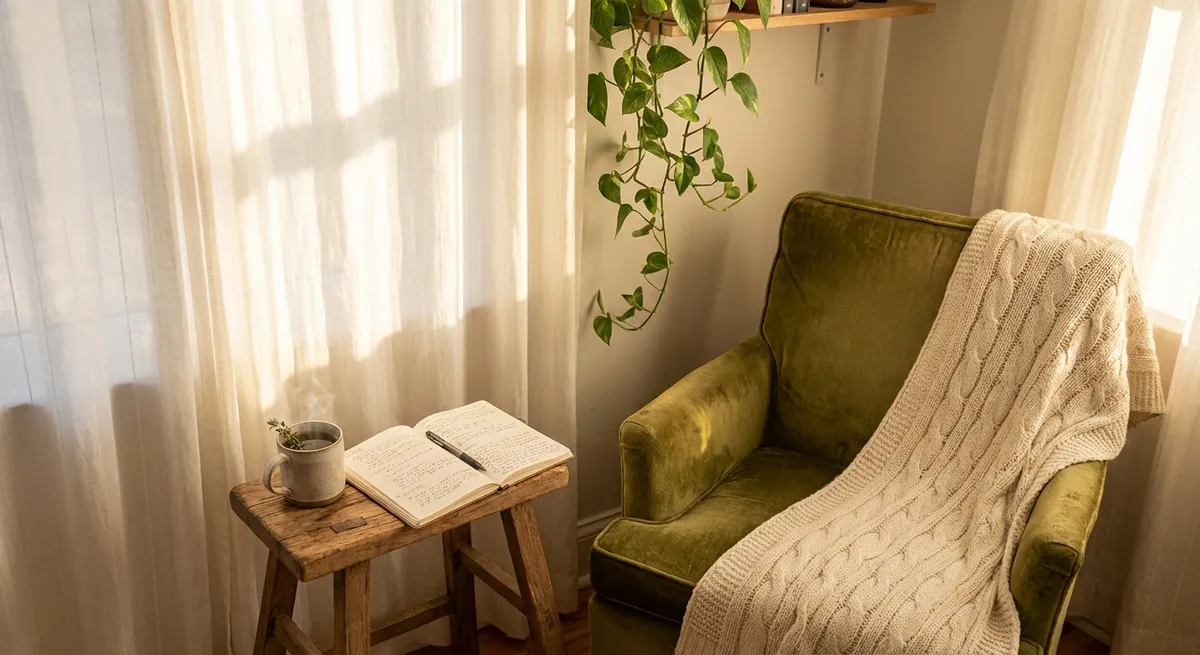
You don’t need a perfect routine or long stretches of free time. You only need a willingness to pause, notice, and care for yourself with kindness. Let these ideas meet you exactly where you are.
Settling the Breath: A Quiet Return to the Present
When stress gathers, one of the first things to change—often without you noticing—is your breathing. It may become shallow, uneven, or held. Gently tending to your breath is a simple way to signal safety to your nervous system and invite calm back in.
Find a comfortable position where your body feels supported: sitting in a chair, lying on the floor, or resting against a couch. Let your eyes soften, either gently closed or with a soft gaze. Begin by noticing your natural breath for a few moments, without trying to change it. Then, slowly inhale through your nose to a gentle count of four, feeling your lungs and belly expand. Pause softly at the top of the breath, then exhale through your nose or mouth to a count of six, allowing your shoulders to drop. Repeat this for a few minutes, letting each exhale be an opportunity to release tension.
You don’t need to force deep breaths; think of it instead as making a little more space for air, like opening a window a bit wider. Over time, this kind of calm breathing can help ease anxiety, lower your heart rate, and bring a softer awareness back into your body.
Softening the Body: A Gentle Scan From Head to Toe
Stress often hides in the body: a tight jaw, tense shoulders, a clenched stomach, or fidgeting hands. A gentle body scan invites you to listen to these quiet signals and respond with care rather than pushing them away.
Begin by sitting or lying somewhere you feel safe. Start at the top of your head and slowly move your attention down through your body, part by part. Notice your forehead, your eyes, your jaw. Are you frowning or clenching? If you are, see if you can loosen these areas just a little. Move your awareness down your neck, shoulders, arms, and hands. Imagine your breath flowing into each area, and on the exhale, allow any tightness to soften or melt downward.
Continue this slow journey through your chest, back, belly, hips, legs, and feet. There is no need to “fix” anything. Simply notice what is there—comfort, discomfort, numbness, or warmth—with gentle curiosity. The act of noticing itself can be soothing. As you practice this over time, your body learns that it is safe to let go, even if only by a small degree, and these small releases can add up to a quieter, more comfortable day.
Caring for the Senses: Creating a Small Oasis Around You
The world can be loud—visually, mentally, and emotionally. Even when you cannot control your entire environment, you can care for your senses in small, intentional ways that help the mind settle.
Choose one sense to gently nourish. For sight, you might clear a tiny space on your desk and place something that brings ease: a candle, a plant, a stone, or a simple photo that makes you feel calm. For sound, you might play soft instrumental music, nature sounds, or white noise that feels soothing, or simply close your eyes for a moment and listen for the gentlest sounds in your environment: a distant hum, the wind outside, or quiet footsteps.
For touch, you might wrap yourself in a soft blanket, hold a warm mug, or rest your hands on your heart or belly to feel the rhythm of your breath. Even scent can be a gentle ally—a favorite tea, a fresh orange peel, or a light essential oil if that feels good to you. These small sensory oases tell your nervous system, “You are safe. You are allowed to rest,” creating a calmer inner landscape even in the middle of a busy day.
Quiet Micro‑Pauses: Tiny Breaks That Soften the Edges
Many people wait for a long break, a day off, or a vacation to truly rest, but calm can also arrive in tiny pieces—moments as brief as a single slow breath. Micro‑pauses are short, intentional breaks you can take throughout the day to reset your mind and body.
You might pause before opening a new email, and take one gentle breath in and out before you read. You might set a reminder on your phone that simply says “soften” or “breathe,” and when it appears, you take 30 seconds to roll your shoulders, uncurl your hands, and relax your jaw. Standing in line, waiting for a page to load, or sitting in your car before driving home can all become quiet invitations to step out of urgency.
These pauses do not need to be elaborate. Even a few seconds of conscious stillness can interrupt a spiral of stressful thoughts. Over time, these small practices can gradually shift your day from feeling like one long rush to a series of gentle, manageable moments.
A Kind Inner Voice: Speaking to Yourself With Softness
Stress is not only created by what happens around you, but also by the way you speak to yourself inside your own mind. Harsh inner commentary—“I’m failing,” “I should be doing more,” “I can’t handle this”—can make an already heavy day feel overwhelming. Practicing a kinder inner voice is a powerful, quiet way to invite more peace into your life.
Begin by noticing your self‑talk, especially when you make a mistake, feel behind, or feel tired. Instead of trying to silence your thoughts completely, see if you can gently soften them. Ask yourself, “How would I speak to a friend in this exact situation?” Then offer those same words to yourself: “You’re doing your best,” “It makes sense that you’re tired,” “It’s okay to rest,” or “This is hard, and you’re not alone in feeling this way.”
You can also place a hand on your heart or over your chest as you say these words, either aloud or in your mind. This simple gesture can be deeply soothing, reminding you that you deserve the same patience and tenderness you so easily extend to others. Over time, a kinder inner voice becomes a calm place to rest, even when life feels uncertain.
Conclusion
Calm does not always arrive as a grand, life‑changing moment. More often, it emerges in small choices—the way you breathe when you feel rushed, the way you soften your shoulders when they tighten, the way you speak to yourself when things are hard. These five gentle practices are not rules but invitations: to come back to your body, to care for your senses, to pause for a breath, and to treat yourself with tenderness.
You are allowed to move slowly. You are allowed to rest, even for a few quiet seconds at a time. As you weave these simple techniques into your day, notice how your inner landscape responds—perhaps not all at once, but gradually, like light softly entering a room.
Sources
- National Institutes of Health – Relaxation techniques: Breath focus – Overview of evidence‑based relaxation methods, including breathing practices
- Harvard Medical School – Relaxation techniques: Breath control helps quell errant stress response – Explains how conscious breathing can calm the nervous system
- American Psychological Association – Mindfulness meditation: A research‑proven way to reduce stress – Discusses mindfulness, body awareness, and their effects on stress
- Mayo Clinic – Stress management: Know your triggers – Provides guidance on recognizing and managing sources of stress
- Cleveland Clinic – Self-Compassion: Be Kinder to Yourself – Explores the benefits of a kinder inner voice for emotional well‑being