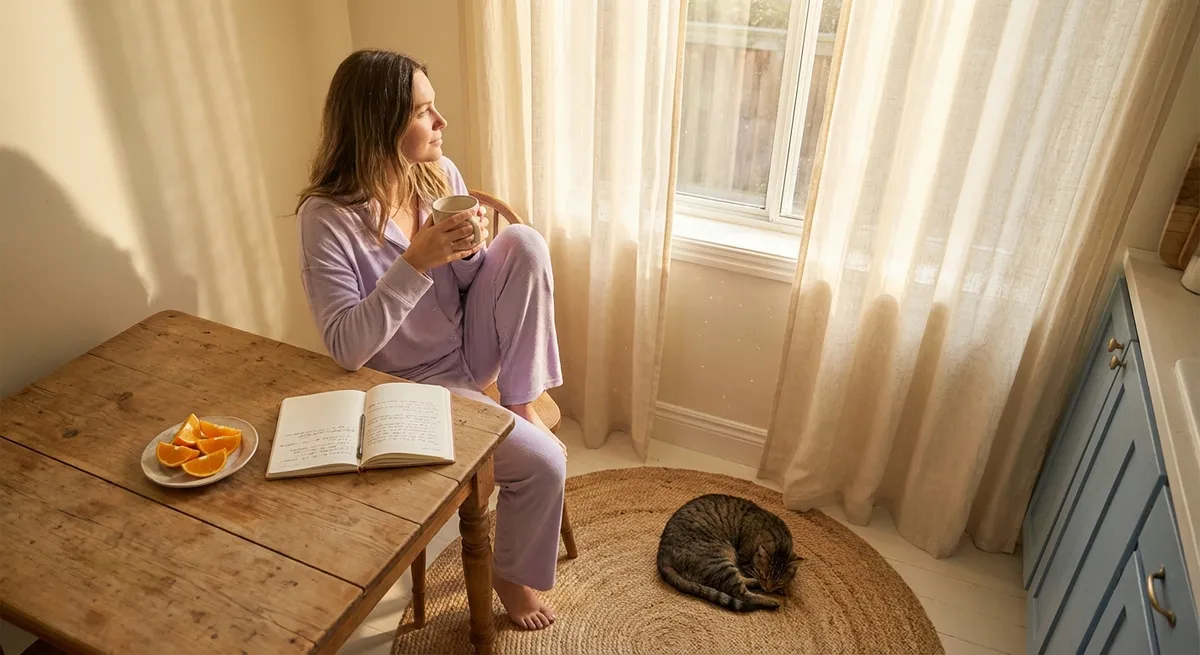
This article is a soft reminder that you are allowed to create small pockets of peace right where you are. You don’t need an empty schedule or perfect conditions. With a few simple, gentle practices, you can give your nervous system a chance to exhale and your mind a moment to soften.
Below are five calming tips for stress-free living—not as rules to follow, but as invitations to try, notice, and return to yourself.
Tip 1: Notice Your Tension, Then Soften One Place
Stress often shows up in the body before we notice it in the mind. Our jaws clench, shoulders rise, and breath becomes shallow, sometimes without us realizing. Instead of trying to force yourself to “relax,” you can begin by simply noticing where your body is quietly working too hard.
Pause for a moment and gently scan from your forehead down to your toes. Where is there tightness? Your brow, your neck, your hands? Pick just one place to soften. You might let your shoulders drop a little, unclench your jaw, or let your tongue rest gently away from the roof of your mouth.
You don’t have to fix your whole body at once. Each time you notice tension and soften one place, you send a small signal of safety to your nervous system. Over time, this becomes a friendly habit: catching yourself in moments of strain and offering a tiny release.
Try setting a soft reminder—each time you check your phone or sit down at your desk, pause for a few seconds to find one spot to relax. Let it be quiet and unhurried. Even a 10-second pause is a way of telling yourself, “I’m allowed to feel a little more at ease.”
Tip 2: Create One Simple, Soothing Ritual Each Day
In a busy life, rituals can act like gentle anchors—small, predictable moments that remind your body and mind that it is safe to slow down. They don’t need to be elaborate. What matters is repetition and kindness.
You might choose:
- A morning cup of tea sipped slowly, without multitasking
- A short stretch before bed with the lights dimmed
- Sitting by a window and watching the sky for a few minutes each afternoon
- Listening to a calming song while you breathe softly
Let your ritual be something you genuinely enjoy, not something that feels like another task. Give it a beginning and an end: maybe lighting a candle, taking three slow breaths, or simply saying silently, “This is my small moment.”
Over time, your body will begin to recognize this ritual as a cue to unwind. Even on difficult days, returning to this familiar practice can offer a sense of steadiness. Your ritual doesn’t have to fix everything; it only needs to give you one gentle place to land.
Tip 3: Breathe in a Way That Feels Kind, Not Forced
Breathing exercises are often suggested for stress, but sometimes they can feel like another thing you’re “supposed” to do correctly. Instead of aiming for perfect technique, you might focus on a breath that feels kind and doable.
A gentle approach is to simply make your exhale a little longer than your inhale. For example:
- Inhale softly through your nose for a count of 3 or 4
- Exhale through your nose or mouth for a count of 5 or 6
You don’t need to count out loud or be exact. The idea is to lengthen the exhale just enough that it feels like a slow sigh. This kind of breathing can help activate the body’s calming response, lowering stress levels over time.
If counting feels stressful, you can instead imagine your breath moving like a tide: softly coming in, gently rolling out. You might place a hand on your chest or belly to feel the rise and fall. Two or three of these softer breaths scattered throughout the day can gently interrupt spirals of worry.
Let your breath be an ally, not a performance. There is no right or wrong—only small adjustments that help you feel a little more settled inside your own body.
Tip 4: Give Your Mind a Quiet Place to Rest for a Moment
When stress builds, the mind often jumps between worries, planning, and replaying conversations. Instead of forcing your thoughts to stop, you can offer your mind a quieter place to rest—just for a short while.
You might try:
- Listening to a single soothing sound, like a fan, rain, or soft music
- Watching one thing in your environment: the way light moves on the wall, leaves outside, or steam rising from a mug
- Gently repeating a calming phrase to yourself, such as “Right now, I am here,” or “One moment at a time”
Think of this as giving your mind a small, simple task instead of letting it run in circles. Even 30 seconds of focused, gentle attention can create a little mental space, like opening a window in a stuffy room.
If your thoughts wander (and they will), you’re not doing anything wrong. When you notice, simply guide your attention back to your chosen sound, sight, or phrase—like kindly taking a child’s hand and leading them back to the path. Each return is a quiet act of self-care.
Tip 5: Make Room for Softness in Your Expectations
One of the heavier sources of stress is often the weight of our own expectations—how much we think we “should” be doing, how fast we “should” be moving, or how perfectly we “should” be coping. Sometimes the kindest stress relief is to loosen those expectations, even just a little.
You might gently ask yourself:
- “Is there one thing I can do more simply today?”
- “Does this truly need to happen now, or could it wait?”
- “If a friend felt this overwhelmed, what would I tell them?”
Perhaps you allow yourself to order a simpler meal, say no to one nonessential commitment, or accept that something can be done “good enough” instead of perfectly. These small acts of softening can lighten the invisible load you carry.
Giving yourself permission to be human—to be tired, to need rest, to move more slowly—doesn’t mean you’re giving up. It means you’re honoring your limits with kindness. When your expectations soften, your nervous system often follows, finding more space to breathe and settle.
Conclusion
Calm is not a destination you have to reach; it’s a series of gentle choices you can make throughout your day. Softening one tense muscle, keeping one simple ritual, taking one kinder breath, resting your mind on one quiet point, easing one expectation—each is a small step toward a more peaceful inner world.
You don’t have to practice all of these tips at once. You might choose just one that feels approachable and let it become a quiet companion for a while. Over time, these small, tender practices can weave together into a life that feels less hurried on the inside, even when the outside world is busy.
You are allowed to slow down. You are allowed to be gentle with yourself. And you are allowed to find soft corners in your day, exactly as you are, right now.
Sources
- [American Psychological Association – Stress Effects on the Body](https://www.apa.org/topics/stress/body) – Overview of how stress affects different systems of the body and why physical relaxation matters
- [National Institutes of Health – Relaxation Techniques: What You Need To Know](https://www.nccih.nih.gov/health/relaxation-techniques-what-you-need-to-know) – Evidence-based summary of relaxation methods such as breathing and their impact on stress
- [Cleveland Clinic – Diaphragmatic Breathing](https://my.clevelandclinic.org/health/articles/9445-diaphragmatic-breathing) – Practical guidance on gentle breathing techniques to activate the body’s calming response
- [Harvard Health Publishing – Mindfulness for Your Health](https://www.health.harvard.edu/mind-and-mood/mindfulness-practices-for-your-health-and-well-being) – Explains how simple mindfulness and focused attention can reduce stress and improve well-being
- [Mayo Clinic – Stress Management](https://www.mayoclinic.org/healthy-lifestyle/stress-management/in-depth/stress-management/art-20044151) – General strategies and lifestyle approaches for managing everyday stress levels