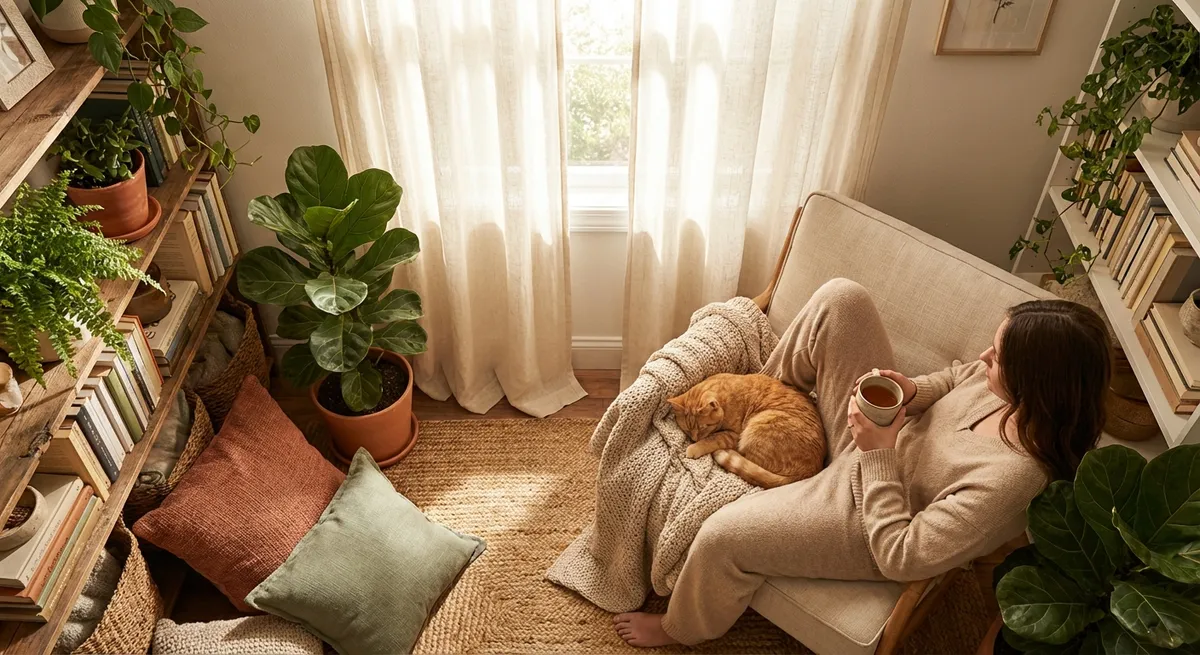
In this gentle guide, you’ll find soft, practical ways to loosen your grip on stress and create pockets of rest in the middle of real life. Let these ideas meet you where you are and move at a pace that feels kind to your nervous system.
Let Your Breath Be a Soft Place to Land
Your breath is always with you, quietly available, asking for nothing. When stress feels loud, returning to your breathing can give your body a simple, clear signal: “You are safe enough in this moment.”
Find a comfortable position—sitting or lying down. Let your shoulders drop slightly, as if they are exhaling too. Close your eyes if that feels comfortable, or soften your gaze on a gentle point in the room.
Slowly inhale through your nose to a count that feels easy—maybe four. Pause softly at the top of the breath, without strain. Then exhale through your mouth a little longer than you inhaled—perhaps to a count of six. The longer exhale invites your nervous system to shift toward rest.
Repeat this for a few minutes. There is nothing to fix and nowhere else to be. If your mind wanders, simply notice that it has wandered and guide it back to the feeling of air moving in and out of your body. Even a few slow breaths can soften the edges of a stressful moment.
Calming tip 1: Practice a few cycles of slower exhale breathing whenever you notice tension—while waiting in line, before a meeting, or as you settle into bed.
Create a Gentle Transition Between “Doing” and “Resting”
Stress often clings to the edges of our day—especially when we move straight from busy tasks to bed, or from work to home demands without a pause. A small transition ritual can act like a gentle doorway, helping your mind and body understand that it’s time to shift gears.
Choose a simple, repeatable action to mark the end of “doing” and the beginning of “resting.” It might be washing your hands slowly, as if you’re rinsing off the day. You might dim the lights, light a candle, or play a short piece of calming music. You could stretch your arms overhead, then fold into a soft forward bend, letting tension drop from your shoulders.
The ritual doesn’t have to be long; what matters is consistency and intention. Over time, your body begins to associate this small act with permission to release, let go, and soften. This can make it easier to relax without feeling like you’ve slammed on the brakes.
Calming tip 2: Choose one tiny ritual—like slowly making a cup of herbal tea—to signal to your body, “We’re shifting from effort to ease now.” Practice it at the same time each day if possible.
Soften Your Inner Voice When Life Feels Tight
Stress doesn’t only arrive from outside pressures; it often grows louder through the way we speak to ourselves. When your inner voice is hard, critical, or demanding, your body tends to stay on alert, as if it’s under constant evaluation. Softening this voice can quietly reduce your stress load.
When you notice tension, gently listen to the thoughts running through your mind. Are you telling yourself you “should” be doing more, faster, or better? Are you replaying conversations or worrying about what others think? Without judging these thoughts, imagine turning down their volume just a little.
Then, experiment with speaking to yourself the way you would to a dear friend who is tired. You might say, “This is a lot; it makes sense that I feel overwhelmed,” or “I’m doing the best I can with what I have today.” This isn’t about pretending everything is perfect—it’s about offering yourself understanding rather than pressure.
Even a few kind sentences can help your body loosen its guard. A softer inner voice becomes a gentle companion, rather than another source of stress.
Calming tip 3: When you feel stressed, quietly place a hand on your chest and say one kind sentence to yourself—something simple, honest, and supportive.
Invite Calm Into Your Senses, One Detail at a Time
Your senses can be a doorway out of racing thoughts and into the present moment, where relaxation has more room to appear. Instead of trying to stop your thoughts, you can gently redirect your attention to what you can see, hear, feel, smell, or taste right now.
Choose one sense to focus on. If you’re indoors, you might notice the soft sound of a fan, the faint hum of a refrigerator, or the rustle of leaves outside your window. If you’re outside, feel the temperature of the air on your skin—the warmth or coolness against your face and hands.
You might rest your hand on a textured object—a mug, a blanket, a smooth stone—and really feel its weight, temperature, and surface. Let your eyes rest on something calming: the sky, a plant, the gentle flicker of candlelight, or a pattern in the fabric nearby.
By spending a few moments with one sensory detail, you offer your mind a quiet anchor. It doesn’t erase your worries, but it can give them a little more distance, making it easier for your body to settle.
Calming tip 4: When your thoughts feel crowded, pause and gently name five things you can see, four you can feel, three you can hear, two you can smell, and one you can taste. Let this be slow and unhurried.
Make Space for Small Pleasures Without Earning Them
In a world that often measures worth by productivity, it can feel like you have to earn your rest or small joys. This belief quietly tightens stress in the body. Allowing yourself small, nourishing pleasures—without needing to “deserve” them—can be a powerful act of relaxation.
Consider what feels gently enjoyable to you, not what you think should be relaxing. It might be reading a few pages of a book, listening to a calming song on repeat, sitting by a window and watching the sky change, or taking a slow walk without tracking your steps.
Give yourself permission to do one small pleasurable thing each day, simply because being human is a tender task and you are allowed to be cared for. You don’t have to finish your to‑do list first. You don’t have to explain it to anyone.
When you regularly include these tiny moments of ease, your body learns that life is not only pressure and performance. This gentle rebalancing can reduce your overall stress, making relaxation a natural part of your day rather than a rare event.
Calming tip 5: Choose one small, quiet pleasure you can enjoy daily for five minutes—no conditions, no earning, just a simple gift to your nervous system.
Conclusion
Relaxation is less about escaping your life and more about weaving softness into it. You don’t need perfect conditions, long stretches of time, or elaborate plans. With a few slow breaths, a gentle transition ritual, kinder inner words, sensory anchors, and small daily pleasures, you can create tiny islands of calm—even in the middle of a busy day.
Let these practices be imperfect and flexible. Some days you may only have time for one slow breath; other days, you might linger in a whole ritual. Every small act of care is meaningful. Over time, these quiet choices teach your body a new story: that rest is allowed, that ease is possible, and that you are worthy of a softer way of being.
Sources
- National Institute of Mental Health – 5 Things You Should Know About Stress – Overview of what stress is, how it affects the body, and coping strategies
- American Psychological Association – Stress Management – Evidence‑based information on stress, relaxation techniques, and self‑care practices
- Harvard Health Publishing – Relaxation Techniques: Breath Control Helps Quell Errant Stress Response – Explains how controlled breathing can influence the nervous system and promote calm
- Mayo Clinic – Meditation: A Simple, Fast Way to Reduce Stress – Describes how mindful attention and simple practices can reduce stress and improve well‑being
- Cleveland Clinic – The Power of Positive Self-Talk – Discusses how a kinder inner voice can support mental health and lower stress levels