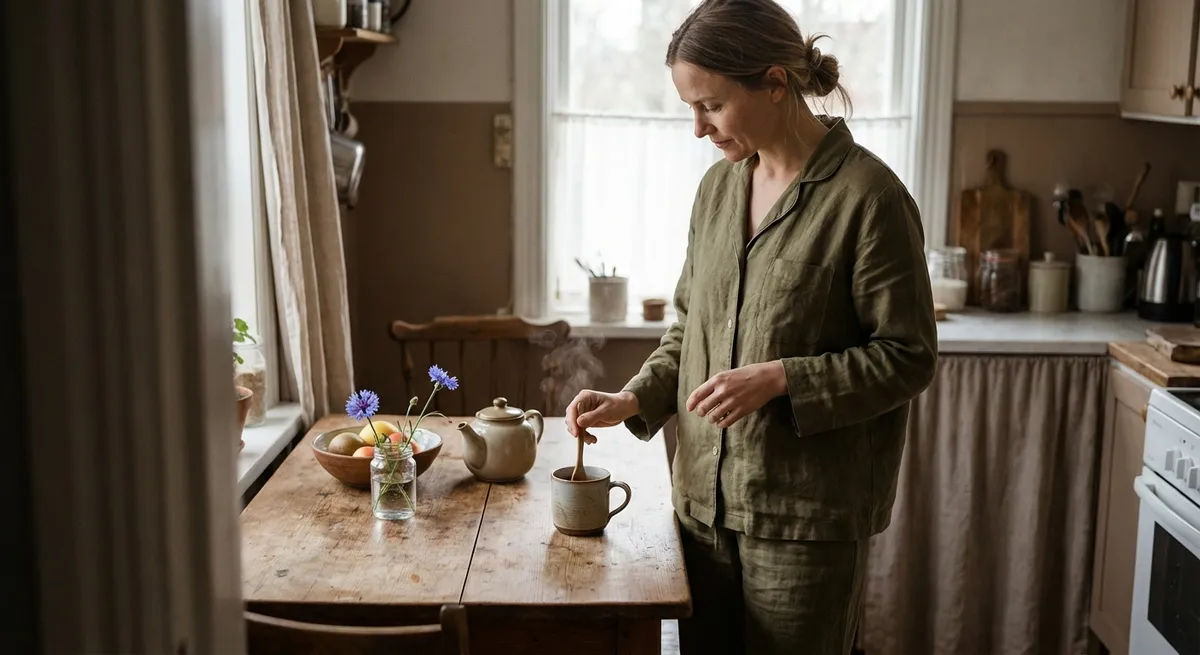
This article offers simple, calming practices you can weave into your day. They are not rules or rigid routines, but invitations—gentle doorways back to yourself when the world feels heavy or hurried.
Meeting Yourself Where You Are
Before adding anything new to your life, it helps to soften around where you are right now. Peace begins with honesty: noticing your energy, your emotions, and your limits without judgment.
You might begin by pausing for a moment and quietly asking, “How am I, really?” Let the answer arrive in its own time. Perhaps there is tension in your chest, a heaviness behind your eyes, or a quiet sense of okay-ness. Whatever you find is welcome.
Meeting yourself where you are doesn’t mean you must fix anything. Instead, it’s an act of gentle witnessing—allowing your inner world to be seen. This simple noticing can be deeply regulating for the nervous system, reminding your body that it is safe enough to rest, breathe, and soften.
The rest of this article offers five calming tips you can visit whenever you need a softer space within your day. Take what feels supportive, leave what doesn’t, and feel free to adapt each suggestion to suit your own life.
Tip 1: Create a One-Minute Breathing Oasis
You don’t need a long meditation session to feel a shift. A single quiet minute can soften the edges of a tense day.
When you notice stress building, gently pause—perhaps while waiting for the kettle to boil, before opening an email, or sitting in your parked car. Let your shoulders drop a little. If it feels comfortable, close your eyes or lower your gaze.
Try a simple rhythm: inhale slowly through your nose to a count of four, let your belly soften and expand, then exhale through your mouth or nose to a count of six. Longer exhales help signal to your body that it is safe to relax. You can repeat this for five to ten breaths.
You might silently say to yourself on the in-breath, “I am breathing in,” and on the out-breath, “I am breathing out.” Nothing to change, nothing to achieve—just this breath, and then the next. Over time, these small breathing oases can gently retrain your body to return to calm more easily.
Tip 2: Make a Gentle Transition Ritual Between Tasks
Much of our stress comes from leaping straight from one demand to another without any pause in between. Creating tiny transition rituals can give your nervous system a moment to reset.
Before shifting from one activity to the next—work to home, screen time to rest, chores to sleep—take a short, intentional pause. This could be as simple as stepping away from your desk to look out a window, feeling your feet on the floor, or taking three slow breaths while placing a hand over your heart.
You might also choose a phrase to quietly mark these transitions, such as, “That is complete for now,” or, “I am gently arriving in this next moment.” This kind inner commentary helps your mind release what came before and soften into what is next.
These rituals don’t have to be elaborate or time-consuming. A few seconds of mindful transition can reduce the sense of constant pressure and help your day feel like a series of gentle waves rather than one long, relentless current.
Tip 3: Tidy One Small Corner as an Act of Care
When life feels chaotic, it’s easy for our surroundings to mirror that inner clutter. Instead of tackling everything at once, you can bring a sense of peace by caring for just one small corner at a time.
Choose a space that feels manageable—a bedside table, a single shelf, the chair where clothes tend to pile up. Move slowly and kindly, noticing textures, colors, and how it feels to bring a little order to this one place. This is not about harsh decluttering or perfection, but about creating a tiny refuge of calm.
You might place one comforting item there—a candle, a plant, a favorite book, a soft scarf. Let this spot become a visual reminder that you are capable of bringing gentleness into your physical world, even when everything else feels busy.
Returning your attention to this cared-for corner during the day can offer a quiet, grounding signal: there is still space for softness, even in the midst of stress.
Tip 4: Practice a Soft “No” to Protect Your Energy
Peaceful living often means honoring your limits, even when it feels uncomfortable. Each gentle “no” you practice is also a deeper “yes” to your own well-being.
When a request arises that feels heavy or draining, pause before answering. Notice what your body says—tightening in the stomach, a sense of dread, or maybe a clear feeling of “this is too much right now.” Instead of overriding this inner signal, see if you can respect it.
A soft “no” can be kind and clear:
“I’d love to help, but I don’t have the space to do this well right now.”
“I need to rest this evening, so I won’t be able to join, but thank you for thinking of me.”
“This isn’t something I can take on, but I hope you find the support you need.”
You do not need to justify your boundaries with long explanations. Protecting your energy is an act of quiet courage and self-respect. Over time, saying gentle nos where needed creates room for more genuine, wholehearted yeses in your life.
Tip 5: End Your Day with a Soft Reflection
The way you close your day can gently shape how you meet the next one. Instead of falling straight into bed surrounded by unfinished thoughts, you might create a brief, soothing night ritual.
Find a few quiet minutes—perhaps already in bed or in a softly lit corner. Take a slow breath and reflect on your day with kindness, not criticism. You can ask yourself three gentle questions:
- What felt nourishing today, even in a small way?
- What felt heavy or draining?
- How can I be a little kinder to myself tomorrow?
You might jot down a few words in a notebook or simply hold the answers in your heart. Allow yourself to acknowledge any difficulties without needing to solve them right now. Let your last thoughts be ones of tenderness: “I did what I could with what I had today. That is enough.”
This practice can help your mind slowly unclench from the day’s demands, inviting a softer sleep and a more compassionate relationship with yourself over time.
Conclusion
Peaceful living does not require a perfect schedule, a quiet home, or a life free of worries. It is something gentler and more intimate—a way of moving through each day with a little more softness, a little more space to breathe.
By returning to simple practices—a one-minute breath, a quiet transition, a lovingly tended corner, a soft boundary, a reflective close to your day—you create pockets of calm that can hold you when life feels loud.
You are allowed to move more slowly. You are allowed to rest. You are allowed to treat your own heart with the same tenderness you would offer someone you love. One gentle moment at a time, a softer life becomes possible.
Sources
- [National Institute of Mental Health – Stress: Coping With Everyday Problems](https://www.nimh.nih.gov/health/publications/stress) - Explores how stress affects the body and offers evidence-based coping strategies
- [American Psychological Association – Stress Management](https://www.apa.org/topics/stress) - Provides research-backed guidance on managing stress and building resilience
- [Mayo Clinic – Meditation: A Simple, Fast Way to Reduce Stress](https://www.mayoclinic.org/tests-procedures/meditation/in-depth/meditation/art-20045858) - Explains how brief mindfulness and breathing practices can support calm
- [Harvard Health Publishing – Relaxation Techniques: Breath Control Helps Quell Errant Stress Response](https://www.health.harvard.edu/mind-and-mood/relaxation-techniques-breath-control-helps-quell-errant-stress-response) - Describes the physiological benefits of slow, controlled breathing
- [NHS – How to Sleep Better](https://www.nhs.uk/every-mind-matters/mental-wellbeing-tips/how-to-fall-asleep-faster-and-sleep-better/) - Offers practical tips for calming evening routines and more restful sleep