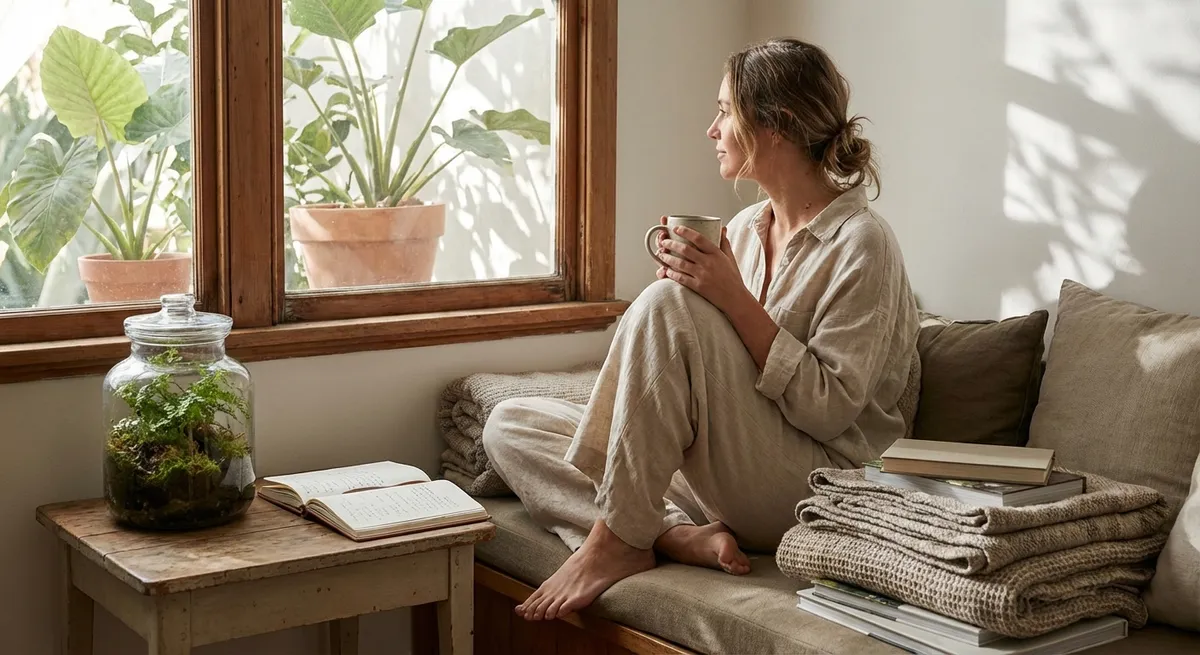
This gentle guide offers five calming techniques to help you meet your days with more softness and less strain. Each is simple, kind to your nervous system, and easy to fold into an ordinary day, even when you feel you have no extra time. Think of them as small lanterns you can light, one by one, whenever you need to find your way back to calm.
1. The Soft Pause: A Gentle Break for Your Nervous System
The soft pause is a simple, intentional moment of stopping—just for a breath or two—before you rush into the next thing. It’s not a big break or a long meditation; it’s a tiny act of kindness toward your nervous system.
You can try it when you close a work email, finish washing a dish, lock your front door, or sit down in your car. Instead of immediately reaching for your phone or jumping to the next task, silently say to yourself, “Pause,” and allow everything in you to settle for a moment. Feel your feet on the floor, your body supported by the chair, and let your shoulders drop even a little.
These brief pauses slowly teach your body that it does not have to live in constant urgency. Over time, the soft pause can shift your inner pace, so you don’t move through the day as if you’re always slightly late to your own life. You are gently telling your system, “It’s safe to slow down—even for a breath.”
2. Grounding Through the Senses: Returning to This Exact Moment
When stress pulls you into worries about the past or future, your senses can guide you back to right now. Grounding through the senses is a calm technique that uses what you can see, hear, feel, smell, and taste to anchor you in the present.
You might begin by quietly noticing five things you can see, without judging or evaluating them: the curve of a mug, sunlight on the wall, a small wrinkle in the curtain. Then, tune into four things you can feel: the fabric of your clothing, the temperature of the air, the weight of your body resting on a chair. Listen for three sounds, near or far. Gently notice two scents (or even the absence of scent). If you wish, acknowledge one taste in your mouth, perhaps after a sip of water or tea.
This simple practice steadies the mind and gives stress less space to spiral. Your senses offer proof that, in this very second, you are here, breathing, safe enough to notice ordinary details. The moment becomes a little wider, and your worries lose some of their grip.
3. Kind Self-Talk: Speaking to Yourself Like a Gentle Friend
The way you speak to yourself can either swirl stress into a storm or settle it into a soft drizzle. Many of us talk to ourselves in ways we would never speak to someone we love—with harsh judgments, impatient criticism, or constant pressure to do more and be more.
Calm begins to grow when you gently shift this inner tone. When you notice self-criticism—“I should be doing better,” “Everyone else is handling this fine”—try pausing and asking, “What would I say to a dear friend who felt this way?” Then quietly offer those same words to yourself, even if they feel unfamiliar. You might say, “You’re doing the best you can,” “This is hard, and it’s okay to feel overwhelmed,” or “You are allowed to rest.”
This kind self-talk does not ignore what’s difficult or pretend everything is perfect. It simply chooses a softer way to be with your own experience. As you practice, your inner voice can become a source of comfort instead of another source of pressure, easing the emotional weight you carry through the day.
4. Mini Rituals of Care: Small Acts That Signal Safety
Rituals are repeated actions that hold meaning, and they can be powerful calm techniques when life feels scattered. Mini rituals are small, simple gestures you return to often—not because you “must,” but because they gently remind your body and mind that you are cared for.
This might look like lighting a candle before starting focused work, and blowing it out when you’re done, marking a soft beginning and end. It could be placing a hand over your heart and taking three slow breaths each time you sit down to eat, inviting your body to shift out of “go mode” into “receive mode.” You might keep a comforting object on your desk—a smooth stone, a plant, a handwritten note—and touch it when your thoughts start racing.
These small rituals don’t fix every stressor in your life, but they create tiny pockets of predictability and comfort. Over time, your body starts to recognize these acts as signals of safety: “Here, for a moment, I can let my guard down.” Even in a busy day, these quiet anchors can help you feel less tossed around by everything you have to do.
5. Gentle Movement Moments: Letting Tension Flow Out
Stress often settles into the body as tight shoulders, clenched jaws, shallow breathing, and a feeling of being “braced” for something. Gentle movement moments are brief, mindful movements that help release this tension without demanding intense exercise or a large block of time.
You might slowly roll your shoulders in small circles, synchronize the motion with your breath, and imagine exhaling tension with each roll. You can stretch your arms overhead and lengthen your spine, then let your arms float down, noticing how the body softens as it returns. Even standing up for a minute, shaking out your hands, and softly rotating your neck (staying within your comfortable range of motion) can invite a sense of lightness.
If you prefer, you can pair movement with something you already do every day—like stretching gently while your tea steeps, moving your ankles and calves while waiting for a page to load, or taking a slow, unhurried walk down the hallway before a meeting. These small movements gently remind your body that it does not need to stay frozen in stress. Motion gives tension a pathway out.
Conclusion
Calm does not always arrive as a dramatic transformation. Often, it comes as a series of small, quiet choices: a soft pause instead of rushing, a kind word inward instead of criticism, a simple ritual instead of chaos, a moment of grounding instead of spiraling, a gentle stretch instead of staying tightly braced.
You do not need to practice all five techniques at once. You might simply choose one that feels kind and realistic today, and let it weave slowly into your routine. Over time, these quiet practices can gather together, forming a softer way of moving through the world—one where stress does not disappear, but it no longer has to define your entire day.
You are allowed to live at a gentler pace inside yourself, even when life around you is busy. Calm is not a prize you earn by doing everything right; it is a relationship you build with your own heart, one soft moment at a time.
Sources
- American Psychological Association – Stress Effects on the Body - Explains how stress impacts physical and mental health, supporting the importance of calm techniques.
- National Institute of Mental Health – 5 Things You Should Know About Stress - Offers foundational information on stress and practical ways to cope.
- Harvard Health Publishing – Relaxation Techniques: Breath Control Helps Quell Errant Stress Response - Describes how simple breathing and relaxation practices can calm the nervous system.
- Mayo Clinic – Stress Management - Provides an overview of stress management strategies and why they support well-being.
- Greater Good Science Center, UC Berkeley – The Science of Mindfulness - Explores how mindful awareness of the present moment can reduce stress and increase calm.