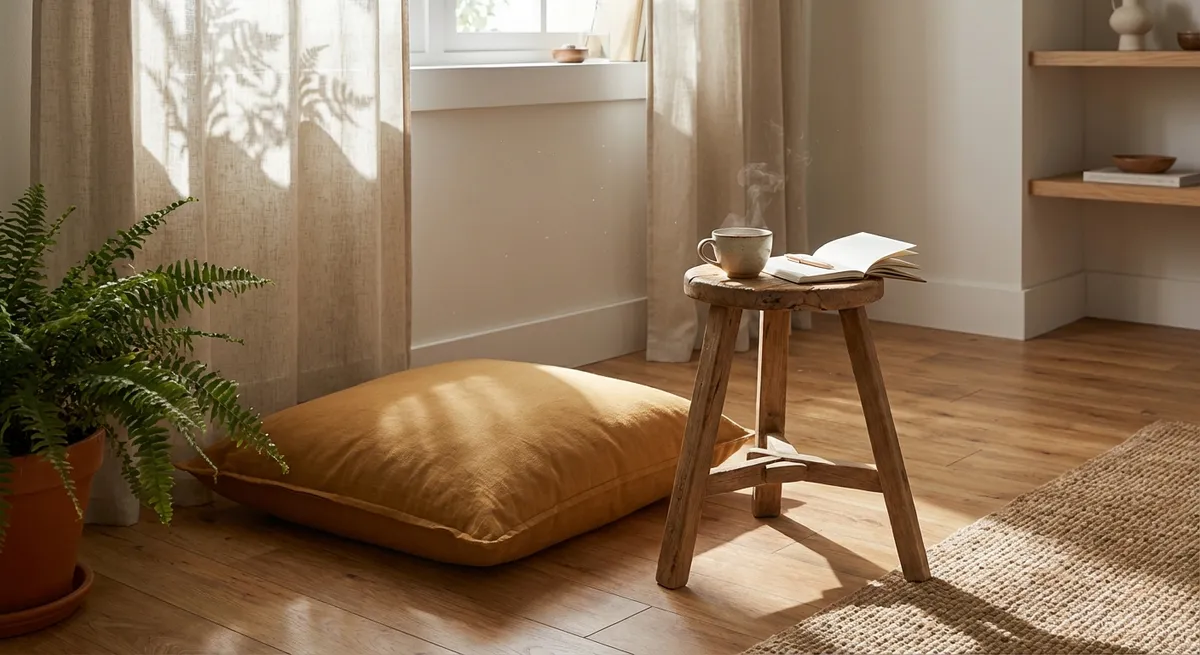
This gentle guide is an invitation to soften the edges of your routine. With five calming practices, you can begin to create a more peaceful rhythm, not by changing everything at once, but by choosing a few soft, steady steps toward a kinder way of living.
Welcoming Your Day Slowly
How you enter the day can shape how the rest of it feels. Instead of waking up and immediately reaching for a screen, you can give yourself a quiet moment to arrive in the morning.
If it feels possible, allow yourself a few extra minutes before responsibilities begin. Sit on the edge of your bed or by a window and take three unhurried breaths, feeling the rise and fall of your chest. Notice the light in the room, the sounds outside, the sensation of your feet on the floor.
You might add a simple phrase to greet the day, such as “I will move gently today” or “I am allowed to go slowly.” This isn’t about forcing yourself to be cheerful; it’s about acknowledging that you deserve a calm beginning, even if the day ahead is full.
Over time, this small ritual can become an anchor, reminding your body and mind that they do not need to leap into urgency the moment your eyes open.
Returning to Your Breath When Life Feels Tight
Stress often shows up first in the body—a tightened jaw, a racing heart, a clenched belly. When you gently notice these signals, you can use your breath as a soft place to return to.
Find a comfortable position, sitting or standing, and rest a hand on your chest or abdomen. Slowly breathe in through your nose for a count that feels natural, then breathe out a little more slowly than you inhaled. The exhale is where the body often finds release, so let it be long and easy.
You do not have to breathe “perfectly.” Simply paying kind attention to your breath can soften tension. If counting helps, you might try inhaling for four counts and exhaling for six, adjusting as needed.
You can use this quiet practice while waiting in line, before a meeting, or after reading a stressful message. Each time, it’s a reminder: you are allowed a pause, even in the middle of everything.
Creating Gentle Boundaries Around Your Energy
Living peacefully does not mean saying yes to everything or everyone. Sometimes, the softest choice is a boundary—a gentle line that protects your time, energy, and emotional space.
You might begin by noticing the moments that leave you drained or uneasy. Is it answering messages late at night? Always saying yes to extra tasks? Constantly checking the news or social media? Choose one area to soften, rather than trying to change them all.
You could set a quiet rule for yourself, such as no work emails after a certain hour, or turning your phone to “do not disturb” during meals. You might practice simple phrases like “I can’t take that on right now” or “I need some time to rest this evening.”
Boundaries are not walls to shut the world out; they are gentle gates that help you decide what comes in. Protecting your inner space in this way can create room for more ease, presence, and calm.
Finding Calm in Simple, Sensory Moments
Peace does not always arrive through big changes. Often, it’s found in ordinary moments when we allow our senses to fully notice what is here.
You can gently practice this by choosing one everyday activity—making tea, washing your hands, stepping outside—and turning it into a small ritual of attention. Feel the warmth of the water, notice the scent of the soap, listen to the quiet sounds around you.
If you drink a warm beverage, rest your hands around the cup and feel the heat on your skin. Take a slow sip and notice the taste. Let your shoulders drop slightly as you exhale.
These moments may seem small, but they remind your nervous system that not every second has to be filled with urgency. You are allowed to simply be with what is in front of you, one soft moment at a time.
Ending the Day with a Gentle Letting Go
As the day closes, your body and mind benefit from a slow unwinding, a signal that it is safe to release the weight of the hours you’ve just lived.
You might create a short, simple evening ritual. This could be writing down three things you’re grateful for or three things you’re ready to set down for the night. It might be dimming the lights, playing soft music, or reading a few pages of something soothing instead of looking at a bright screen.
Some people find comfort in a brief body scan: lying down or sitting comfortably, slowly bringing attention from the top of the head to the toes, noticing where there is tension and gently inviting it to soften. You don’t need to force relaxation—just offer your body permission to ease.
As you prepare for sleep, you might quietly tell yourself, “For now, I have done enough. For now, I am allowed to rest.” Let this be your closing note, a soft curtain drawn over the day.
Conclusion
Peaceful living is not about having a perfect life or never feeling stressed. It is about making room for softness, even when life is imperfect and noisy. By greeting your mornings gently, returning to your breath, setting tender boundaries, savoring sensory moments, and closing your days with care, you slowly weave more calm into the fabric of your life.
You do not need to change everything at once. Even one small practice, repeated kindly, can become a quiet refuge you can return to again and again.
Sources
- [National Institute of Mental Health – 5 Things You Should Know About Stress](https://www.nimh.nih.gov/health/publications/stress) – Overview of stress, its impact, and basic coping strategies
- [American Psychological Association – Stress Management](https://www.apa.org/topics/stress) – Evidence-based information on stress, boundaries, and healthy coping methods
- [Harvard Health Publishing – Take a Breath for Better Health](https://www.health.harvard.edu/mind-and-mood/take-a-breath-for-better-health) – Explains how breathing practices can influence the nervous system and promote calm
- [Mayo Clinic – Relaxation Techniques: Try These Steps to Reduce Stress](https://www.mayoclinic.org/healthy-lifestyle/stress-management/in-depth/relaxation-technique/art-20045368) – Practical guidance on relaxation methods such as deep breathing and body scans
- [UCSF Health – Sleep Hygiene](https://www.ucsfhealth.org/education/sleep-hygiene) – Research-based advice on creating soothing evening routines and improving sleep quality