Each of these five calming tips is meant to feel light, kind, and doable. You don’t need special tools or large amounts of time—just a willingness to pause and care for yourself with softness.
1. The Gentle Check-In: Asking Yourself “How Am I, Really?”
Stress often builds quietly, layer upon layer, until it feels heavy and confusing. A gentle self check-in is a way to pause and listen beneath the noise. Find a moment—perhaps while waiting for the kettle to boil or sitting in your parked car—to place a hand on your chest or over your heart and quietly ask, “How am I, really?”
Slow your breathing and notice what rises: tightness in your shoulders, a quick heartbeat, a tired mind. Instead of judging what you find, simply acknowledge it: “I feel tense.” “I feel rushed.” “I feel sad.” Naming feelings can soften their intensity and help the nervous system calm. You might even add a kind phrase, such as, “It makes sense I feel this way,” or “I am allowed to feel this.” Over time, this small practice can become a safe inner ritual—a way of returning to yourself with gentleness rather than pressure.
2. Softening the Edges of Your Breath
When stress gathers, the breath often becomes shallow and hurried, even if we don’t notice. Softening your breathing is like dimming a bright light in a room—it doesn’t make everything disappear, but it helps everything feel a little less harsh.
Find a comfortable position, sitting or standing, and gently exhale through your mouth as if you are sighing. Then, inhale slowly through your nose for a count that feels natural—perhaps four—and exhale for a slightly longer count, like six. Imagine your breath as a slow wave, washing in and then retreating. Let your shoulders drop with each out-breath. You can repeat this for a few cycles, allowing each breath to smooth the edges of your thoughts. Even one minute of softened breathing can be enough to remind your body that it is safe to relax, even just a little.
3. One-Task Moments: Letting Your Attention Rest
Modern life often asks us to do many things at once: check messages while eating, think about tomorrow’s tasks while finishing today’s, hold conversations with half our mind elsewhere. This constant pull can leave the body feeling tense and the mind scattered. One-task moments offer a small way back to steadiness.
Choose a simple activity you already do—washing your hands, making tea, brushing your hair—and, just for that moment, let it be the only thing you do. Feel the temperature of the water, notice the scent of the soap, listen to the quiet clink of the mug against the counter. When your mind wanders, gently bring it back to the task, like guiding a child’s hand softly. This is not about doing the task perfectly; it’s about allowing your attention to rest in one place. These small single-task islands throughout the day can create spaces of calm, reminding your nervous system that not every moment has to be rushed or divided.
4. Creating a Tiny Sanctuary in Your Space
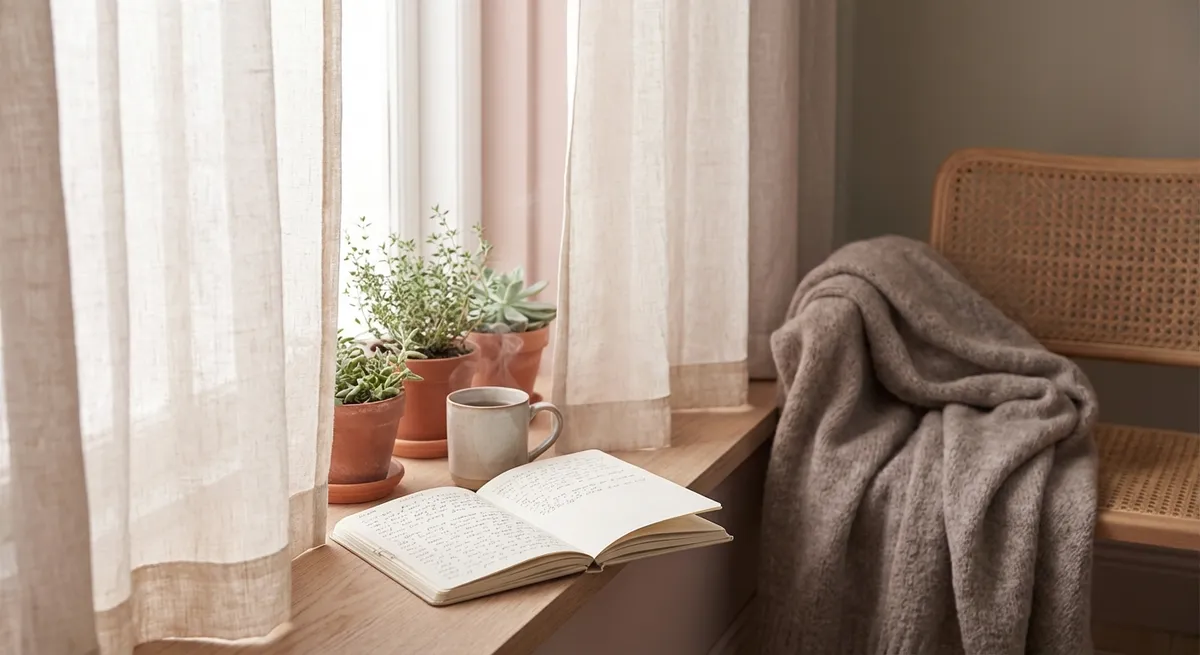
You don’t need an entire room to feel calmer—sometimes a tiny, intentional corner is enough. A small sanctuary can be a chair by the window, a spot on the floor with a cushion, or a corner of your desk with a few objects that bring you ease. The point is not decoration; it’s intention: this is a place where you come to slow down, even for a minute or two.
Choose one or two items that feel peaceful to you: a plant, a soft blanket, a favorite book, a photograph, or a stone you like to hold. When the day feels tight, visit this sanctuary for a short pause. Sit, breathe, and notice how it feels to be in that space—supported, grounded, gently held. Over time, your body and mind will begin to associate this small area with calm, making it easier to settle each time you return.
5. Evening Unwind: A Gentle “Closing” for Your Day
When the day blends into night without a clear pause, the mind can stay in “doing” mode long past bedtime. Creating a soft closing ritual—just a few minutes each evening—can signal to your body that it is safe to release the day.
You might dim the lights, put your phone away for a short while, and choose one small calming activity: stretching your neck and shoulders, writing a few lines about what you’re grateful for, making a warm drink, or simply sitting quietly with your eyes closed. As you do this, you can silently say to yourself, “The day is done. I have done enough for now.” This simple phrase can be soothing, especially when self-expectations feel heavy. Over time, this gentle ritual can help ease you from alertness into rest, making room for deeper sleep and a kinder start to the next day.
Conclusion
Calm does not need to be dramatic or distant; it can arrive in small, almost invisible ways. A hand over your heart. A softened breath. A single-task moment. A tiny sanctuary. A quiet closing of the day.
You do not have to master all of these techniques at once. You might begin with just one that feels kind and manageable and let it become a familiar companion. With patient, gentle practice, these little pauses can add up to something meaningful: a life that feels less rushed, more spacious, and a little softer around the edges.
Sources
- [American Psychological Association – Stress: The Different Kinds of Stress](https://www.apa.org/topics/stress) – Overview of stress, its effects on the body and mind, and coping approaches.
- [National Institutes of Health – Relaxation Techniques: What You Need To Know](https://www.nccih.nih.gov/health/relaxation-techniques-what-you-need-to-know) – Evidence-based information on breathing, relaxation, and their impact on stress.
- [Harvard Health Publishing – Breath focus: A simple way to reduce stress](https://www.health.harvard.edu/mind-and-mood/breath-focus-a-simple-way-to-reduce-stress) – Practical guidance on using the breath to calm the nervous system.
- [Mayo Clinic – Stress management](https://www.mayoclinic.org/healthy-lifestyle/stress-management/basics/stress-basics/hlv-20049495) – General strategies and tips for managing daily stress.