Honoring Your Pace: Moving Through the Day More Slowly
Modern life often asks us to move faster than our hearts prefer. When you move at a pace that isn’t truly yours, the body holds tension like a secret—tight jaws, clenched hands, shallow breath. Honoring your own pace is a quiet form of self-respect.
Begin by noticing where you rush the most: mornings, mealtimes, emails, or getting ready for bed. See if you can soften just one of these moments by moving at three-quarters speed. Walk slightly slower to the kitchen, take an extra breath before answering a message, or linger for a few seconds before you stand up. These small shifts give your nervous system time to realize it is not in danger.
You might set a gentle reminder on your phone with a simple phrase like, “Go softer,” or “There is time.” Over days and weeks, you’ll start to recognize the subtle difference between being productively engaged and being hurried. As you practice, notice any feelings that arise when you slow down—impatience, guilt, or restlessness—and meet them with curiosity instead of judgment. The goal is not perfect calm; it is kinder pacing.
Creating a Soft Landing Space at Home
Your environment quietly teaches your body how to feel. Even in a busy household, a small “soft landing” space can signal safety and rest to your nervous system. It doesn’t need to be elaborate—just intentional.
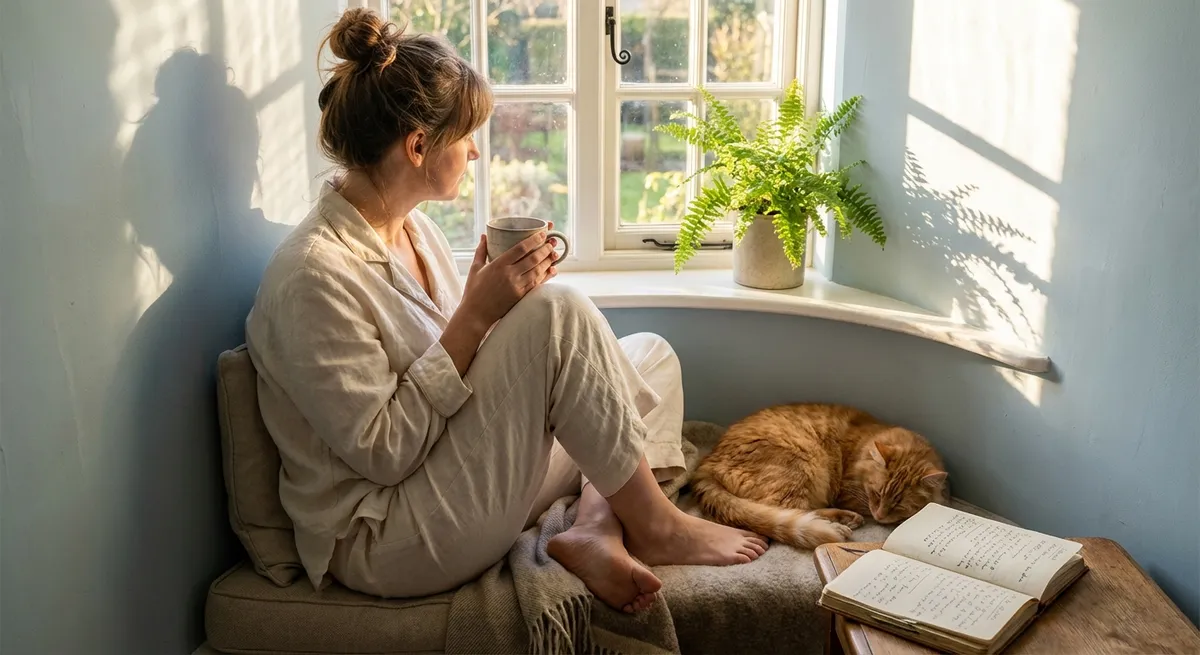
Choose a corner that feels even slightly comforting: a chair near a window, a small part of your couch, or a place by your bed. Add one or two items that feel soothing: a favorite blanket, a candle, a plant, a comforting photograph, or a small stack of books. Let this space be simple, unhurried, and easy to maintain, so it never becomes another task on your list.
When the day feels tight, allow yourself a few minutes in this spot. You can sit quietly, stretch your hands, look out a window, or simply rest your eyes. Try to associate this place with gentle experiences only—no work emails, no hard conversations, no to-do lists. Over time, your body will begin to recognize this small area as a refuge, and just sitting there may help your breath deepen and your thoughts soften.
Softening the Body: Gentle Release for Quiet Calm
The body often speaks first when stress appears—before the mind has found words, your shoulders lift, your jaw tenses, your brow furrows. Learning to notice and soften these signals can invite calm without forcing it.
A few times a day, pause and silently scan your body from head to toe. Notice your forehead, jaw, neck, shoulders, chest, belly, hands, and feet. Wherever you find tightness, quietly say to that area, “You can rest now.” With your next exhale, imagine the tension slowly loosening, even if only a little. There is no need to push; even a 5–10% softening can feel meaningful.
You can turn this into a tiny ritual at natural pauses in your day: while waiting for water to boil, sitting at a red light, or before opening a new message. If you like, pair the release with very simple movements—rolling your shoulders, unclenching your hands, or gently stretching your neck. This kind of awareness doesn’t demand that tension disappear; it simply reminds your body that it is allowed to let go.
Tending to Your Thoughts with Gentle Curiosity
Stressful thoughts can arrive like waves—sudden, repetitive, and loud. Trying to push them away often makes them stronger. Instead, you might practice meeting them as you would a worried friend: with patience and calm curiosity.
When a stressful thought appears, silently notice: “I’m having the thought that…” For example, “I’m having the thought that I’ll never get everything done,” or “I’m having the thought that I’m failing.” This small phrase creates a bit of space between you and the story in your mind, reminding you that a thought is something you experience, not something you are.
You might then ask a gentle question: “What do I need right now, in this moment?” The answer may be simple—a sip of water, a short walk, a slow breath, or a kind message to yourself. If the mind continues to race, you can imagine placing your thoughts on leaves floating down a quiet stream, watching them pass by. They may return, but each time you notice them without harshness, you are teaching your mind that it does not have to fight itself to find peace.
Weaving Calm Into Everyday Rhythms
Sustained relaxation often comes not from one big change, but from many small, tender ones woven into the rhythm of your day. Instead of adding long routines, you can gently infuse calm into moments that already exist.
Choose one everyday activity—making tea or coffee, washing your face, walking to your car, or turning off the lights at night—and let it become a signal for ease. Move a little slower during this moment. Notice a few sensory details: the warmth of water, the texture of a cup in your hands, the sounds in the room, the feeling of your feet on the ground. Let yourself fully inhabit these seconds.
You may also wish to end your day with a simple closing ritual: quietly listing three small things that brought even a hint of comfort—a kind message, a patch of sunlight, a song you enjoyed, a moment of stillness. These gentle acknowledgments don’t erase difficulty, but they remind your heart that the day held more than stress. Over time, these woven moments of presence can create a soft foundation, making calm more accessible even when life feels full.
Conclusion
Relaxation does not require a silent life or an empty schedule. It grows slowly, like a quiet root system beneath your days, nourished by small acts of kindness toward your body, your mind, and your pace. As you experiment with these five calming practices—moving a bit slower, creating a soft space, releasing tension, meeting your thoughts gently, and weaving calm into daily rituals—allow yourself to be imperfect and patient.
Stress may still visit, but it does not have to be your home. With each gentle choice, you are quietly reshaping the way you move through the world, creating a life that feels a little softer, a little kinder, and a little more your own.
Sources
- [American Psychological Association – Stress Effects on the Body](https://www.apa.org/topics/stress/body) - Explains how stress affects different body systems and why relaxation practices matter
- [National Institutes of Health – Relaxation Techniques for Health](https://www.nccih.nih.gov/health/relaxation-techniques-for-health) - Overview of evidence-based relaxation approaches and their benefits
- [Harvard Health Publishing – Take a Daily Stress Relief Break](https://www.health.harvard.edu/mind-and-mood/take-a-daily-stress-relief-break) - Discusses simple, practical strategies to reduce daily stress
- [Mayo Clinic – Stress Management](https://www.mayoclinic.org/healthy-lifestyle/stress-management/basics/stress-basics/hlv-20049495) - Provides guidance on recognizing stress and incorporating coping strategies
- [Cleveland Clinic – Progressive Muscle Relaxation](https://health.clevelandclinic.org/progressive-muscle-relaxation) - Describes a gentle method for releasing physical tension and promoting calm