Honoring The Pause: A Soft Reset For Your Nervous System
Relaxation often begins with permission—to stop, to breathe, to simply be. Throughout the day, your nervous system collects signals of tension: a sharp email, a loud environment, a racing thought. Honoring a pause, even for one quiet minute, offers your body a chance to reset. You might close your eyes, place a hand over your heart, and feel the gentle weight of your palm as a reminder that you are here, now, and safe enough to soften. This simple practice can help shift your body from a state of constant “doing” into a quieter “being,” where rest becomes possible. Over time, these tiny pauses weave together into a calm undercurrent, making stressful moments feel less overwhelming. Let the pause be small, imperfect, and real—something you can return to again and again, like a familiar doorway into ease.
Calming Tip 1: A Slower Breath That Softens The Edges
Breath is a quiet companion that follows you everywhere, and it can become a gentle tool for relaxation. When stress rises, your breathing often becomes shallow and quick, which can keep your body on alert. To soften this, you might try a slow, simple pattern: breathe in softly through your nose for a count of four, then breathe out through your mouth for a count of six. Let the exhale be easy, like a sigh that doesn’t need to be dramatic to be real. This slightly longer out-breath can nudge your nervous system toward calm, especially if repeated for a few minutes. You don’t need perfect posture; you can do this while sitting at your desk, resting in bed, or standing in line. Over time, this slower breath can become a trusted way to smooth the sharp edges of a stressful moment.
Calming Tip 2: Creating A Gentle “Landing Place” At Home
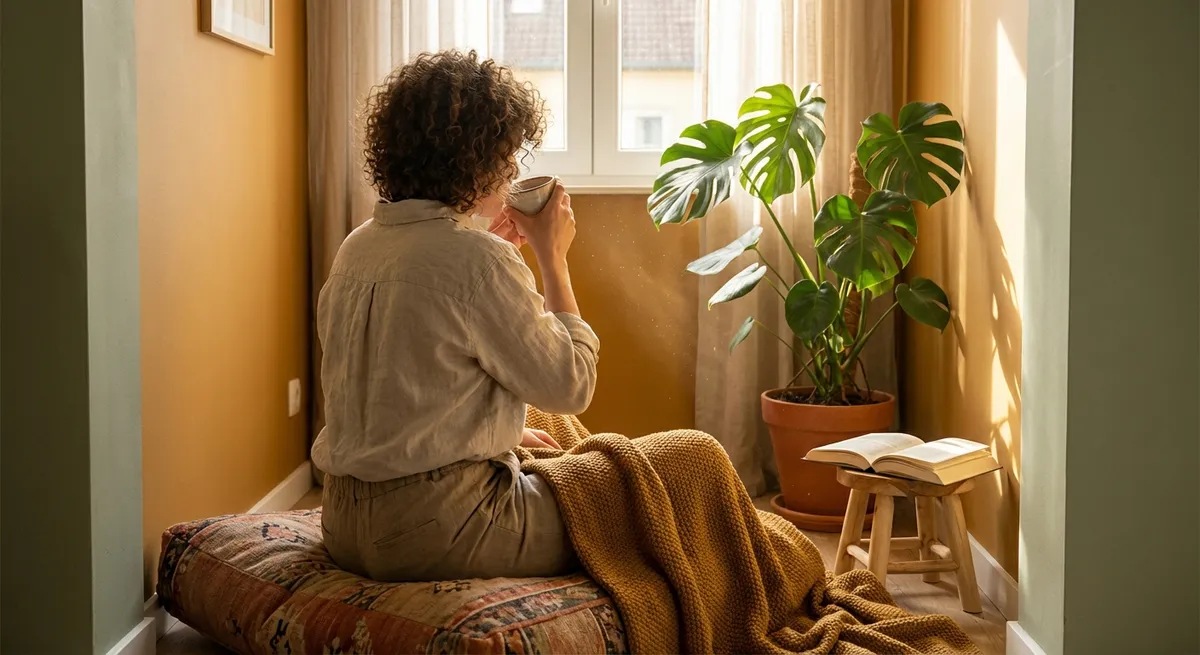
Your surroundings quietly shape how you feel, and a small, soothing space can become a sanctuary for your senses. You don’t need an entire room; a single corner, chair, or spot by a window is enough. You might place a soft blanket there, a favorite mug, a plant, or a few objects that make your shoulders drop when you see them. Keep this space for quiet things: reading, breathing, stretching, or simply sitting without a screen. When you return to this spot regularly, your body begins to recognize it as a place where it can soften and let go. Even five minutes in your chosen corner can send a gentle signal to your mind that this is a time for rest, not rush. In this way, your home becomes not just a place you live in, but a place that helps you unwind.
Calming Tip 3: Gentle Movement To Melt Stored Tension
Stress often settles into the body as tight shoulders, a clenched jaw, or a heavy chest. Gentle movement offers a kind way to invite that tension to loosen. You might roll your shoulders slowly, stretch your arms overhead, or sway side to side while standing, as if you were moving with a quiet piece of music. Even a few minutes of soft stretching or a slow walk can help your muscles release and your mind follow. You don’t have to “work out” or break a sweat; the goal here is to feel more space inside your body, not to achieve a fitness milestone. Imagine your movement as a way of telling your body, “You are allowed to feel safe and spacious.” With regular practice, these small movements can become a natural part of your day, gently clearing away accumulated stress.
Calming Tip 4: Soft Boundaries Around Your Daily Input
What you take in—through screens, conversations, and noise—can quietly fill your inner world. Without gentle boundaries, constant notifications and heavy headlines may leave your mind buzzing long after the day ends. You might begin by choosing one small boundary, such as a screen‑free first 10 minutes after waking or a quiet half hour before sleep. During that time, you can replace scrolling with a simple ritual: sipping warm tea, writing a few lines in a journal, or listening to calming sounds. You can also practice saying kind, clear “no’s” to commitments that drain you, giving your time and energy more room to breathe. Over time, these soft boundaries act like a gentle filter, letting in what supports you and reducing what overwhelms you, so your inner world feels less crowded and more at ease.
Calming Tip 5: Ending The Day With A Kindness Ritual
The way you close the day can shape how deeply you rest. A bedtime ritual does not need to be elaborate; it only needs to be consistent and kind. You might dim the lights, slow your breathing, and reflect on three small moments you are grateful for—or simply three things you made it through. You could write them down, whisper them to yourself, or hold them silently in your mind. If worries appear, you might imagine placing them in a gentle container—a box, a cloud, a basket by your bed—with the promise that you can return to them in the morning, but not now. This simple act of acknowledgment can soothe your mind, making sleep feel more inviting. With repetition, your body will begin to associate this ritual with safety and rest, helping you drift into sleep with a softer heart.
Conclusion
Relaxation is not about escaping your life; it is about moving through it with a kinder rhythm. Each small tip—slower breaths, a cozy corner, gentle movement, soft boundaries, and an evening ritual—offers a doorway into a quieter way of being. You do not need to practice them all at once; even one small change, repeated with tenderness, can ease the weight of a busy day. As you move forward, may you remember that calm is not something you earn—it is something you are always allowed to return to, one gentle moment at a time.
Sources
- [National Institutes of Health – Relaxation Techniques](https://www.nccih.nih.gov/health/relaxation-techniques-what-you-need-to-know) - Overview of evidence-based relaxation methods and their benefits
- [Harvard Medical School – Breath Control and Stress](https://www.health.harvard.edu/mind-and-mood/relaxation-techniques-breath-control-helps-quell-errant-stress-response) - Explains how slow breathing patterns influence the stress response
- [Mayo Clinic – Stress Management](https://www.mayoclinic.org/healthy-lifestyle/stress-management/in-depth/stress-relief/art-20044476) - Practical guidance on simple daily habits that reduce stress
- [Cleveland Clinic – Progressive Muscle Relaxation](https://health.clevelandclinic.org/progressive-muscle-relaxation) - Describes how gentle physical relaxation can ease tension and anxiety
- [Sleep Foundation – Bedtime Routines for Better Sleep](https://www.sleepfoundation.org/sleep-hygiene/bedtime-routine-for-adults) - Discusses how consistent evening rituals support deeper, more restful sleep