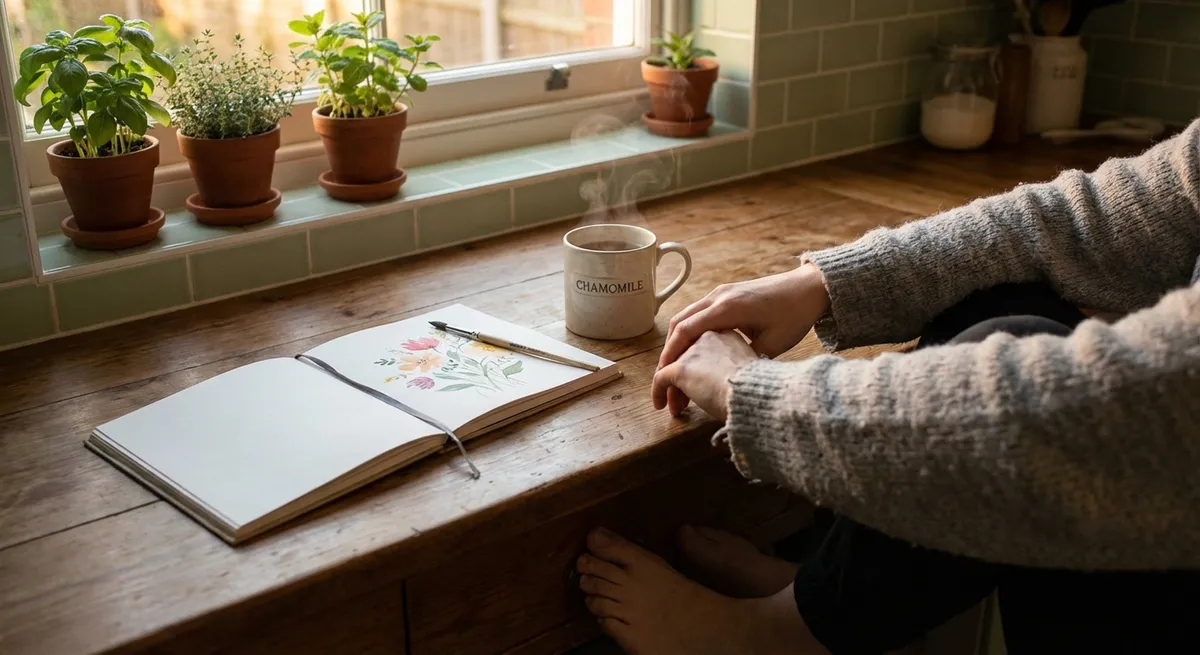
Think of this article as a gentle pause: a place to soften your breathing, loosen your grip on the day, and gather a few quiet anchors you can return to whenever you need them.
Meeting Your Stress with Kindness
Stress often shows up before we fully notice it. It can hide in a quickened heartbeat, a racing mind, a tight jaw, or a restless need to check your phone. Many of us were never taught to recognize these early whispers of tension, so we push through until we feel overwhelmed.
Instead of fighting stress or judging yourself for feeling it, you can begin by greeting it with kindness. Noticing, “I’m feeling tense right now,” can be the first step toward softening. Our nervous systems respond gently when we feel safe, heard, and accepted—even when that comfort comes from ourselves.
You don’t need big, dramatic changes to feel more at ease. Often it’s the small, repeatable moments of care that slowly shift how your body and mind move through the day. The following calming tips are meant to be simple and forgiving. You can try them one at a time, in any order, and return to the ones that feel most natural to you.
Calming Tip 1: A Soft Breath You Can Carry Anywhere
Your breath is always with you, quietly offering a way back to steadiness. When you’re stressed, breathing can become shallow or hurried, sending signals of alarm through your body. Gently slowing your breath can send the opposite message: “You are safe enough to soften.”
Try this simple pattern, often called “4–6 breathing”:
- Breathe in slowly through your nose for a count of 4.
- Exhale softly through your mouth or nose for a count of 6.
- Repeat for about 1–3 minutes, or as long as it feels comfortable.
Let the breath be easy rather than forced. Imagine each exhale as a small release: shoulders dropping, jaw softening, thoughts untangling a little. If counting feels stressful, you can simply notice the coolness of the air as it enters, and the warmth as it leaves.
You can use this calm, lengthened exhale while waiting in line, sitting at your desk, or before you respond to a difficult message. Over time, this practice can become a familiar refuge—like a gentle hand on your own shoulder.
Calming Tip 2: Create a Tiny Ritual of Pause
Rituals are simple actions you repeat with intention. They don’t need to be elaborate; their power lies in their consistency. A tiny ritual of pause can give your nervous system a predictable moment of rest in the middle of a busy day.
You might:
- Light a candle before starting work and take three slow breaths as the flame steadies.
- Place your hand on your heart for a few moments before opening your email.
- Take a sip of water while looking out a window, letting your eyes rest on something far away.
- Stretch your arms overhead when you finish one task before moving to the next.
Choose something that feels natural and soothing, not like another obligation. Over time, your body may begin to associate this small ritual with a sense of slowing down and safety. It becomes a quiet signal: “For this moment, I am allowed to rest.”
Calming Tip 3: Soften Your Inner Voice
Stress is often amplified by the way we speak to ourselves. A harsh inner voice—full of “should,” “not enough,” and “why can’t you just…”—can keep your body braced and on guard. Softening this inner dialogue can be a surprisingly powerful form of stress relief.
When you notice self-criticism, pause and gently ask:
- “If a dear friend felt this way, what would I say to them?”
- “Is there a kinder way to describe what I’m going through?”
- “Can I acknowledge that this is hard, without blaming myself?”
You might choose a simple phrase to offer yourself in tough moments, such as:
- “I’m doing the best I can with what I have today.”
- “It’s okay to feel this way; it will pass.”
- “I can move slowly. I don’t have to rush.”
You don’t have to fully believe these words at first. Simply offering them begins to soften the edges of your stress. Over time, this gentler voice can become your default, and your body will feel the difference.
Calming Tip 4: Let Your Body Move the Tension Out
Stress, even when it starts in the mind, settles in the body. Muscles tighten, breathing shortens, and energy can either spike or crash. Gentle movement helps your nervous system release some of that stored tension, giving stress a pathway out instead of holding it in.
You don’t need a long workout to feel a shift. You might try:
- Slow neck rolls, pausing where you feel tightness.
- Rolling your shoulders up toward your ears, then letting them drop.
- Standing up every hour to stretch your arms and legs.
- A short walk—around your home, down the hallway, or outside if you’re able.
- A few gentle yoga poses, like child’s pose or forward fold.
Move at a pace that feels kind to your body. Notice any sensations: a slight warmth, a subtle release, or even a sense of emotional softness. Think of each small movement as a way of telling your body, “You don’t have to hold everything alone.”
Calming Tip 5: Create a Quiet Corner for Your Senses
The world can be loud and bright, and constant stimulation can quietly wear down your reserves. Creating a tiny “quiet corner” for your senses—even if it’s just a chair by a window or a cozy spot on your bed—can give you a place to gently reset.
In your quiet corner, you might:
- Dim the lights or use soft, warm lighting.
- Keep one comforting object nearby—a soft blanket, a favorite mug, or a small plant.
- Limit screens, notifications, and loud sounds for a few minutes.
- Add a calming scent, like a lightly scented candle or a drop of essential oil on a tissue, if that feels pleasant.
When you visit this space, give yourself permission to do very little. You might simply sit, breathe, and notice how the light falls, or listen to one gentle song. Even five minutes in a space that feels safe and unhurried can soothe your nervous system and ease the pressure of the day.
Conclusion
Stress will always weave in and out of our lives, but you are not powerless in its presence. With each soft breath, each tiny ritual, each kind word to yourself, and each small movement, you create pockets of safety and calm inside your day.
You don’t have to do all of these tips at once. Choose one that feels gentle and reachable, and let it become a familiar companion. Over time, these quiet anchors can help you feel less swept away and more rooted—present not just in your responsibilities, but in your own peacefulness.
Your pace is enough. Your efforts are enough. And you are allowed to seek calm, even in the smallest of ways.
Sources
- American Psychological Association – Stress Effects on the Body - Explains how stress affects different body systems and why calming practices matter
- National Center for Complementary and Integrative Health – Relaxation Techniques - Overview of evidence-based relaxation methods like breathing and meditation
- Harvard Health Publishing – Take a Breath for Better Health - Describes how slow, deep breathing can help ease stress and support overall well-being
- Mayo Clinic – Stress Management - Offers practical guidance on recognizing stress and integrating simple stress-relief strategies
- Cleveland Clinic – Progressive Muscle Relaxation - Details a body-based method to release physical tension and calm the nervous system