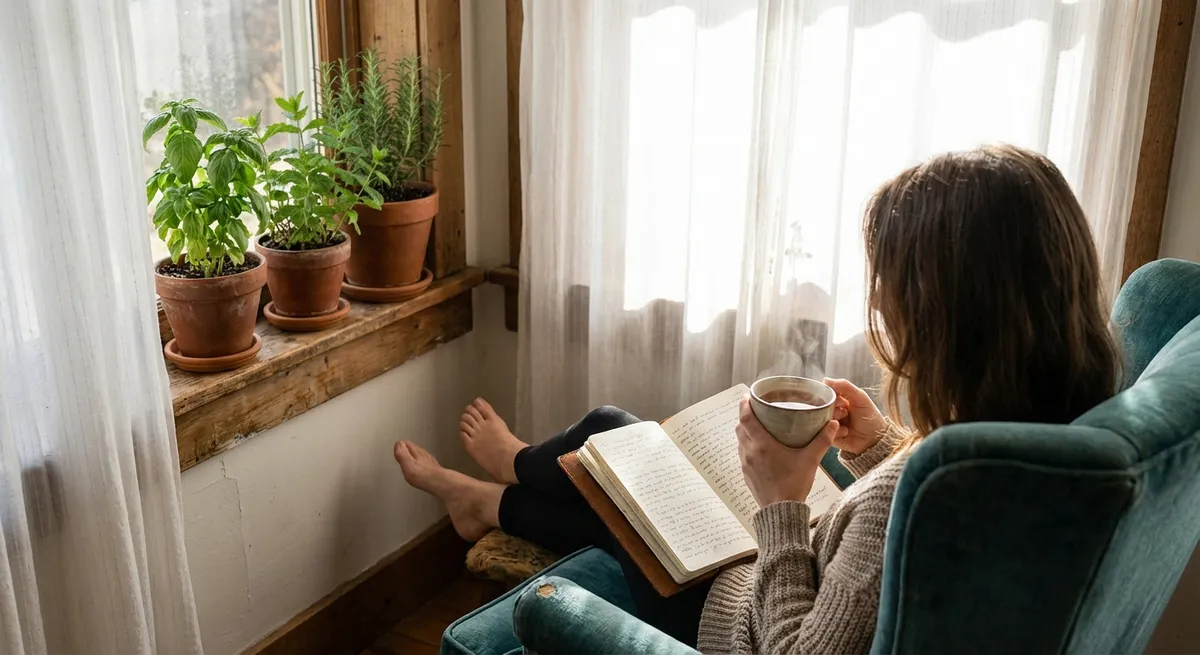
Relaxation as a Soft Companionship, Not a Goal
Many of us learn to think of relaxation as an achievement: something we “earn” after finishing enough work, being productive enough, or ticking off every box. Yet this way of thinking often keeps calmness just out of reach, like a horizon that moves as we walk toward it.
Instead, you might imagine relaxation as a quiet companion who walks beside you, rather than a destination you must arrive at. It does not demand that you empty your mind or feel blissful. It simply invites you to notice: your breath, your body, the way your shoulders sit, the sounds around you. In this way, relaxation becomes less about “fixing stress” and more about softening around what already is.
When you think of calm as companionship, it becomes easier to welcome small pockets of ease into ordinary moments—waiting in line, sipping water, washing your hands. You begin to discover that peacefulness is not always dramatic or grand; sometimes, it is simply the gentle permission to be exactly where you are, as you are.
Calming Tip 1: Breathe in Shapes
Breathing exercises can feel intimidating if you imagine you must “do them perfectly.” To soften this, you might think of your breath as drawing shapes in the air—simple, kind, and forgiving.
One gentle practice is “shape breathing.” Choose a shape in your mind: a square, a circle, or a soft wave. As you inhale, imagine your breath tracing the first part of the shape. As you pause, it traces the next part. As you exhale, it completes another section, and so on. For a square, for example, you might breathe in for a count of four, pause for four, breathe out for four, and pause again for four, each side a tender line.
This visualization invites both your body and mind to slow down together. The counting offers your thoughts a quiet place to rest, while your lungs gently expand and soften. You are not trying to force relaxation; you are simply following the outline of a shape with your breath, allowing calm to arrive if and when it is ready.
If numbers feel stressful, you can drop the counting and simply “feel” the shape: a rounded circle with a smooth inhale and exhale, a gentle wave gliding in and rolling out. The important part is kindness, not precision.
Calming Tip 2: Create a Little Harbor in Your Day
Even in a busy life, you can create a small harbor—a tiny, protected moment where you can anchor and rest. This does not require a full hour or a quiet house. A harbor can be as brief as three unhurried minutes, set aside on purpose.
Choose one consistent time in your day, perhaps just after you wake, right before a meal, or just before bed. During that time, allow yourself to pause one layer deeper than usual. You might sit with your feet on the floor, close your eyes or soften your gaze, and simply notice what is here: the weight of your body, the temperature of the room, small sounds in the distance.
If thoughts arise, you do not need to push them away. Instead, you can silently tell yourself, “I notice you, and I am still here.” Your harbor is not about emptying your mind; it is about letting yourself feel held for a moment, no matter what is happening inside or outside.
Over time, this consistent, gentle pause can become a familiar refuge. Your nervous system learns that, even on harder days, there will be a small harbor where you can land—where nothing is asked of you, and your only task is to be present.
Calming Tip 3: Ground Through Your Senses, One at a Time
When the mind feels crowded or the world feels too loud, coming back to your senses can be a simple way to ground yourself. Rather than trying to notice everything at once, you can move through your senses slowly, one at a time, as if you are offering them quiet attention.
You might begin with sight. Gently look around and name, in your mind, a few colors you can see: the soft gray of a cloud, the warm brown of a table, the soothing green of a plant. Then shift to touch: notice the texture of your clothing, the surface beneath you, the feeling of air on your skin. Allow yourself to linger there for a breath or two.
Next, invite in sound. You might listen for the farthest sound you can hear, then the closest. Perhaps there is a distant car, a bird, a hum of an appliance, or even your own breath. Finally, if it feels right, notice scent and taste, however faint—maybe the smell of soap on your hands or the simple freshness of your own breath.
This gentle, step-by-step sensing invites your attention out of spiraling thoughts and into the safety of the present moment. It does not demand that you feel instantly calm; it simply offers your body a reminder that, right here, in this exact moment, you are allowed to be.
Calming Tip 4: Speak to Yourself Like Someone You Love
The way you speak to yourself quietly shapes how safe you feel inside. When your inner voice is harsh, even rest can feel unsafe; when it is gentle, relaxation has a soft place to land.
You might experiment with offering yourself a few kind phrases throughout the day, especially during stressful moments. These do not have to be dramatic or overly positive. They can be simple, steady reminders, such as: “I am doing the best I can with what I have,” or “It’s okay to pause,” or “I don’t have to have this all figured out right now.”
If saying kind words to yourself feels unfamiliar, imagine speaking to a dear friend or a younger version of yourself. How would you respond to them if they were tired, overwhelmed, or afraid? You likely would not tell them to “just relax” or “get over it.” You might instead say, “I see how hard this is,” or “You’re not alone in this.” Those same gentle words can be offered inward.
Over time, this soft self-talk can become a cushion beneath your day—the voice that reassures you when things feel heavy, the quiet reminder that you are worthy of rest and kindness, exactly as you are.
Calming Tip 5: Let Your Body Unwind in Small, Natural Ways
Your body often holds on to what your mind cannot fully process—tension in the shoulders, a tight jaw, a clenched stomach. Rather than forcing your body to relax, you can invite it to unwind in small, natural ways that feel accessible.
You might start by choosing one area—perhaps your shoulders. Gently lift them toward your ears as you take a soft inhale, then let them drop as you exhale, as if you are placing a heavy bag down. You can repeat this a few times, noticing the tiny waves of warmth or looseness that follow.
Another gentle practice is a “mini stretch scan.” Beginning at your hands, you might slowly stretch and release your fingers, roll your wrists, or open and close your palms. Then move up to your arms, neck, and face, allowing each area a little movement—nothing forced, just an invitation. Yawns, sighs, and tiny shifts are welcome; they are your body’s quiet way of recalibrating.
Even standing up briefly, feeling your feet on the floor, and gently swaying side to side can signal to your body that it is allowed to soften. These small movements, scattered through your day, can gradually melt built-up tension without demanding a long workout or a perfect routine.
Conclusion
Calm does not always arrive as a dramatic stillness. Often, it comes in gentle fragments: the shape of a breath, a three-minute harbor, a kind sentence whispered inward, the release of a single shoulder.
You do not need to master these practices or perform them flawlessly. They are simply soft invitations—ways of listening to your quiet within, even as life continues around you. As you explore these five calming tips, you might let them meet you exactly where you are, adjusting them to your body, your schedule, and your heart.
With time, these small moments of ease can weave together into something steady: a quieter way of being with yourself, where relaxation is no longer a distant reward, but a gentle companion walking beside you, step by step.
Sources
- [National Institutes of Health – Relaxation Techniques: What You Need To Know](https://www.nccih.nih.gov/health/relaxation-techniques-what-you-need-to-know) – Overview of evidence-based relaxation methods and their benefits for stress and health
- [Mayo Clinic – Stress Relief: When and How to Say No](https://www.mayoclinic.org/healthy-lifestyle/stress-management/in-depth/stress-relief/art-20047500) – Discusses healthy boundaries and stress management, supporting the idea of small, intentional pauses
- [American Psychological Association – Mindfulness Meditation: A Research-Proven Way to Reduce Stress](https://www.apa.org/topics/mindfulness/meditation) – Explains how mindful awareness of the present moment can calm the nervous system
- [Harvard Health Publishing – Yoga, Meditation, and Mindfulness: What You Need to Know](https://www.health.harvard.edu/mind-and-mood/yoga-meditation-and-mindfulness-what-you-need-to-know) – Reviews how gentle movement and mindful practices support relaxation and emotional balance
- [Cleveland Clinic – Deep Breathing: The Science of Calm](https://health.clevelandclinic.org/deep-breathing-exercises) – Describes how breathing exercises influence the body’s stress response and promote calm