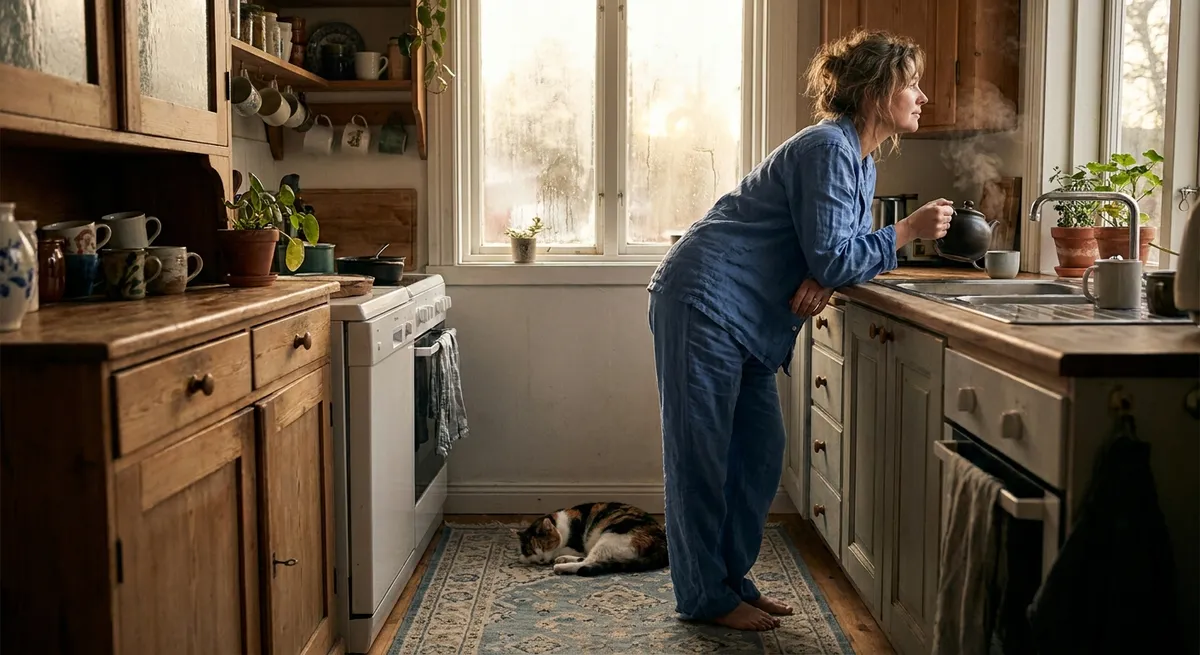
Below are five calming, simple practices to ease tension and create a steadier, more peaceful way of moving through your day. You do not need special tools or long stretches of time—only a willingness to pause, soften, and begin where you are.
Returning to Your Breath: A Soft Anchor in Busy Moments
Your breath is the quietest friend you carry everywhere. It changes with your moods—quick when you are worried, shallow when you are tense, slow when you feel safe. Learning to gently guide it can help your whole body remember what ease feels like.
Choose a small pause in your day: before opening your email, while the kettle boils, or just after you sit in your car. Bring one hand to your chest or abdomen, and slowly inhale through your nose, counting “one… two… three… four.” Let your belly rise. Then exhale gently through your mouth, counting “one… two… three… four… five… six,” letting your shoulders soften as you breathe out.
Repeating this for just a few cycles helps your nervous system step out of “emergency mode” and back into a more restful state. Over time, your body learns that this longer, softer exhale means safety, and it becomes easier to return to calm even when the day feels demanding. You do not need to control your breath perfectly; simply meeting it with kindness is enough.
Creating Small Rituals of Quiet in Familiar Spaces
Peaceful living often begins with the smallest edges of our day—the few minutes before others wake, the moment after you turn out the light, or the gentle pause after finishing a task. Rather than waiting for a long vacation or a day off, you can create tiny islands of quiet that fit inside your regular routine.
Choose one place you spend time in every day: your bedside, your desk, a favorite chair, or even a corner of your kitchen. Decide that this spot will be a “gentle space.” When you arrive there, you might silence your phone, take three slow breaths, and do one comforting action: light a candle, stretch your hands and wrists, sip warm tea, or simply look out a window for a minute.
These tiny rituals signal to your mind, “Here, we move more slowly.” Over days and weeks, your body begins to associate this place with rest. You may find that just sitting there brings a quieting feeling. This is how peaceful living grows—not through sudden, major changes, but through steady, familiar moments of intentional softness.
Softening Self-Talk: Speaking to Yourself Like a Dear Friend
Much of our stress comes not only from what happens, but from how we speak to ourselves about what happens. The inner voice that says, “You’re behind. You should be doing more. Why can’t you handle this?” can keep your body in a constant state of tension. Shifting this voice, even slightly, is a powerful act of peaceful living.
Begin by noticing your inner dialogue without judgment, as if you were gently listening to someone you care about. When you catch a harsh thought—“I messed everything up”—try pausing and adding a kinder follow-up, such as, “I’m doing the best I can with what I know right now,” or “It’s okay to be learning.”
You can also place a hand on your heart when you feel overwhelmed and quietly say something simple and soothing: “This is hard, and I’m allowed to be gentle with myself,” or “I am safe in this moment.” These phrases do not erase problems, but they soften the strain around them. Over time, this kinder inner tone becomes more natural, and your nervous system learns that it does not need to stay on high alert to keep you moving.
Moving Calmly: Letting the Body Unwind the Mind
Stress often settles into the body as tight shoulders, a clenched jaw, or a stiff back. When we ignore these whispers, they can grow into aches, headaches, and a constant hum of unease. Gentle movement is a way to ask your body, “What do you need?” and to let it answer through soft stretches and simple motions.
You do not need a formal workout or special equipment. You might slowly roll your shoulders forward and back while waiting for the kettle, circle your wrists and ankles before bed, or stand up every hour to stretch your spine and open your chest. Another calming practice is to walk a bit more slowly than usual, feeling your feet touch the ground and noticing how your body shifts with each step.
Even a few minutes of unhurried movement can reduce muscle tension and quiet the “buzz” of stress. As your body loosens, your thoughts often follow, becoming less sharp and urgent. This is not about performance or “doing exercise right”—it is simply a conversation with your body, where you listen more than you demand.
Gentle Boundaries: Protecting Your Peace with Kind “No’s”
Peaceful living is not only about what you add to your day, but also about what you gently set aside. Constant availability—to messages, to requests, to notifications—can leave your mind feeling thin and easily frayed. Creating softer boundaries is an act of self-respect and quiet strength, not selfishness.
Begin very small. You might choose one hour in the evening when you do not check your phone, or decide that you will not commit to new plans on a certain day of the week. When someone asks something of you and you feel tension in your body—perhaps a tightness in your chest or stomach—give yourself permission to say, “Let me think about that and get back to you,” instead of agreeing immediately.
When you do say no, keep your words simple and kind: “I wish I could, but I don’t have the space for that right now,” or “Thank you for thinking of me; I need to rest this weekend.” Each gentle boundary you set makes more room for rest, creativity, and genuine presence. In that spaciousness, peace has room to grow.
Conclusion
Peaceful living does not mean a life without noise, responsibility, or challenge. It means carrying a softer center inside the life you already have. By returning to your breath, shaping small rituals of quiet, softening your inner voice, moving your body with care, and protecting your time with gentle boundaries, you can create a steadier, kinder way of being.
You do not need to master all of these at once. Choose one practice that feels approachable and let it become part of your day, like a quiet thread woven through everything else. Over time, these small, consistent acts of gentleness form a deeper calm—a calm that is not easily shaken, because it lives within you.
Sources
- [American Psychological Association – Stress Effects on the Body](https://www.apa.org/topics/stress/body) – Overview of how stress influences different body systems and why calming practices matter
- [Harvard Health Publishing – Relaxation Techniques: Breath Control Helps Quell Errant Stress Response](https://www.health.harvard.edu/mind-and-mood/relaxation-techniques-breath-control-helps-quell-errant-stress-response) – Explains how slow, controlled breathing supports the nervous system
- [Cleveland Clinic – Progressive Muscle Relaxation](https://my.clevelandclinic.org/health/articles/17411-progressive-muscle-relaxation-pmr) – Describes how physical relaxation can ease mental stress and tension
- [Mayo Clinic – Positive Thinking: Stop Negative Self-Talk to Reduce Stress](https://www.mayoclinic.org/healthy-lifestyle/stress-management/in-depth/positive-thinking/art-20043950) – Discusses the impact of self-talk and ways to shift toward a kinder inner voice
- [National Institute of Mental Health – 5 Things You Should Know About Stress](https://www.nimh.nih.gov/health/publications/stress) – General information on stress, its effects, and healthy coping strategies