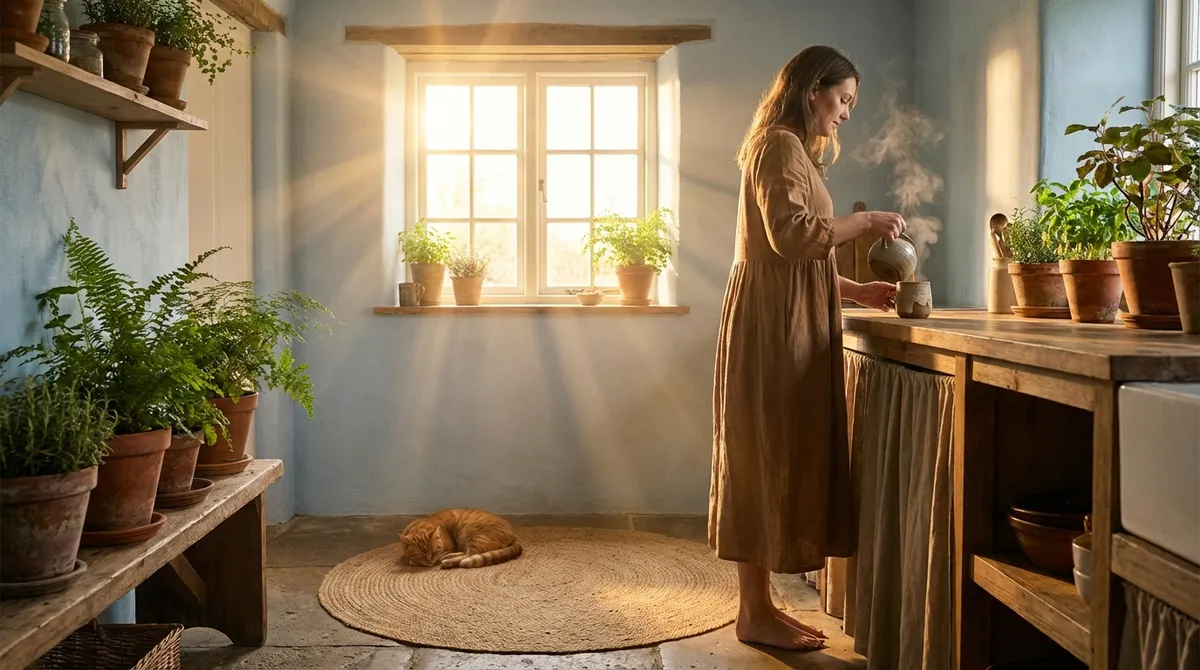
This gentle guide offers five calming practices you can weave into your ordinary days. Each is simple, kind to your nervous system, and designed to fit into a real life—one with emails, dishes, children, deadlines, and everything in between.
Meeting Yourself Where You Are
Peaceful living begins with a simple, radical shift: instead of trying to fix yourself, you start by gently noticing yourself.
Many of us move through the day bracing against our own experience—pushing away fatigue, frustration, and worry. This quiet resistance is exhausting. When you pause and acknowledge, “This is where I am right now,” your body often softens, even if nothing outside you has changed.
You might practice this by taking a small pause during transitions: before opening your laptop, after finishing a task, or when you step into your home. Place a hand over your heart or resting on your chest, and silently name three words for how you feel: “Tired. Stretched. Hopeful.” You are not judging; you are simply greeting your own experience.
This gentle witnessing lowers the internal pressure to be “OK” all the time. Studies on mindfulness show that observing feelings without judgment can reduce stress and support emotional regulation. Instead of fighting your inner weather, you become the sky—spacious enough to hold sun, clouds, and storm, all passing through.
From this softer place, the rest of your calming practices will feel more natural, because they are rooted in acceptance, not self-correction.
Tip 1: Create One Quiet Anchor in Your Day
Rather than trying to overhaul your entire routine, begin with one quiet anchor—a small moment that gently steadies you, no matter how the rest of the day unfolds.
An anchor can be a cup of tea you drink without multitasking, a five‑minute sit by a window, or a slow stretch before bed. The key is consistency and simplicity. Choose a time that already exists in your day (like just after waking or just before sleep) and attach your anchor to it.
When you repeat the same calming action in the same general window of time, your body starts to anticipate it. Over time, your anchor becomes a signal to your nervous system: “Here is a safe moment. Here is where we exhale.” This can gently support your stress response, particularly if your days feel unpredictable.
You do not need to feel peaceful for your anchor to work. You only need to show up, as you are. Some days the quiet will feel nourishing, other days it might feel restless. Both are allowed. Your commitment is not to feeling calm; your commitment is to offering yourself this one reliable pause in the noise.
Let your anchor be small enough that you can keep it, even on hard days. A two‑minute ritual you do is more powerful than a thirty‑minute routine you abandon after a week.
Tip 2: Soften Your Senses Throughout the Day
Stress often builds because our senses are constantly overstimulated—bright screens, sharp noises, fast images, rapid conversations. Peaceful living doesn’t require complete silence; it invites gentler input.
Begin by noticing what your senses are taking in at this very moment: the light, the sounds, the textures, the smells. Without needing to change everything, ask, “Is there one small way I can soften this?” Perhaps you lower the screen brightness, close one unneeded tab, turn off non‑essential notifications, or choose softer lighting in the evening.
You might bring in one calming sensory cue: a quiet instrumental playlist, a candle with a gentle scent, a soft scarf around your shoulders, or a plant in your workspace. When chosen intentionally, these small elements can remind your nervous system that it is safe enough to loosen its grip.
If you have a few spare minutes, try a short “sensory reset”:
- Gently close or lower your eyes for a moment, letting visual stimulation fade.
- Notice three sounds around you, without labeling them as good or bad.
- Feel where your body touches the chair or floor, letting your weight rest there.
- Take three slow, comfortable breaths, lengthening the exhale slightly if it feels okay.
This simple act of tending to your senses can create a surprising amount of inner quiet, even if the outside world remains busy.
Tip 3: Speak to Yourself in a Kinder Voice
The way we talk to ourselves can either tighten or soften the body, sometimes more than any external stress. A harsh inner voice keeps your nervous system on high alert; a kinder one gently reassures you that you are not under attack—from yourself.
Peaceful living invites you to become a more compassionate narrator of your own life. When you catch self‑criticism (“I should be handling this better,” “I’m failing at everything”), pause for a moment. Imagine saying those exact words to someone you love deeply. How would you soften them?
You might experiment with phrases like:
- “This is hard, and I’m doing what I can.”
- “Of course I feel overwhelmed; this is a lot.”
- “I can move through this one step at a time.”
- “I don’t have to be perfect to be worthy of rest.”
Research on self‑compassion suggests that speaking to ourselves with the same kindness we’d offer a friend is linked to lower stress and greater emotional resilience. This is not about pretending everything is fine; it is about acknowledging your difficulty with warmth rather than attack.
Over time, this gentler inner voice becomes a steady companion. Even on difficult days, you are no longer facing life alone—you are facing it with your own quiet support.
Tip 4: Move in Ways That Feel Like an Exhale
When stress builds, the body often holds it—clenched shoulders, tight jaw, shallow breath. Peaceful living includes movement, not as punishment or performance, but as a kind of physical sigh.
You do not need a formal workout to help your body release tension. A two‑minute stretch between tasks, a slow walk around the block, or standing up to roll your shoulders and gently twist your spine can be enough to shift your internal weather.
Consider inviting short “movement breaks” into your day:
- Between meetings, stand and gently circle your shoulders backward and forward.
- After a long time at your desk, slowly roll your head side to side, staying within a comfortable range.
- While waiting for the kettle to boil, sway softly from side to side or stretch your arms overhead.
Choose movement that feels soothing rather than strenuous. Let your body guide you: what would feel like relief right now? Maybe it’s walking a little slower, taking the stairs with awareness, or standing barefoot for a moment to feel the floor under you.
Even light physical activity has been linked to reduced anxiety and improved mood. When you move with kindness instead of urgency, your body receives the message that it is allowed to come down from high alert, even if only a little.
Tip 5: Gently Simplify One Small Corner of Your Life
Stress grows in cluttered spaces—physical, digital, and emotional. You don’t have to simplify everything. You only need to choose one small, manageable corner and tend to it with care.
This might be:
- A bedside table cleared of everything but a lamp and one book
- A single drawer in your desk organized so it closes easily
- Your phone’s home screen simplified to the few apps you truly use daily
- One evening a week lightly protected from non‑urgent plans
When you choose one area to gently declutter or streamline, you are sending yourself a quiet message: “I deserve a little more ease.” The goal is not minimalist perfection; it is reducing tiny frictions that accumulate into daily stress.
As you simplify, move slowly. Ask, “Does this help me feel supported or scattered?” Let the answer guide what stays and what goes. Even a small pocket of order—a clear kitchen counter, a tidy bag, a calm corner with a blanket—can become a visual reminder of peaceful living amidst the rest of life’s messiness.
In time, you may find that each small simplification creates just a bit more emotional breathing room, making it easier to meet your day with steadier shoulders and a softer jaw.
Conclusion
Peaceful living is not a destination you arrive at and remain in forever. It is a gentle rhythm you return to, again and again, through anchors, softer senses, kinder inner words, tender movement, and small simplifications.
There will be days when stress feels louder than your calm. That is part of being human. Yet even on those days, you can pause for a moment, notice where you are, and offer yourself one simple kindness.
You do not have to transform your whole life at once. Begin with one soft step. Let your calm be allowed to be small at first, like a quiet stream finding its way through the rocks. Over time, with repeated care, that stream can become a steady current—subtle but strong—carrying you through your days with a little more ease.
Sources
- National Institute of Mental Health – 5 Things You Should Know About Stress - Overview of how stress affects the body and mind, with practical coping suggestions
- American Psychological Association – Mindfulness Meditation: A Research-Proven Way to Reduce Stress - Summarizes research on mindfulness and its impact on stress and emotional regulation
- Harvard Health Publishing – Exercising to Relax - Explains how gentle physical activity can ease stress and improve mood
- Mayo Clinic – Self-care Tips to Improve Mental Health - Discusses practical self-care strategies that support emotional well-being
- Greater Good Science Center, UC Berkeley – Self-Compassion Research - Provides research-backed insights into how self-compassion reduces stress and supports resilience