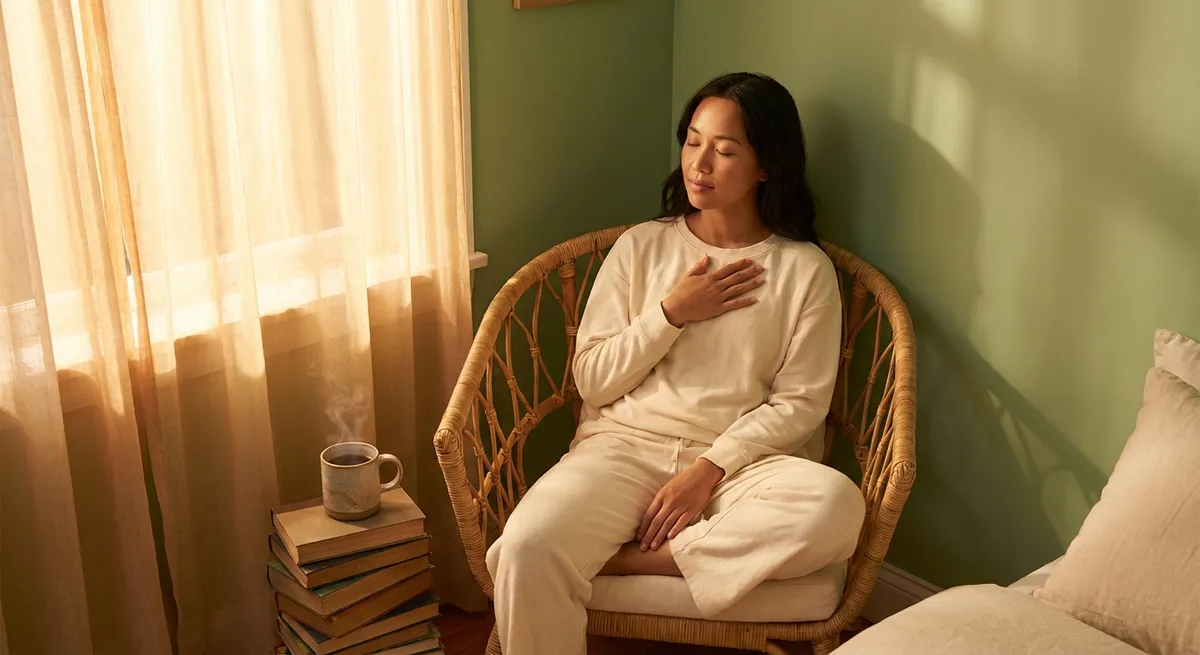
This is a gentle space to loosen that tightness. Below, you’ll find five soft, calming tips for stress-free living—not as rules or rigid routines, but as invitations. Take what soothes you, leave what doesn’t, and let your own nervous system guide the pace.
1. A Quiet Breath Ritual to Greet (or End) the Day
Instead of aiming to “fix” your stress, you might begin by simply greeting it with a few kind breaths.
Find a comfortable position—sitting, standing, or lying down. Let your shoulders drop in their own time. Then try this gentle rhythm:
- Inhale through your nose for a slow count of 4
- Pause softly for a count of 2
- Exhale through your mouth for a slow count of 6
Repeat this pattern for 1–3 minutes, or as long as it feels supportive. Think of the exhale as a quiet release, like air leaving a balloon—no force, no rush. If counting feels stressful, let it go and simply focus on lengthening your exhale just a little more than your inhale.
You can pair this with a simple phrase as you breathe, such as:
- Inhale: “Here.”
- Exhale: “I soften.”
This tiny ritual can bookend your day—once in the morning, once before sleep—to gently remind your body that it’s allowed to come down from high alert.
2. Turning Ordinary Moments into Tiny Rest Stops
Relaxation doesn’t always require a yoga mat, a quiet room, or an hour of free time. Often, it comes from how we inhabit the moments we already have.
Choose one everyday activity as a “tiny rest stop.” It could be:
- Waiting for the kettle to boil
- Standing in line at the store
- Sitting in your car before going inside
- Washing your hands
In that small pocket of time, do just one calming thing:
- Feel the sensation of your feet on the floor.
- Notice five things you can see, four you can feel, three you can hear.
- Soften your jaw, your forehead, and your shoulders.
These moments may only last 30–60 seconds, but with repetition, they teach your nervous system that safety and rest are available even in the middle of a busy day. You’re not postponing calm for “later”; you’re sprinkling it gently through your day, like soft light through a window.
3. Creating a Soft Corner in Your Space
A full home makeover isn’t needed to feel more relaxed. Sometimes, all you need is one small “soft corner”—a place your body learns to associate with ease.
This can be:
- A single chair by a window
- A cushion on the floor with a blanket
- A spot on the couch with a favorite pillow
- A small area on your balcony or porch
Add one or two simple comforting elements: a warm throw, a plant, a candle, a soft lamp, or a journal. Let this be the place you visit for a few minutes when you feel overwhelmed. You might:
- Close your eyes and listen to a calming song
- Sip something warm
- Read a page from a gentle book
- Sit in silence and watch light or shadows
Even if you only rest there for five minutes, your body begins to recognize, “This is where I can exhale.” Over time, this soft corner becomes a quiet anchor—a place where your system remembers how to slow down.
4. A Kind Check-In with Your Body
Often, stress lives not just in our thoughts, but in how our body is holding itself—tight shoulders, clenched jaw, shallow breathing. A kind, slow check-in can gently invite your body to release some of that tension.
Take a moment and scan from the top of your head down to your toes. Move through a few areas:
- Forehead and eyes: Can you soften the muscles around your eyes?
- Jaw: Let your teeth separate slightly, letting the jaw grow heavy.
- Shoulders: Imagine your shoulders melting away from your ears.
- Hands: Notice if you’re gripping or clenching, and let your fingers loosen.
- Stomach: Allow your belly to rise and fall as you breathe, without holding it in.
You don’t need to change anything perfectly—just noticing is powerful. If it feels good, add a small touch, such as placing a hand on your chest or your stomach, and say quietly (out loud or in your mind): “It’s okay to soften. I’m here with you.”
This simple act of noticing can shift your body from high alert toward a more peaceful state, reminding your system that it doesn’t have to carry everything alone.
5. Gentle Boundaries to Protect Your Quiet
Relaxation is not only about what you add to your day; it’s also about what you gently set down. Soft boundaries can create the space your mind and body need to rest.
Consider one small boundary you could experiment with:
- Turning off non-urgent notifications for an hour each day
- Placing your phone in another room during meals or before bed
- Saying, “I’ll need to think about that and get back to you,” instead of giving an immediate yes
- Allowing yourself one “do-nothing” block of time each week, even if it’s only 20 minutes
Boundaries don’t have to feel harsh or rigid. They can be tender and kind—like drawing a soft curtain around your energy. When you protect even a little quiet time, you send yourself a clear message: “My peace matters, too.”
As you practice, you may notice that even small boundaries create a ripple of calm, making it easier to breathe, think clearly, and respond with more steadiness.
Conclusion
Relaxation is not a finish line you must reach. It’s more like a series of small, gentle choices that remind your body and mind: “You are allowed to rest.”
You might begin with just one of these tips—a few longer exhales, a softer jaw, a quiet corner in your home, a small boundary around your time. Let these practices be light and flexible, something you can return to without pressure or judgment.
On the days that feel especially full, may you remember that even a single kind breath is a step toward ease. Calm does not need to be loud or dramatic; often, it’s simply the soft whisper that says: “You’re doing enough. You are allowed to slow down now.”
Sources
- National Center for Complementary and Integrative Health – Relaxation Techniques - Overview of evidence-based relaxation practices and their benefits
- American Psychological Association – Stress Relief: Relaxation Techniques - Explains how different relaxation methods can reduce stress and support mental health
- Harvard Health Publishing – Relaxation Techniques: Breath Control Helps Quell Errant Stress Response - Describes how controlled breathing influences the body’s stress response
- Mayo Clinic – Stress Management - Practical suggestions for everyday stress relief and self‑care
- Cleveland Clinic – The Power of Setting Boundaries - Discusses how gentle boundaries can support emotional well‑being and reduce stress