This article is an invitation to create a little more breathing room in your day. Softly, at your own pace, you can begin to loosen the grip of stress and return to a steadier, kinder rhythm within yourself.
Meeting Stress with Soft Curiosity
Stress is not a personal failure or a sign that you’re doing life “wrong.” It is your body’s way of trying to protect you. The racing heart, the busy thoughts, the tense jaw—these are signals, not shortcomings.
When you notice stress, you might be tempted to push it away or power through. Instead, you can try meeting it with soft curiosity. Ask yourself gentle questions: What is my body asking for right now? Where do I feel this most? What would help me feel just a little safer in this moment?
This shift—from judgment to curiosity—creates a small opening. In that opening, you can choose one tiny action that brings you closer to calm. Not a perfect solution, just a softer next step. Over time, these small choices tell your nervous system: I hear you. I’m here with you. We can move through this together.
1. A Quiet Hand on Your Heart
When stress feels loud inside, your own touch can be surprisingly soothing. It sounds simple, but your nervous system often responds to gentle, warm contact.
Sit or stand comfortably. Place one hand over your heart and, if it feels okay, the other on your lower belly. Close your eyes or soften your gaze. Notice the gentle rise and fall of your chest, the warmth of your hand, the softness of the fabric beneath your fingers.
You don’t need to change your breath or “do it right.” Just stay for a few breaths and silently offer yourself a kind phrase, such as:
- “I’m allowed to slow down.”
- “This is a lot, and I’m doing my best.”
- “For this moment, I can simply be here.”
This small gesture can help signal to your body that you are safe enough right now, and that it can release its grip little by little.
2. Softening One Small Muscle at a Time
Stress often hides in tiny corners of the body: clenched jaws, hunched shoulders, tight hands. You may not even notice it until you gently look for it.
Try a slow scan from head to toe, inviting one area at a time to soften:
- Forehead: Let your eyebrows drift away from each other.
- Jaw: Unclench your teeth and let your tongue rest behind your bottom teeth.
- Shoulders: Imagine they are melting down and away from your ears.
- Hands: Uncurl your fingers and let your palms rest easily.
- Belly: Allow your breath to gently expand it without forcing.
You don’t have to release all the tension at once—just soften by a few percent. If some areas stay tight, that’s okay. You are simply saying to your body, You’re allowed to rest here. Even a small easing can be enough to make the day feel a little more spacious.
3. A Gentle Breathing Pattern for Overbusy Moments
When life speeds up, your breath often becomes shallow without you noticing. A slow, steady breathing rhythm can encourage your body to step back from “alarm mode.”
One simple pattern is sometimes called “4-6 breathing”:
- Breathe in softly through your nose to a count of 4.
- Breathe out gently through your mouth or nose to a count of 6.
- Repeat for 6–10 rounds, or as long as it feels comfortable.
Let the exhale be like a quiet sigh of relief. There is no need to strive—if counting feels stressful, simply breathe in a bit shorter and out a bit longer. Over time, this kind of breathing can help calm your nervous system, slow your heart rate, and give your mind a place to rest for a moment.
You can use this while waiting in line, sitting in your car (parked), or just before sleep. Each time is a small reminder that you can create a little island of calm, even in the middle of a busy day.
4. Creating a Tiny “Soothing Corner” in Your Day
You don’t need a full retreat to feel a bit more grounded. Sometimes one tiny soothing space—physical or emotional—is enough to interrupt the cycle of stress.
You might:
- Keep a soft object nearby (a scarf, cushion, or smooth stone) to hold when you feel tense.
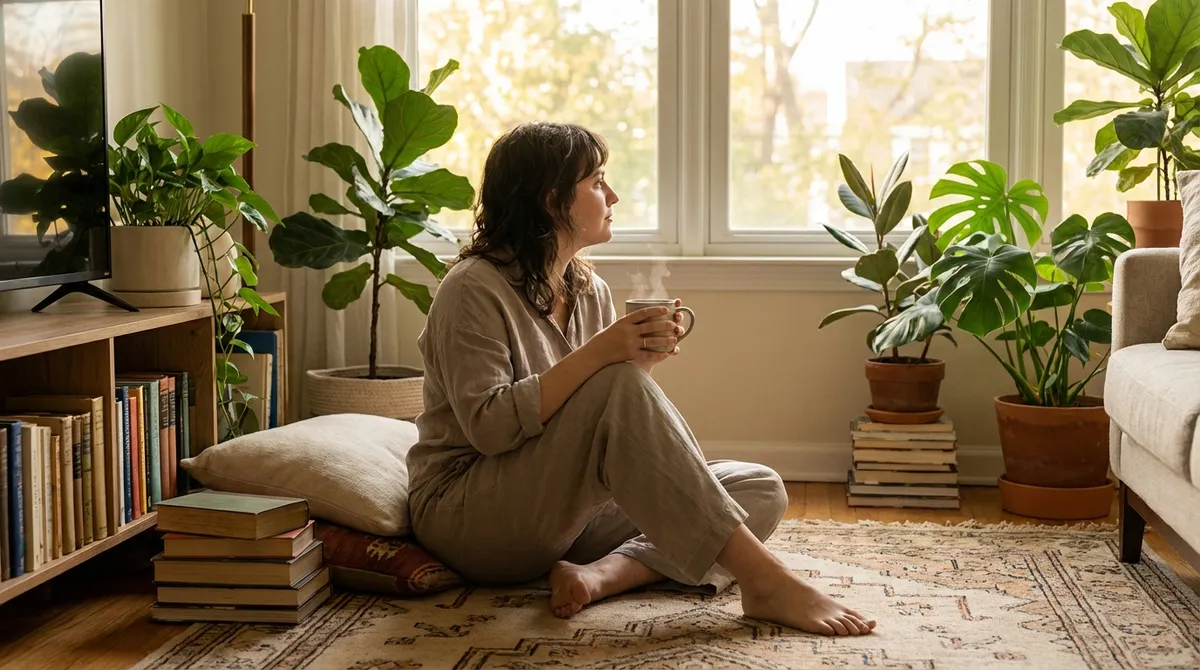
- Choose one chair, corner, or spot by a window where your only “task” is to slow down.
- Create a short ritual when you arrive home: wash your hands slowly, change into comfortable clothes, or light a candle and take three deep breaths.
Let this soothing corner become a place where you don’t have to fix or solve anything. You simply get to arrive. Even a few minutes here can act like a reset, helping you return to your responsibilities with a little more steadiness and ease.
5. Gentle Boundaries as Acts of Self-Compassion
Stress often grows when your energy is stretched beyond what feels manageable. Gentle boundaries are not walls; they’re soft edges that protect your well-being.
You might practice by:
- Saying, “Let me think about that and get back to you,” instead of giving an automatic yes.
- Setting a time in the evening when you stop checking work messages.
- Choosing one day a week with fewer plans, leaving room for rest or spontaneity.
- Limiting how much stressful news or social media you consume at once, and balancing it with something comforting.
At first, boundaries may feel uncomfortable, especially if you’re used to putting everyone else first. But over time, they become quiet messages of self-respect. You are telling yourself: My limits matter. My nervous system matters. I deserve space to breathe.
6. Letting Nature Help You Pause
Even brief, gentle contact with nature can soothe an overworked mind. You do not need a forest or a beach—tiny pieces of the natural world can be deeply calming.
If you can, step outside for a moment. Notice:
- The way the light touches nearby buildings, leaves, or clouds.
- Any movement: branches swaying, a bird flying, people walking by.
- The feel of air on your skin—cool, warm, or somewhere in between.
- The ground beneath your feet and the quiet support it offers.
If you can’t go outside, you might look out a window, tend to a plant, or simply gaze at a photo of a natural place that comforts you. Even these small connections can gently remind your body that the world is larger than this single moment of stress, and that you are held within something bigger and more steady.
Conclusion
Stress will visit—it’s part of being human. But you are not powerless in its presence. Through small, kind practices—a hand on your heart, a longer exhale, a softened jaw, a quiet corner, a firmer boundary, a moment with the sky—you can create more room for calm to live alongside everything else.
You don’t have to change your whole life overnight. Choose one thing from today’s reading that feels gentle and possible, and let it accompany you. Over time, these tiny acts of care weave together into a softer way of living with yourself—a life where even on stressful days, there is still space for ease, breath, and kindness.
Sources
- American Psychological Association – Stress: The different kinds of stress - Overview of what stress is, how it affects the body and mind, and evidence-based coping approaches
- Mayo Clinic – Stress management - Practical information on recognizing stress and using relaxation techniques for relief
- Harvard Health Publishing – Relaxation techniques: Breath control helps quell errant stress response - Explains how controlled breathing can calm the nervous system
- National Institutes of Health (NIH) – Nature and mental health - Research review on how contact with nature supports emotional well-being and stress reduction
- Cleveland Clinic – Setting boundaries for mental health - Discusses how healthy boundaries can lower stress and protect emotional health