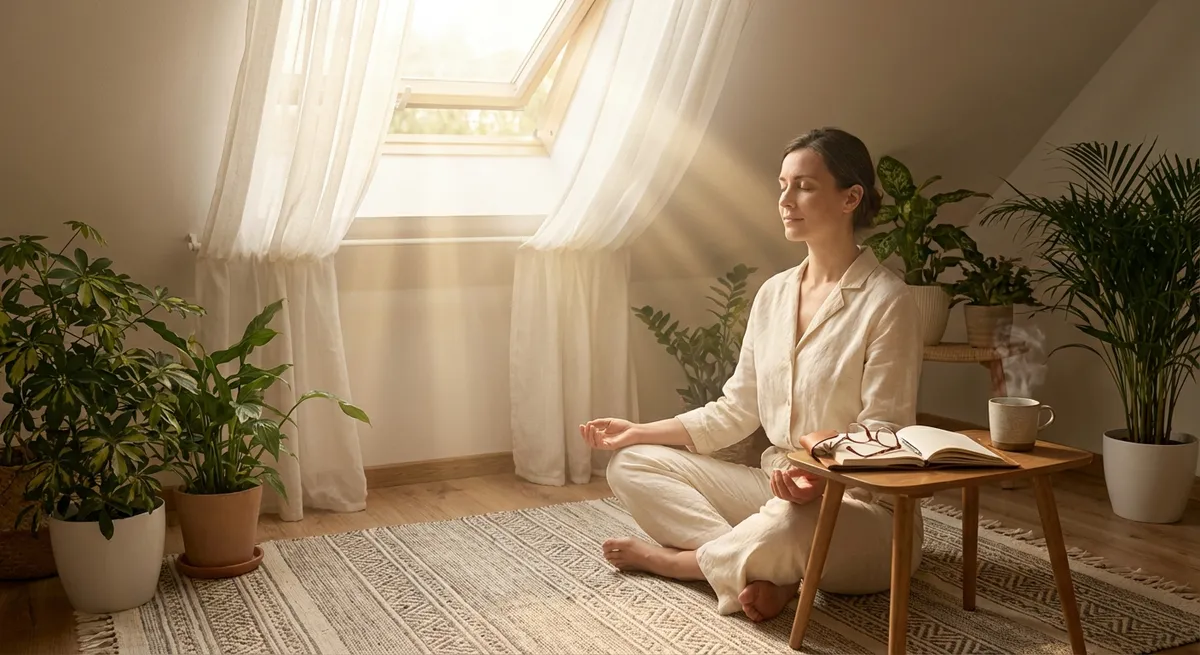
Below are five calming techniques for stress-free living, offered like small resting places along your day. You don’t need special tools, long stretches of time, or a perfect mindset. Just a willingness to pause, notice, and soften—one small moment at a time.
1. The “Three-Window” Breath Pause
Imagine your breath as three small windows you open, one after another, to let fresh air into a crowded room. This gentle practice helps create space between you and your stress.
When you notice tension rising, pause and:
- First window: Inhale slowly through your nose for a count of four, letting your belly expand.
- Second window: Hold the breath for a soft count of four—no strain, just a brief stillness.
- Third window: Exhale through your mouth for a count of six, as if you’re gently blowing out a candle.
Repeat this three times. Let your shoulders drop with each exhale. As you breathe, quietly name what you’re feeling: “Tight,” “Worried,” “Rushed,” or simply “Tired.” There is no need to fix anything; noticing alone can be deeply calming.
This small ritual can be done at your desk, in the car (while parked), or even in the bathroom during a busy day. Over time, your body learns that this pattern of breathing means “safe, slower, softer,” and it becomes easier to return to a grounded, settled state.
2. Light-Touch Grounding with Everyday Objects
Grounding doesn’t always need elaborate techniques. Often, the simplest objects within reach can gently pull you out of spiraling thoughts and back into the present.
Choose an item near you—a mug, a pen, a set of keys, a cushion. Rest it in your hand and quietly explore:
- How heavy or light it feels
- The temperature against your skin
- Any textures or patterns
- The colors and shapes you notice
As you do this, allow your breathing to find a slow, steady rhythm. You might silently repeat: “Right now, I am here.” The goal is not to escape your feelings, but to give your nervous system a calm anchor when your thoughts feel scattered.
This practice is especially helpful in moments of quiet anxiety—waiting for an email, standing in line, or sitting before an important conversation. It offers your mind something gentle and neutral to rest on, even for a few seconds.
3. Soft Transitions Between Parts of Your Day
Stress often hides in the gaps between activities—moving from work to home, from one task to another, from online to offline. When transitions happen abruptly, your mind can feel as if it’s always “trying to catch up.”
Consider introducing a tiny “soft landing” whenever you shift from one part of your day to the next. Before you start a new task, pause for 30–60 seconds and:
- Place your hands over your heart or on your belly
- Notice three things you can see and three things you can hear
- Name your next intention in a calm phrase, like “Answer emails slowly,” or “Move through this evening gently”
These micro-moments form a thin but steady thread of calm through your day. Instead of being catapulted from one thing to another, you give yourself a gentle bridge. Over time, these small bridges can ease feelings of chronic rush and help your body relax into a more sustainable rhythm.
4. A Quiet Body Check-In Before Bed
Stress often lingers most loudly at night, just as the world around you begins to settle. A short, kind body check-in can help you release some of the day’s weight before you try to sleep.
Lie down or sit comfortably. Starting at your forehead and moving slowly down to your toes, gently notice each part of your body:
- Forehead and eyes: Are they tight or soft? Invite them to loosen.
- Jaw and mouth: Is your jaw clenched? Let it drop slightly, tongue resting on the floor of your mouth.
- Neck and shoulders: Imagine them melting a little deeper into the pillow or chair.
- Chest and belly: Feel the gentle rise and fall of your breathing.
- Hands and arms: Let them be heavy and supported.
- Legs and feet: Notice any areas of gripping; imagine sending a slow exhale there.
If you encounter tension, simply say to that area: “It’s okay to rest now.” You don’t have to force relaxation; just offer an invitation. Even if everything doesn’t release, the act of kind attention sends a calming signal to your nervous system and can soften the edge of stress before sleep.
5. A Gentle “Enough for Today” Ritual
A significant source of stress is the quiet belief that we should always be doing more, achieving more, or fixing more. Having a ritual that marks the end of “doing” for the day can bring a sense of internal permission to rest.
Choose a simple end-of-day practice that feels soothing and sustainable:
- Closing your laptop and placing your hands on top of it for a moment of silence
- Turning off a particular light as a signal that work or chores are done
- Writing down three things you completed, no matter how small
- Whispering to yourself: “For today, this is enough.”
Let this ritual be soft and uncomplicated. It isn’t about productivity or self-improvement; it’s about gently acknowledging that you are allowed to stop. Over time, this small closing gesture can ease the mind’s habit of replaying unfinished tasks and help you rest more fully in your evenings.
Conclusion
Calm doesn’t have to arrive in grand, life-changing moments. Often, it comes quietly—through a few slow breaths, a soft touch on your heart, or a small ritual at the end of your day. These five techniques are not rules, but invitations. You can adapt them, shorten them, or combine them in ways that fit your life.
When your days feel crowded, remember that even a single, steady breath is a doorway back to yourself. You are allowed to pause. You are allowed to move gently. And you are allowed to create small pockets of peace, right inside the life you already have.
Sources
- [National Institutes of Health – Deep Breathing Benefits](https://www.nccih.nih.gov/health/relaxation-techniques-for-health) - Overview of relaxation techniques, including deep breathing and their effects on stress and health
- [Harvard Medical School – The Benefits of Mindfulness](https://www.health.harvard.edu/mind-and-mood/mindfulness-meditation-may-ease-anxiety-mental-stress) - Discusses how mindfulness practices can reduce anxiety and mental stress
- [American Psychological Association – Mind/Body Health: Stress](https://www.apa.org/topics/stress) - Explores what stress does to the body and evidence-based strategies for managing it
- [Mayo Clinic – Relaxation Techniques: Try These Steps to Reduce Stress](https://www.mayoclinic.org/healthy-lifestyle/stress-management/in-depth/relaxation-technique/art-20045368) - Describes practical relaxation methods, including breathing and progressive relaxation
- [Cleveland Clinic – Grounding Techniques](https://health.clevelandclinic.org/grounding-techniques) - Provides guidance on grounding practices that help bring attention back to the present moment