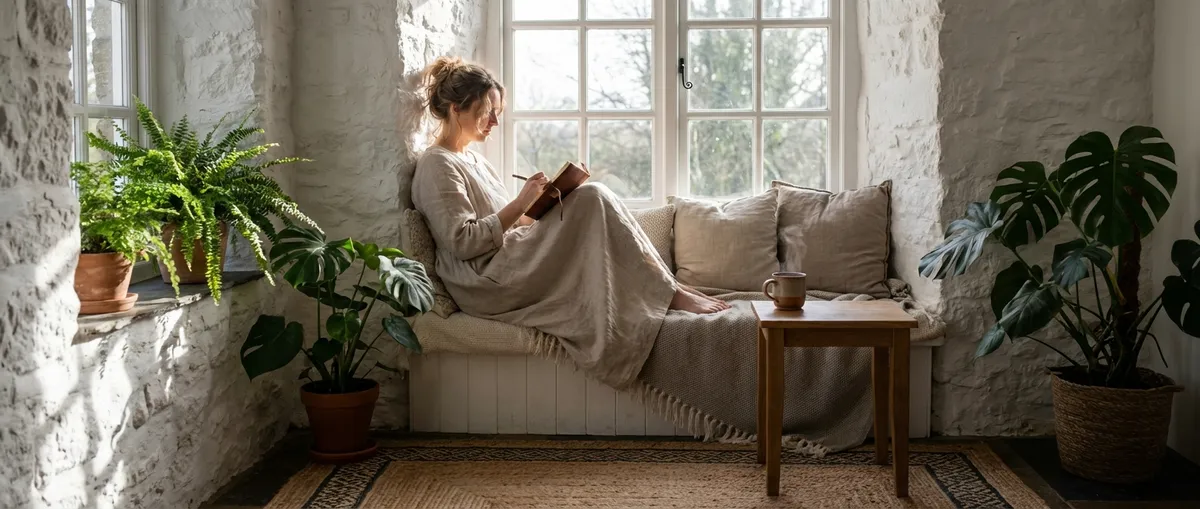
Below are five calming tips to gently support a more stress‑free way of being. You don’t need to do them all at once. Let them arrive like little lanterns you can light whenever the day feels a bit too bright.
1. Begin the Day with a Pause, Not a Sprint
Before the world asks anything of you, give yourself a moment that belongs only to you.
When you first wake up, resist the pull of your phone, email, or notifications. Instead, place one hand on your chest, one on your belly, and simply feel three slow, unhurried breaths. Notice the rise and fall beneath your palms. Let your thoughts be fuzzy and unfinished—there is nowhere to rush to in these first thirty seconds.
If you’d like, add a simple phrase in your mind, such as “I choose a gentle start” or “Today, I will move with softness.” This quiet beginning doesn’t need to be long to be powerful. It’s a signal to your nervous system that the day can start from calm, not from tension. Over time, this small pause becomes a familiar doorway into steadiness, even when the hours ahead are full.
2. Create Quiet Corners in Your Day
Peace doesn’t always come in long, luxurious stretches. Often, it slips in through tiny openings—a few minutes in between tasks, a quiet moment before a meeting, the pause while the kettle boils.
Choose one or two “quiet corners” in your day where you consciously soften. It could be:
- While you wait for your morning drink
- Right after you park your car or step off the bus
- Before you open your inbox
- As you sit down to eat
In these pockets of time, do just one gentle thing: feel your feet on the floor, roll your shoulders back and down, or take a single deeper breath than usual. You might gaze softly out a window or rest your eyes by looking away from screens for a minute.
These tiny, repeated moments of presence add up. They remind your body that it’s safe to exhale, even when life is busy. You’re not adding more to your to‑do list; you’re weaving softness into what you already do.
3. Let Your Breath Be Your Soothing Companion
Your breath is always with you, and it is one of the simplest tools for easing stress.
When you notice your mind racing or your chest tightening, try this gentle breathing pattern:
- Breathe in through your nose to a slow count of four.
- Pause softly at the top for a count of two.
- Breathe out through your mouth to a count of six.
- Repeat for 5–8 rounds, or until you feel a small shift.
This longer exhale tells your body it is safe to relax, easing the stress response and inviting calm. If counting feels like too much, simply let your exhale be a little longer than your inhale and keep your attention on the feeling of air moving in and out.
You can use this breathing companion anywhere—at your desk, in the bathroom on a busy day, in your parked car, or as you lie in bed at night. Over time, your body learns the pattern and begins to soften more quickly when you return to it.
4. Speak to Yourself as You Would to Someone You Love
Stress often grows louder when our inner voice becomes harsh. Peaceful living is not only about what you do, but how you speak to yourself while you’re doing it.
When you catch yourself thinking, “I should be handling this better,” “I’m failing,” or “I’m too much,” gently pause. Imagine a dear friend sitting where you are, feeling exactly what you feel. What would you say to them? Perhaps:
- “You’re doing the best you can in a hard moment.”
- “It makes sense that you feel overwhelmed.”
- “You don’t have to be perfect to be worthy of rest.”
Now, offer that same kindness to yourself—out loud if you can, or silently if you prefer. At first, it may feel unfamiliar. That’s okay. You are slowly teaching your nervous system that it can feel stressed and still be met with warmth, not criticism. That simple shift in tone is deeply calming.
5. Choose One Small Evening Ritual to Gently Unwind
The way you close your day can soften how you enter sleep and how you meet tomorrow.
Choose a single, simple ritual that signals to your body, “We’re easing down now.” It doesn’t need to be elaborate. Some possibilities:
- Placing your phone in another room 30 minutes before bed
- Dimming the lights and lighting a candle
- Stretching your neck, shoulders, and back for a few minutes
- Writing down three small things you’re grateful for or proud of
- Listening to a calming song or gentle nature sounds
Let this ritual be tender and unhurried. It’s not another task to accomplish; it’s a soft landing for your evening. When you repeat the same small practice regularly, your body begins to recognize it as a cue for rest, helping you loosen the grip of the day and drift into deeper, more restorative sleep.
Conclusion
Peaceful living isn’t about having a perfect life, an empty calendar, or a forever‑quiet mind. It’s about finding gentle ways to stay close to yourself, even when the world feels loud. A slow breath, a kinder inner voice, a tiny pause before you rush on—these are not small things. They are loving choices that slowly reshape how you move through your days.
You don’t have to change everything at once. Perhaps choose one of these calming tips and let it walk beside you this week. Notice how your body feels when you offer it a little more space, a little more softness. Peace doesn’t arrive all at once; it’s something you meet again and again, each time you remember to breathe a little deeper and treat yourself a little more gently.
Sources
- National Institutes of Health – Relaxation Techniques - Overview of evidence-based relaxation practices and their effects on stress and health
- American Psychological Association – Stress Management - Explains how stress affects the body and provides research-backed strategies for coping
- Harvard Health Publishing – Controlled Breathing - Describes how slow, controlled breathing can calm the stress response
- Mayo Clinic – Self-Care and Stress Relief - Offers practical, medically reviewed tips for managing daily stress
- University of California, Berkeley – Greater Good Science Center: Self-Compassion - Shares research and practices on how self-compassion supports emotional well-being