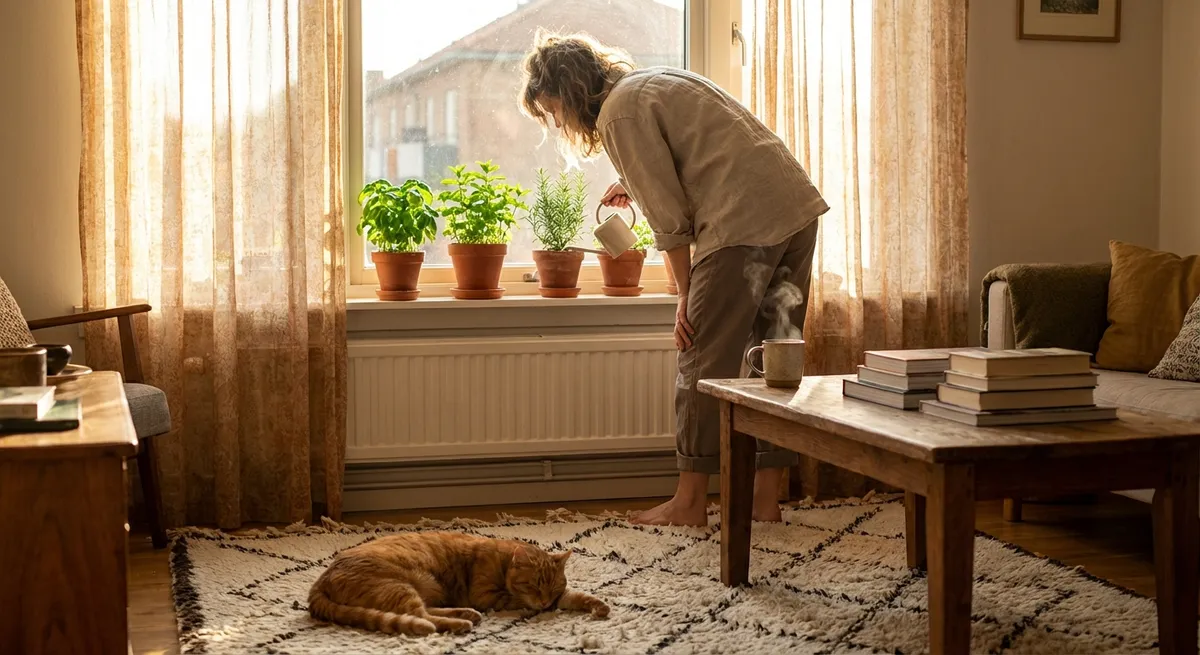
Below are five calming tips for stress-free living—not as rules or demands, but as gentle options you can explore at your own pace.
1. Create a Small Daily “Landing Place”
It can be soothing to know there is one moment in your day that will always be quiet—no matter what else happens. Think of it as a “landing place” for your mind and body, a small pause that reminds you you’re allowed to rest.
This could be the first five minutes after you wake up, sitting on the edge of your bed with your feet on the floor and your phone out of reach. It could be a brief pause before lunch, where you sip water slowly and notice three things you can see, three things you can hear, and three things you can feel. The purpose is less about how long it lasts and more about consistency; your nervous system begins to trust that rest is coming.
Over time, this simple ritual becomes a soft anchor in your day. Even when life is busy or uncertain, your body remembers: there will be a moment to land, to breathe, to simply be. Let it be small, imperfect, and easy enough that you can return to it, again and again.
2. Soften Your Body’s Tension, Gently and Often
Stress often shows itself through the body—tight shoulders, clenched jaw, shallow breathing. You may not even notice these patterns; they become familiar, like background noise. Bringing gentle attention to these areas can quietly lower your stress levels without needing any elaborate routine.
You might start with a simple check-in a few times a day: pause and ask, “Where am I holding on?” Notice your forehead, jaw, neck, shoulders, hands, and belly. Without forcing anything, let each area soften just a little. You can imagine your muscles melting like warm wax or gently loosening a tight knot.
Another soothing option is a slow stretch or two when you stand up from your desk or before bed: roll your shoulders, turn your head side to side, or stretch your arms above your head and take a soft, unhurried breath. These small, quiet movements tell your body it is safe to release some of the tension it has been carrying for you.
As this practice becomes familiar, you may catch yourself softening automatically in moments of stress. Your body learns that it does not always have to stay braced for impact; it is allowed to relax, even for a breath or two.
3. Use Gentle Senses to Return to the Present
When stress pulls your mind into worries about the future or regrets about the past, the present moment can become a refuge. One way to access this refuge is through your senses—what you can see, hear, feel, smell, or taste right now.
You might try a simple sensory grounding practice:
- Look for one calm or comforting thing in your environment—a plant, a patch of sky, a favorite mug. Let your eyes rest on it for a few breaths.
- Listen for the farthest sound you can hear, then the closest sound, noticing without judging.
- Feel the contact points of your body: your feet on the floor, your back on the chair, your hands resting on your lap or one another.
You can also use soothing objects or experiences to calm your senses: a warm cup of tea held in both hands, the softness of a blanket, the smell of something you enjoy, or gentle instrumental music. None of this has to be dramatic; often, the smallest sensory shifts say to your nervous system, “You are here, and right now you are okay.”
The more you practice returning to your senses, the easier it becomes to step out of the swirl of stressful thoughts, even for a brief, healing moment.
4. Speak to Yourself as You Would to Someone You Love
Stress is often intensified by the way we speak to ourselves in difficult moments. Harsh inner criticism—“I should be doing better,” “Why can’t I handle this?”—can turn ordinary stress into something heavy and overwhelming. One gentle way to soften stress is to practice kinder self-talk, especially when you’re struggling.
Imagine someone you care for deeply is going through what you’re experiencing now. What would you say to them? Perhaps you would offer words like, “You’re doing the best you can,” “It’s understandable to feel this way,” or “You deserve a break.” Now, try turning those same words toward yourself, even if it feels unfamiliar at first.
You might quietly repeat a simple phrase in stressful moments, such as:
- “This is hard, and I am allowed to go slowly.”
- “I am doing what I can with what I have.”
- “I can offer myself a little kindness right now.”
Over time, this gentle language can become a softer background to your days. It doesn’t erase stress, but it removes the extra layer of self-blame. In its place, you begin to build a relationship with yourself that is rooted in compassion and understanding.
5. Let Small Rhythms Hold What Feels Heavy
When life feels overwhelming, it can be soothing to lean on simple, repeatable rhythms. These do not have to be strict routines; think of them more as quiet patterns that help your mind and body feel held, even when your emotions are heavy.
You might choose one tiny rhythm for morning, one for midday, and one for evening. For example:
- Morning: Drinking a glass of water slowly and taking three gentle breaths before checking your phone.
- Midday: Stepping outside for a few minutes of fresh air, even if it’s just to stand at your doorway or by an open window.
- Evening: Dimming the lights a little and doing one small act that signals “winding down” (like reading a page of a book, stretching, or writing down one thing you’re grateful for or relieved about).
These rhythms do not fix everything, and they don’t need to. They simply give your day a soft shape—a sense of familiarity your nervous system can lean into. Over time, they can reassure you that even on difficult days, there are gentle touchpoints of care waiting for you.
If a rhythm stops working, you can adjust it. This is not about perfection, but about creating small, kind structures that make stress easier to carry.
Conclusion
You do not need to earn rest, and you do not need to be entirely free of stress to invite more calm into your day. Even in the middle of busy schedules and uncertain seasons, there is space for softness: a brief landing place, a relaxed shoulder, a kind phrase spoken inward, a quiet rhythm that steadies your steps.
You can begin with just one of these calming tips, the one that feels easiest or kindest right now. Let it be small. Let it be gentle. With time, these subtle shifts can add up to a life that feels less braced and more at ease—a life where you are allowed to move at a softer pace, one peaceful moment at a time.
Sources
- [American Psychological Association – Stress Effects on the Body](https://www.apa.org/topics/stress/body) - Explains how stress impacts different body systems and why physical relaxation helps
- [National Institute of Mental Health – 5 Things You Should Know About Stress](https://www.nimh.nih.gov/health/publications/stress) - Provides an overview of stress, its effects, and coping strategies
- [Mayo Clinic – Stress Management](https://www.mayoclinic.org/healthy-lifestyle/stress-management/basics/stress-basics/hlv-20049495) - Offers practical approaches to managing stress in daily life
- [Harvard Health Publishing – Understanding the Stress Response](https://www.health.harvard.edu/staying-healthy/understanding-the-stress-response) - Describes how the stress response works and how calming practices can regulate it
- [Cleveland Clinic – Grounding Techniques](https://health.clevelandclinic.org/grounding-techniques) - Shares sensory-based exercises that help bring attention back to the present moment