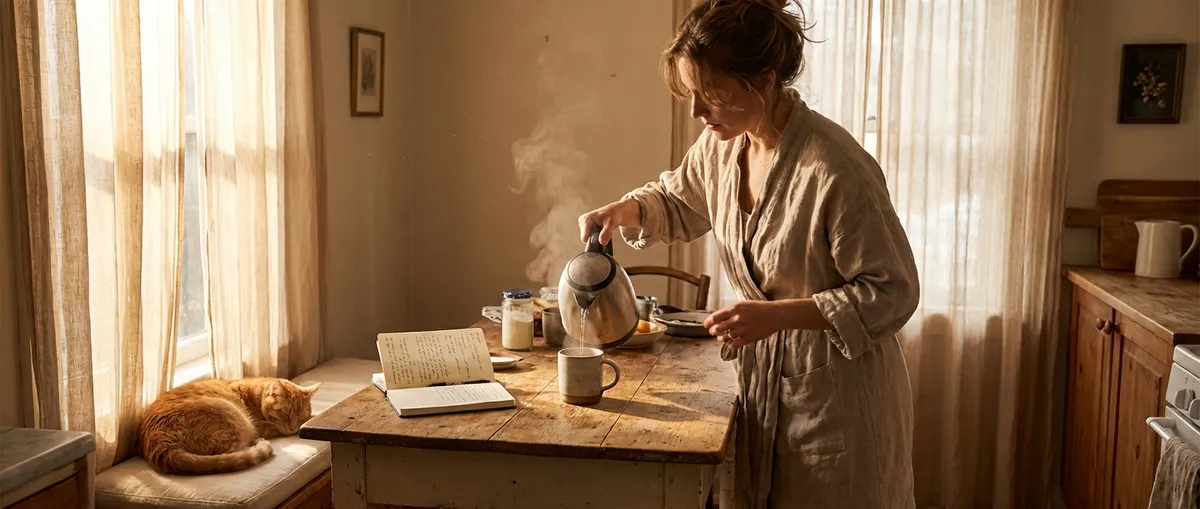
In this article, we’ll explore five calming practices that you can weave into your everyday routine. They are simple, gentle, and designed to fit into real, imperfect lives—moments you can return to when the day feels a little too loud.
1. The Pause Between Things
Most days are a chain of tasks linked tightly together—finish one thing, begin the next. Over time, this unbroken pace can leave the mind tense and restless. The simple act of adding a soft pause between activities can loosen that tension and create room to breathe.
A pause can be very small: three slow breaths before opening your email, a minute of stillness after a meeting, a quiet moment in the car before going inside when you arrive home. Let the pause be unproductive on purpose—no planning, no scrolling, no checking. Just notice your breath, the weight of your body, the feeling of your feet on the floor or your hands resting in your lap.
These tiny in‑between moments tell your nervous system, “You are safe. You may soften.” Over time, they can become gentle anchors throughout the day, reminding you that you don’t have to carry everything at once. Between one task and the next, let there be a space that belongs only to you.
2. Softening the Body to Quiet the Mind
The mind often follows the body. When muscles are clenched and shoulders are tight, your thoughts tend to mirror that tension. A simple way to invite peaceful living is to soften the body intentionally, even for a few minutes at a time.
You might try a brief “head‑to‑toe softening” practice. Sit or lie somewhere comfortable. Starting at the forehead, quietly say to yourself: “Soft here.” Let your forehead smooth, your jaw unclench, your tongue soften in your mouth. Move slowly downward: neck, shoulders, chest, belly, hips, legs, feet. If some areas stay tight, that’s all right. Notice them kindly, without forcing change.
This gentle scan can be done in bed when you wake up, during a break at work, or before sleep. The goal is not perfect relaxation but a kinder relationship with your own body. As the body loosens, even slightly, the mind often feels less crowded and more spacious, as if a window has been opened in a stuffy room.
3. Creating One Quiet Island in Your Day
You don’t need a full retreat to experience calm; sometimes, one dedicated “quiet island” in your day can shift everything. This is a small, intentional pocket of time where you choose to do only one simple, soothing thing—slowly, gently, and without distraction.
Your quiet island might be a calm morning cup of tea without your phone, a brief evening stretch in low light, or a short walk where you leave your headphones behind and notice the sky, the trees, or the sounds around you. Let this time be technology‑light or completely screen‑free if you can, so your senses can rest.
You don’t have to make this moment perfect. If your mind wanders to worries, just notice and return to the softness of what you’re doing—the warmth of the mug, the feeling of the air on your skin, the rhythm of your footsteps. Over time, this daily island of quiet can become something you look forward to, a reliable harbor in the changing weather of your life.
4. Speaking Gently to Yourself
The way you speak to yourself shapes how safe and calm you feel inside. Harsh inner commentary—“I should be doing more,” “I’m failing,” “What’s wrong with me?”—can keep the nervous system in a constant state of alert. Peaceful living grows more easily in an inner environment of kindness.
Begin by noticing your inner tone, especially when you’ve made a mistake, missed a deadline, or are feeling behind. Ask gently: “What am I saying to myself right now?” Without judgment, just listen. Then, see if you can soften your words the way you would if you were speaking to a dear friend.
You might try phrases like, “This is hard, and I’m doing the best I can,” or “It’s understandable to feel this way,” or simply, “May I be kind to myself right now.” You don’t have to fully believe the words at first. The intention itself begins to loosen the hold of self‑criticism. Over time, a softer inner voice can make daily stresses feel more workable and less overwhelming.
5. Letting One Thing Be Enough
Stress often grows from the feeling that whatever we do is never quite enough. There is always more to achieve, more to fix, more to improve. Peaceful living asks a different question: “What if, just for this moment, what I’ve done is enough?”
Try this gentle practice at the end of the day. Instead of reviewing what went wrong or what’s still unfinished, quietly name three small things you did or lived through today. They do not need to be impressive: “I answered a difficult message,” “I made myself something to eat,” “I showed up even though I felt tired.” Let each one be acknowledged, without adding “but I still didn’t…”
You can place a hand over your heart or belly as you do this, adding a small physical gesture of kindness. This practice does not erase responsibilities or goals; it simply balances them with appreciation. Allowing one moment, one effort, or one breath to be enough—if only for a little while—invites a deep exhale into the day.
Conclusion
Peaceful living is not a destination you arrive at once and for all. It is a series of simple, tender choices: a pause between tasks, a softening in the shoulders, a quiet island of stillness, a kinder inner voice, a moment of “enoughness” at the end of the day.
You do not need to transform your life overnight. You might begin with a single practice that feels gently possible and let it root itself into your routine. Over time, these soft choices can weave together into a life that feels less rushed and more spacious—one in which you can meet each moment with a little more ease, and a little more kindness toward your own heart.
Sources
- National Institutes of Health – Relaxation Techniques for Health – Overview of evidence‑based relaxation practices and their effects on stress and health
- American Psychological Association – Stress Management – Research‑based information on how stress affects the body and mind, plus coping strategies
- Harvard Health Publishing – Mindfulness Meditation May Ease Anxiety, Mental Stress – Discussion of mindfulness practices and their impact on stress and well‑being
- Mayo Clinic – Positive Thinking: Stop Negative Self‑Talk – Explores how shifting self‑talk can improve emotional resilience and reduce stress
- Cleveland Clinic – Progressive Muscle Relaxation – Guide to using body‑softening techniques to relieve stress and tension