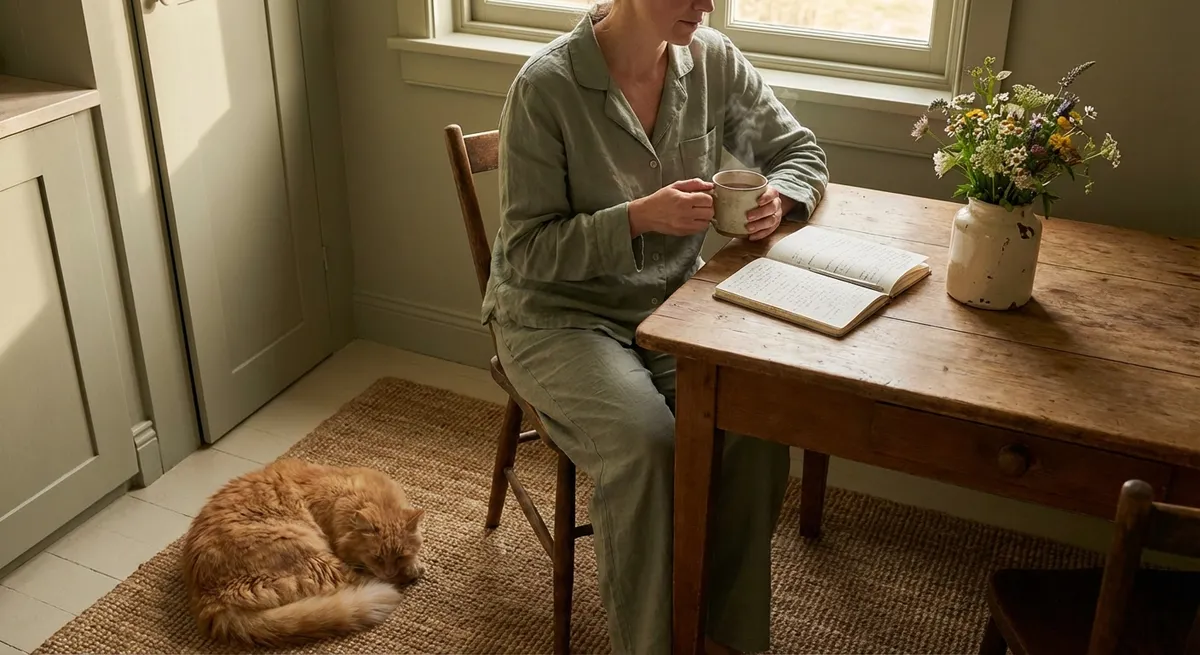
This gentle guide offers five calming practices to help you move through your day with more ease and less strain. Each one is simple, soft, and designed to be woven into the life you already have, rather than added as another task on your to‑do list.
Softening the Edges of Your Day
Peaceful living is not about having a perfect life or a perfectly quiet schedule. It is about softening the edges of your days—creating small pockets of ease where your body and mind can rest, even briefly.
Often, stress grows not only from what happens to us, but from how tightly we hold ourselves while it is happening. Our shoulders rise, our breath shortens, our thoughts race. Learning to recognize these moments with gentleness allows us to respond instead of react. By introducing simple calming practices, we remind our nervous system that it is safe to loosen its grip.
In peaceful living, kindness becomes the starting point—not another standard to measure yourself against, but a soft place to land. You are not trying to become a different person; you are learning to be with yourself in a more tender way.
Tip 1: A Gentle Check‑In with Your Breath
Your breath is a quiet companion, always with you, always ready to help you return to yourself. You don’t need complex techniques to feel its calming effect; you only need a moment of attention.
Find a comfortable position—sitting, standing, or lying down. Gently place one hand on your chest and one on your belly. Without changing anything at first, simply notice your natural breath for a few cycles. Let your breath move at its own pace, as if you are listening to a soft, familiar song.
When you feel ready, slowly lengthen your exhale. You might inhale for a count of four and exhale for a count of six or seven. Do this for five to ten breaths. Longer exhales send a quiet signal of safety to the nervous system, helping the body unwind.
If counting feels stressful, let go of numbers and imagine you are gently fogging a window with each exhale—soft, steady, unforced. Even one minute of this kind of breathing can create a small but meaningful pause in your day.
Tip 2: Creating a Small Island of Calm in Your Space
Your environment can either amplify stress or help soften it. You don’t need a full room makeover to feel more at ease; a single corner, chair, or spot by a window can become an “island of calm” in your home.
Choose a place where you can sit or stand comfortably for a few minutes most days. Clear away any obvious clutter from that small area—just enough so your eyes can rest there without feeling pulled in many directions. You might add a soft blanket, a candle (if safe), a plant, or an object that feels comforting to you.
Let this space become a gentle invitation rather than a project. You don’t need to spend long periods there. Even two or three minutes of sitting quietly, sipping tea, or simply looking out the window can begin to associate this space with rest and safety.
Over time, your body may start to relax more quickly when you enter this little island of calm. It becomes a reminder that even on busy days, there is a place where you are allowed to slow down and breathe.
Tip 3: Practicing One-Thing-at-a-Time Attention
Multitasking can make our minds feel scattered, even when our bodies are relatively still. Peaceful living often begins with doing less at once, not necessarily doing less overall.
Choose one everyday activity to practice doing with full attention. It might be washing your hands, making tea, brushing your teeth, or walking from one room to another. During that moment, gently set aside the urge to scroll, plan, or mentally rehearse conversations. Let the activity be enough.
Notice the small details: the warmth of the water, the scent of soap, the way your feet feel on the floor, the sound of the kettle. If your mind wanders—and it likely will—kindly bring it back without scolding yourself. Each return is a tiny act of peace.
This kind of one-thing-at-a-time attention doesn’t need to be constant. Even a few mindful moments throughout the day can slowly shift your inner pace, creating a softer rhythm in the midst of everyday life.
Tip 4: Speaking to Yourself in a Kinder Voice
The way we speak to ourselves can either calm us or quietly add to our stress. Many of us carry an inner voice that is sharp, demanding, or endlessly critical. Softening that voice is a powerful step toward peaceful living.
When you notice tension rising—perhaps after a mistake, a forgotten task, or a difficult interaction—pause for a moment. Gently place a hand over your heart or rest your palm on your chest or cheek. Ask yourself: “If a dear friend were feeling this way, what would I say to them?”
Then offer some of those words to yourself. It might be something like:
- “It’s understandable to feel overwhelmed right now.”
- “You are doing the best you can with what you have.”
- “It’s okay to be human. You are allowed to rest.”
You do not have to fully believe these words at first. Think of them as seeds you are planting. Over time, repeating them creates a softer inner atmosphere. The goal is not perfection, but a little more gentleness each day.
Tip 5: Ending the Day with a Small Moment of Closure
When a day ends without a sense of closure, our minds often keep spinning long into the night. Creating a simple, soothing way to close your day can help signal to your body that it is safe to let go.
Choose a brief practice that feels easy and kind. You might:
- Write down three small things you’re glad happened today, no matter how simple—finishing an email, enjoying a warm drink, hearing a kind word.
- List any lingering worries on a piece of paper with the quiet promise: “I’ll return to this tomorrow.”
- Sit by a window or outside for a minute or two, noticing the evening light, the sky, or the night sounds.
Keep this ritual soft and flexible. It should feel like a gentle exhale, not another task to complete. Over time, this small moment of closure can create a bridge between the activity of your day and the rest of your night, giving your mind permission to slowly unwind.
Conclusion
Peaceful living does not ask you to escape your life. It invites you to move through it with a little more softness, a little more breath, and a little more kindness toward yourself.
These five gentle practices—breath awareness, a small calm space, one-thing-at-a-time attention, a kinder inner voice, and an evening moment of closure—are simple, but they can steadily reshape the way your days feel from the inside.
You do not need to do them all at once. You might begin with just one that feels especially comforting and let it become part of your natural rhythm. In these quiet, consistent moments, stress loosens its hold, and a softer, steadier peace begins to emerge—one tender breath, one gentle choice at a time.
Sources
- [National Institutes of Health – Relaxation Techniques](https://www.nccih.nih.gov/health/relaxation-techniques-for-health) - Overview of evidence-based relaxation practices and their health effects
- [American Psychological Association – Stress Management](https://www.apa.org/topics/stress) - Explains how stress affects the body and offers research-backed coping strategies
- [Harvard Health Publishing – The Importance of Deep Breathing](https://www.health.harvard.edu/mind-and-mood/relaxation-techniques-breath-control-helps-quell-errant-stress-response) - Discusses how breath control can calm the stress response
- [Cleveland Clinic – Mindfulness: What It Is and How It Helps](https://health.clevelandclinic.org/what-is-mindfulness/) - Describes mindfulness practices and their benefits for emotional well-being
- [Mayo Clinic – Practicing Self-Compassion](https://www.mayoclinic.org/healthy-lifestyle/adult-health/in-depth/self-compassion/art-20448293) - Explores self-compassion and how kinder self-talk supports mental health