Meeting Your Nervous System with Kindness
Stress is not a personal failure; it is your nervous system doing its best to protect you. When your mind senses threat—emails, deadlines, worries about the future—it can react as if you are in real physical danger. Heart rate rises, muscles tense, and thoughts begin to race. Understanding this can soften some of the self-judgment that often arrives with stress.
Calming techniques work by offering your body and mind evidence that this moment is safe enough. Slow breathing, gentle movement, soothing touch, and kind words all send signals of safety back to your brain. Over time, these practices can help your nervous system become more flexible, so it is easier to shift from “on alert” back to “at ease.”
You do not need to perform these techniques perfectly. Even a few quiet seconds of care can begin to loosen stress. Let this be less about “doing it right” and more about offering yourself small moments of tenderness.
Tip 1: The Soft Shoulder Release
When we’re stressed, our shoulders often creep upward without us noticing, holding tension like a quiet storm. This simple practice can help them settle back down and invite the rest of your body to follow.
Sit or stand comfortably and let your arms hang heavy by your sides. Slowly inhale as you gently lift your shoulders toward your ears—not straining, just enough to notice the movement. Hold for a soft count of three, then exhale as you let your shoulders drop, as if you’re setting down a weight you’ve been carrying all day.
Repeat this three to five times, moving with care rather than force. Notice any warmth, tingling, or lightness that appears. You might pair this with a quiet phrase such as, “I can soften, even just a little.” This small ritual can become a signal to your body that it is allowed to loosen its grip on the day.
Tip 2: The Six-Count Exhale
Your breath is one of the gentlest ways to speak to your nervous system. Lengthening your exhale can nudge your body toward a calmer state, reminding it that the immediate moment is not an emergency.
Begin by noticing your natural breath without changing it. Then, lightly shape your breathing into a pattern: inhale through your nose for a count of four, and exhale slowly through your mouth or nose for a count of six. If those numbers feel uncomfortable, you can make them smaller—just keep the exhale a little longer than the inhale.
Try this for one to three minutes, letting each exhale feel like a soft release. If your thoughts wander, simply return to the gentle counting. Over time, this practice can become a quiet refuge you carry with you—on public transport, in a waiting room, or while lying awake at night.
Tip 3: One-Object Quiet Focus
When your mind is pulled in a dozen directions, it can help to rest your attention on just one simple thing. This is not about “emptying your mind,” but about giving it a calm, steady anchor.
Choose a single object nearby: a mug, a plant, a pen, a piece of fabric. Spend one or two minutes exploring it with curious, gentle attention. Notice its color, shape, texture, the way light touches it, any small details you usually overlook. Each time your thoughts drift back to worries, kindly bring them back to this one object.
This soft focus gives your mind a break from scanning for problems. Over time, it can train your attention to settle more easily. You might make a small ritual of choosing a “focus object” each day—a favorite stone, a leaf from outside, or a cherished bookmark—to remind you of your capacity to pause.
Tip 4: The Friendly Hand on Heart
Supportive touch can be deeply calming, even when it comes from your own hands. The body often responds to gentle, warm contact as a sign of safety and care, which can ease tension and soften harsh inner dialogue.
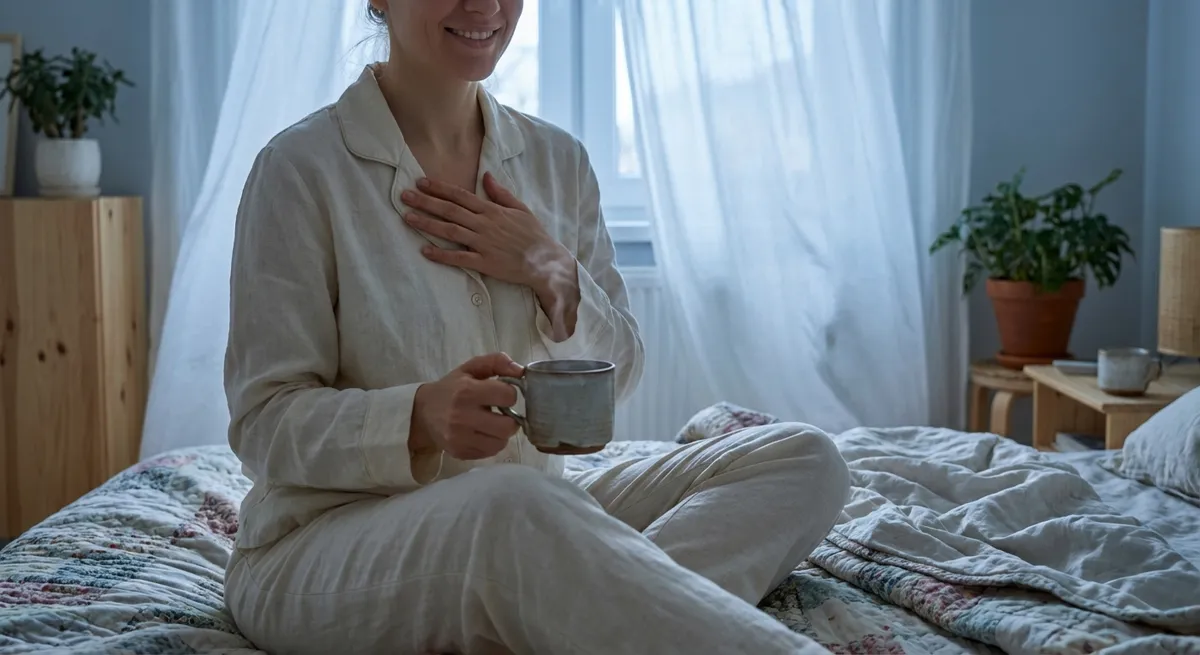
Find a comfortable position—sitting or lying down. Place one hand on your chest over your heart, and if it feels soothing, rest the other hand on your abdomen. Feel the warmth of your hands, the rise and fall of your breath, and the subtle movement beneath your palms.
You might quietly say to yourself: “I’m here with you,” “This is hard, and I’m doing my best,” or simply, “May I be gentle with myself right now.” Stay for a minute or two, letting your hands be an anchor. This simple gesture can become a way to comfort yourself during difficult conversations, before sleep, or whenever emotions feel big.
Tip 5: A Small Ritual to Close the Day
Stress often lingers because our days have no clear ending; work, messages, and thoughts continue late into the night. A tiny closing ritual can signal to your mind and body that it is safe to shift into rest.
Choose something simple and repeatable: dimming the lights and lighting a candle for a few minutes, stretching quietly by your bed, or writing down three small things you’re grateful for or relieved to have finished. The ritual does not need to be impressive—it only needs to feel kind and doable.
As you practice this regularly, your nervous system begins to recognize it as a cue: “The day is closing now. I can soften.” Over time, this can make it easier to sleep, let go of looping thoughts, and greet the next day with a little more space inside.
Allowing Calm to Be Imperfect
Calm is not a permanent state you are meant to achieve and hold. It is more like a gentle tide that comes and goes. Some days, these techniques may bring a deep sense of ease; other days, they may simply make things feel a little less tight. Both are enough.
You are not behind. You are not failing if stress still shows up. Each small, quiet act of care—one softer breath, one gentle shoulder release, one minute of focused attention—is a thread in the larger fabric of your well-being.
Let these practices be invitations, not obligations. Return to them when you can, set them down when you need to, and trust that calm will continue to visit, in its own tender time.
Sources
- [National Institute of Mental Health – 5 Things You Should Know About Stress](https://www.nimh.nih.gov/health/publications/stress) - Explains how stress affects the body and offers basic strategies for coping
- [American Psychological Association – Stress Effects on the Body](https://www.apa.org/topics/stress/body) - Describes the impact of stress on different body systems and why calming techniques help
- [Harvard Health Publishing – Relaxation Techniques: Breath Control Helps Quell Errant Stress Response](https://www.health.harvard.edu/mind-and-mood/relaxation-techniques-breath-control-helps-quell-errant-stress-response) - Details how controlled breathing supports the nervous system
- [Cleveland Clinic – Deep Breathing Exercises](https://my.clevelandclinic.org/health/articles/9445-deep-breathing) - Provides guidance on safe, simple breathing practices
- [Mayo Clinic – Stress Management](https://www.mayoclinic.org/healthy-lifestyle/stress-management/basics/stress-basics/hlv-20049495) - Offers an overview of stress, symptoms, and evidence-based coping strategies