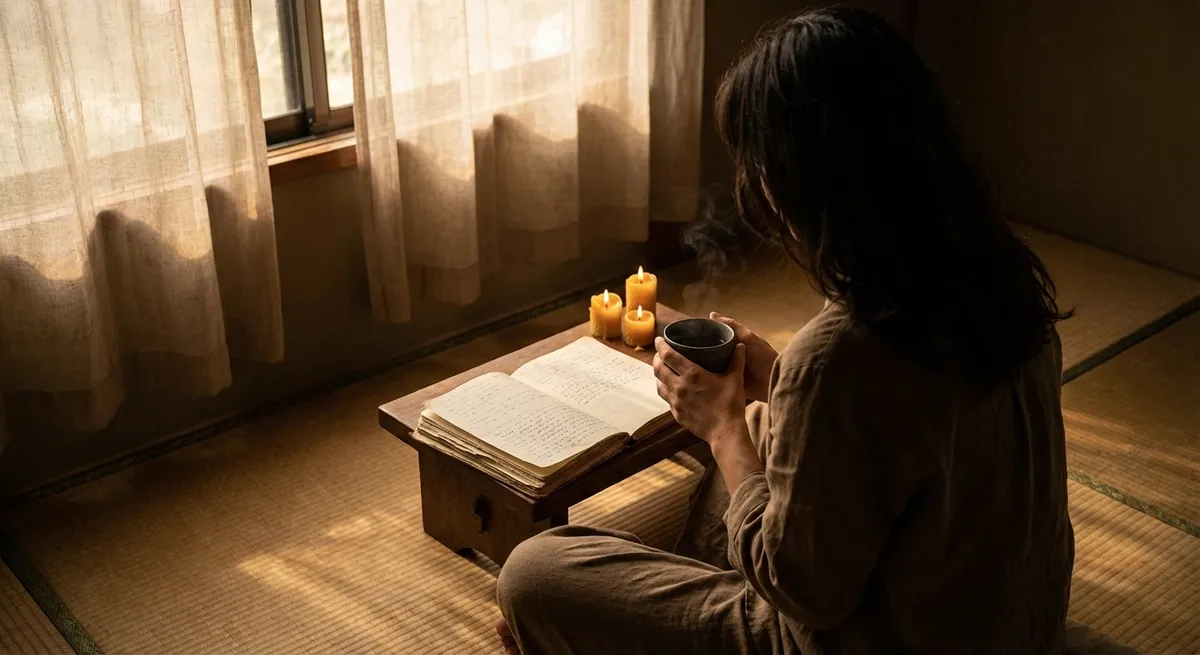
This gentle guide is an invitation to step out of urgency and into a quieter rhythm. Below you’ll find five calming, practical tips you can return to whenever life feels too loud. Take what resonates, leave what doesn’t, and move slowly. Your only job is to be kind to yourself as you read.
Meeting Your Stress With Kind Attention
Before trying to “fix” stress, it can help to simply notice it. Many of us move through tension on autopilot—clenched jaw, shallow breath, tight stomach—without realizing how much we’re holding. When you pause and turn toward your experience with kindness, you give your nervous system a chance to soften.
Begin by quietly acknowledging how you feel, without judgment. You might say to yourself, “I notice I’m feeling overwhelmed,” or “There is a lot on my mind right now.” Naming your experience can create a small but powerful space between you and the stress itself.
This practice of kind attention is not about forcing yourself to be calm. It’s about allowing whatever is present to be there, while also offering yourself a gentle anchor: a hand on your heart, a slower breath, a reassuring phrase. From this softer place, the following five tips can become easier to explore, like stepping stones toward a more peaceful day.
Tip 1: Create a One-Minute Breathing Haven
Long meditations can feel intimidating when your mind is busy, but one minute of intentional breathing can still shift your inner landscape. Think of this as a tiny “haven” you can visit anytime, anywhere.
Try this simple pattern:
- Breathe in slowly through your nose for a count of four.
- Hold your breath gently for a count of four.
- Exhale softly through your mouth for a count of six.
- Rest for a moment before the next breath.
Repeat this for one minute. If counting feels stressful, let it go. Just focus on lengthening your exhale a little more than your inhale—this helps signal to your body that it is safe to soften.
You can lean your back against a chair, place a hand on your belly, or close your eyes if that feels comfortable. Over time, this one-minute breathing haven becomes like a quiet room you carry inside you—a place to pause before reacting, to reset before moving on.
Tip 2: Soften Your Body in Small, Gentle Movements
Stress often lives in the body long after a busy moment has passed. Shoulders hover near the ears, the jaw stays firm, hands grip the phone a little too tightly. Softening these hidden tensions can gently tell your nervous system, “You can rest now.”
You don’t need a full workout or yoga session to feel relief. Throughout your day, you might try:
- Slowly rolling your shoulders backward and forward a few times.
- Opening your mouth wide in a gentle yawn to release jaw tension.
- Placing your hands over your heart or belly and noticing the rise and fall.
- Stretching your arms above your head as if you’re waking up from sleep.
Move in a way that feels kind, not forced. The goal is not to “exercise,” but to reconnect with your body in a compassionate way. Even 30 seconds of soft movement can be like a small window opening in a stuffy room, letting in a bit of fresh air.
Tip 3: Practice “Single-Task Moments” Instead of Multitasking
Multitasking can feel efficient, but it often leaves the mind scattered and tense. Instead of trying to do many things at once, you can experiment with short “single-task moments” throughout the day. These are brief windows when you gently choose to be with just one thing.
For example:
- When you drink water, simply drink water. Notice the temperature, the sensation of swallowing, the feeling of being refreshed.
- When you wash your hands, feel the warmth of the water and the movement of your fingers, instead of scrolling or rushing.
- When you walk from one room to another, focus on the sound of your footsteps and the rhythm of your breathing.
These small moments of single-tasking can give your mind a quiet place to land. You don’t have to do this all day—just here and there, as a way to invite a slower, more focused rhythm. Over time, this can lessen the feeling of mental clutter and gently ease stress.
Tip 4: Create a Soothing Evening Wind-Down Ritual
The way we end our day can shape how we sleep and how we feel tomorrow. A simple, predictable evening ritual signals to your body and mind that it’s time to release the day’s weight. This doesn’t need to be elaborate or perfect—only consistent and kind.
You might choose two or three of these:
- Dim the lights at least 30–60 minutes before bed.
- Turn off notifications or place your phone in another room, if possible.
- Sip a warm, non-caffeinated drink and breathe slowly between sips.
- Write down any lingering worries or to-do items, reassuring yourself, “They’ll wait for tomorrow.”
- Read a few pages of a gentle book or listen to calming music or nature sounds.
Think of this ritual as tucking your nervous system into bed. By repeating it most nights, you offer yourself a daily moment of care, turning sleep from a rushed necessity into a quiet act of self-kindness.
Tip 5: Speak to Yourself as You Would to a Dear Friend
Stress often grows louder when we add self-criticism on top of an already difficult day. The mind may whisper things like, “You should handle this better,” or “Everyone else seems fine—what’s wrong with you?” These thoughts can deepen tension and make it harder to find calm.
A gentle alternative is to practice speaking to yourself the way you would to someone you love. When you notice inner criticism, pause and ask:
- “If a friend felt this way, what would I say to them?”
- “What’s the kindest sentence I can offer myself right now?”
You might try phrases like:
- “This is a lot, and I’m doing the best I can.”
- “It’s okay to feel overwhelmed; I’m still worthy of rest.”
- “I am allowed to slow down.”
This kind inner voice will not solve everything, but it can soften the edges of a hard moment. Over time, self-compassion becomes a steady companion: a quiet, supportive presence that walks with you through stress instead of criticizing you for feeling it.
Conclusion
Stress may visit often, but it does not have to define your day. With tiny, compassionate choices—a slower breath, a softened shoulder, a kinder inner voice—you begin to weave small threads of peace through even the busiest moments.
You do not need to practice all five tips perfectly. Let them be gentle invitations rather than strict rules. Choose one that feels accessible today, and let that be enough. You deserve a life that includes pauses, softness, and room to simply be.
When the world feels fast, you are allowed to move slowly.
Sources
- [American Psychological Association – Stress Effects on the Body](https://www.apa.org/topics/stress/body) – Overview of how stress affects physical and emotional health
- [National Institute of Mental Health – 5 Things You Should Know About Stress](https://www.nimh.nih.gov/health/publications/stress) – Evidence-based information on stress and coping strategies
- [Harvard Health Publishing – Relaxation Techniques: Breath Control Helps Quell Errant Stress Response](https://www.health.harvard.edu/mind-and-mood/relaxation-techniques-breath-control-helps-quell-errant-stress-response) – Explores how breathing practices support the nervous system
- [Mayo Clinic – Stress Management](https://www.mayoclinic.org/healthy-lifestyle/stress-management/basics/stress-basics/hlv-20049495) – Practical guidance on daily habits for managing stress
- [Greater Good Science Center, UC Berkeley – What Is Self-Compassion?](https://greatergood.berkeley.edu/topic/self_compassion/definition) – Research-based explanation of self-compassion and its benefits for emotional well-being