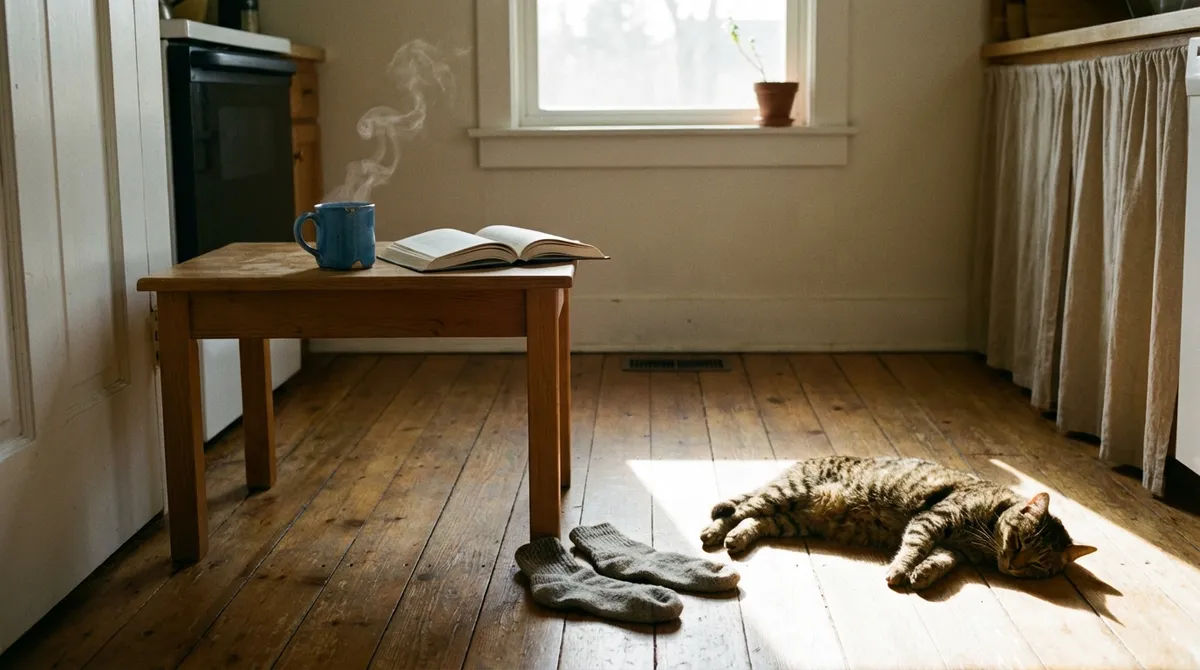
Rather than long routines or strict practices, you will find small, compassionate shifts you can weave into your everyday life—where you are, as you are.
Let Your Senses Slow Down
When stress builds, the senses often become overwhelmed: bright screens, loud notifications, and constant movement can leave your nervous system on high alert. A soft way to begin relaxing is to intentionally slow your senses, just for a few minutes. You might dim the lights, lower the volume, and give your eyes and ears a little rest.
Try choosing one sense at a time. For sight, you could look at something steady and gentle—a plant, the sky, a candle flame—and let your gaze soften without trying to “do” anything. For hearing, you might listen to a calming soundscape, like rain or ocean waves, or simply notice the quietest sound in the room. As your senses settle, your breath often follows, becoming slower and smoother without force.
Even two or three minutes of soft sensory focus can signal to your body that it is safe to release a bit of tension. This is not about blocking the world out; it is about offering your nervous system a small pocket of relief so it can find its own natural rhythm again.
Create a Gentle Transition Between Tasks
Many people move from one task to the next without a pause—finishing a work call and immediately checking messages, rushing from one obligation straight into another. Over time, this can make the day feel like a single, unbroken line of effort. Relaxation becomes easier when you introduce tiny transitions between activities, like stepping stones of calm.
After completing a task, try taking one full minute before starting the next. During that minute, you might stretch your shoulders, roll your wrists, or simply place your hands over your heart or belly. Notice any sense of completion: “This is done. I can gently let it go.” Then invite in the next thing without urgency: “Now I will move into what comes next.”
These short transition moments act like small exhale points in your day. They do not require a long break or a change of location—just a brief willingness to honor that you are a human being, not a machine. Over time, these pauses can reduce the sense of mental clutter and help your mind feel less flooded.
Offer Your Body Small Acts of Kindness
The body often carries what the mind cannot process: tight jaws, hunched shoulders, clenched hands, shallow breathing. Relaxation begins when you treat your body not as an obstacle to push through the day, but as a companion that deserves care. Even subtle acts of kindness can make a difference.
You might try a gentle body check-in: starting at the top of your head and moving slowly downward, notice where you feel tightness. You do not have to change anything; simply acknowledging the tension can soften it. If it feels comfortable, place a warm hand on a tense area—your neck, chest, or stomach—and imagine your hand sending quiet reassurance.
Small physical comforts also help: drinking a glass of water slowly, feeling your feet firmly on the ground, or wrapping yourself in a soft blanket for a few minutes. These small gestures signal safety to your nervous system. When the body feels a little more held, the mind often follows, loosening its grip on worry and urgency.
Let Your Thoughts Pass Like Moving Clouds
Stressful thoughts can arrive in waves: “What if this goes wrong?” “Did I say the right thing?” “There’s so much to do.” Trying to force thoughts to stop can sometimes make them louder. Instead, gentle relaxation comes when you allow thoughts to move through, without treating each one as an emergency.
When you notice your mind racing, you might silently say, “Thinking,” the way you would gently name a passing cloud. You do not need to argue with the thought or fix it. Just notice: “A worried thought is here.” Imagine placing that thought on a leaf and letting it float down a quiet stream. Another thought may appear; you place it on another leaf, and let it go again.
This does not mean ignoring real problems or responsibilities. It simply means giving your mind a moment to step out of the whirlwind. By relating to your thoughts with a bit more tenderness and distance, you create inner space. In that space, it becomes a little easier to choose your next step with clarity rather than tension.
End the Day With a Soft Closing Ritual
How you end your day can shape how your body and mind prepare for rest. Instead of collapsing into sleep after scrolling or rushing through tasks, consider creating a small closing ritual—something simple that signals, “The day is gently coming to an end.”
Your ritual might be turning off bright overhead lights and using softer lighting an hour before bed. You could write down three small things from the day that you are grateful for or simply glad to have made it through. Some people like to place their hand over their heart and offer a quiet sentence such as, “I did enough for today. I am allowed to rest.”
You do not have to do this perfectly or every night. The intention is what matters: giving yourself a moment of kindness before sleep, so your nervous system can slip more easily from alertness into restoration. Over time, this soft closing practice can become a comforting anchor, reminding you that rest is not something you earn—it is something you are always allowed to receive.
Conclusion
Relaxation is not about escaping your life; it is about meeting your life with a softer, more spacious heart. By slowing your senses, honoring transitions, tending to your body, loosening your grip on thoughts, and closing the day with kindness, you offer yourself small islands of quiet in the middle of everything else.
These gentle shifts do not have to be perfect or consistent to be meaningful. Even one soft moment of ease in a busy day can remind you that calm is still possible—that within you, there is always a soft place to land.
Sources
- National Institute of Mental Health – Stress Basics - Explains what stress is, how it affects the body, and evidence-based ways to manage it
- American Psychological Association – Stress Management - Provides research-backed strategies for coping with stress and improving well-being
- Mayo Clinic – Relaxation Techniques: Try These Steps to Reduce Stress - Outlines various relaxation methods and how they support physical and emotional health
- Harvard Health Publishing – Mindfulness Meditation May Ease Anxiety, Mental Stress - Reviews research on mindfulness and its impact on stress and anxiety
- Cleveland Clinic – Sleep and Relaxation - Discusses how relaxation practices can improve sleep quality and overall health