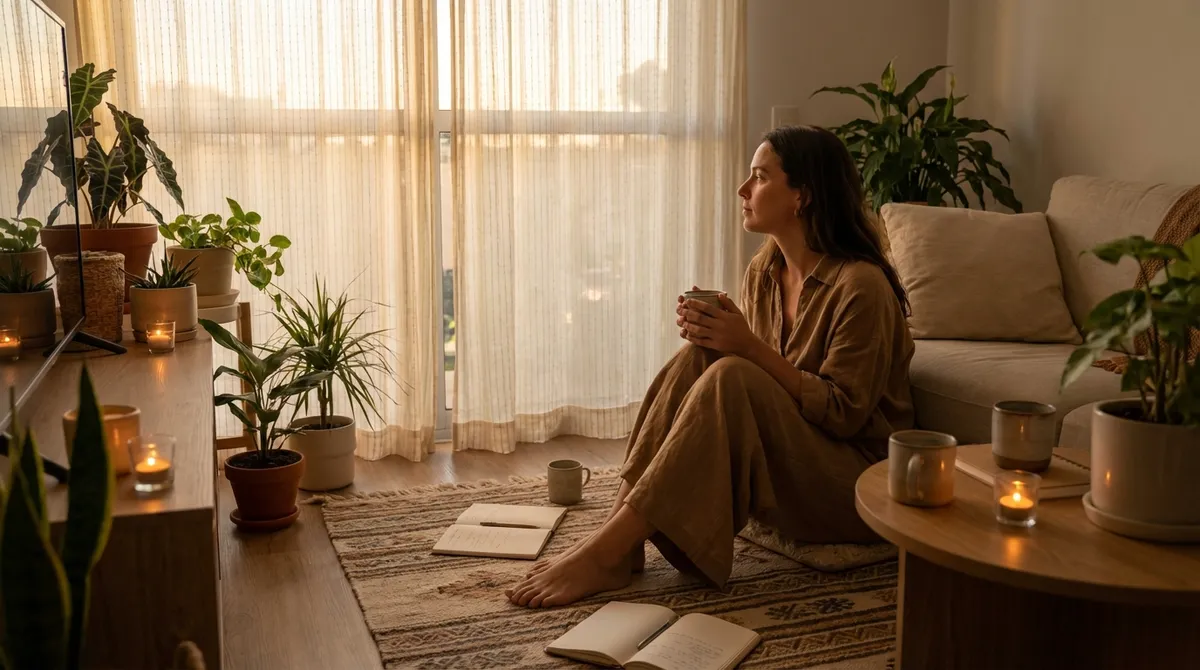
These five calming techniques are meant to tuck easily into ordinary moments. You can try one at your desk, another before bed, and another in the middle of a busy afternoon. Take what feels kind, leave what doesn’t, and come back to them in your own time.
1. The “Four‑Corner” Breath: Finding Calm Through What You See
When your mind feels scattered, it can help to rest your attention on something simple and steady. The “four‑corner” breath is a soft way to anchor yourself using the space around you. It gently guides your nervous system toward safety by pairing slow breathing with quiet noticing.
Wherever you are, let your gaze find a rectangle: a window, a picture frame, your phone, a notebook. As you inhale slowly, trace one side of the rectangle with your eyes. As you exhale, trace the next side. Continue like this, inhaling for one edge and exhaling for the next, moving around all four corners. There’s no perfect speed—only a pace that feels kind to your body.
If it helps, you can silently count to four on the inhale and four on the exhale, but don’t force it. If four feels too long, try three; if it feels too short, gently lengthen it. By weaving your breath with gentle visual focus, you give your mind a simple pattern to follow, and your body often responds by softening into a quieter rhythm.
2. Micro‑Rest Moments: Tiny Pauses That Actually Fit Your Day
Calm does not have to arrive in long stretches of time. It can live in the thin, quiet spaces between tasks: before you open a door, after you send a message, while water is boiling, or in the moment before you speak. These “micro‑rests” are not grand rituals; they are three to thirty seconds of not pushing.
To try a micro‑rest, pause for just one breath before you move into the next thing. Feel your feet on the floor, your hands on the keyboard, or the fabric against your skin. Let your shoulders drop a little. You don’t have to “clear your mind”—you’re simply allowing one pocket of stillness before motion.
Over time, these tiny pauses can gently retrain your body away from constant urgency. Instead of waiting for the perfect time to relax, you begin to weave small threads of ease throughout your day. You may notice that you feel slightly less rushed, even when nothing on your schedule has changed. Calm becomes something you practice in small sips, not something you wait to earn.
3. Softening the Jaw: A Quiet Signal of Safety to Your Body
Tension often gathers in places we barely notice: jaw, tongue, neck, forehead. When stress builds, your jaw may clench as if bracing for impact. Softening that one area can send a subtle message to your nervous system that you are allowed to be a little more at ease.
Begin by bringing gentle awareness to your jaw. Without judgment, simply notice: Are your teeth pressed together? Is your tongue pressed hard against the roof of your mouth? If so, let your tongue rest softly on the floor of your mouth. Allow a slight, almost invisible space between your upper and lower teeth, even if your lips remain closed.
Next, imagine your jaw growing just a bit heavier, as though warm water is flowing over it. If you like, place your fingertips lightly along the sides of your face and circle slowly, not to fix anything, but to bring warmth and attention. Breathe in through your nose and out through your mouth with a soft sigh, as if you’re fogging a mirror. This tiny release can loosen not only your jaw, but also some of the urgency held in your chest and shoulders.
4. Gentle Grounding With the “5 Senses Check-In”
When stress pulls you into worries about the future or replayed moments from the past, your senses can guide you back to the place your body is actually in: here, now. The “5 senses check‑in” is a tender way to remind yourself that, in this moment, you are simply a person sitting or standing in a room, breathing.
You can do this quietly anywhere. Start with sight: slowly name to yourself one or two things you can see—colors, shapes, or light. Then move to touch: notice what your body is resting on, the temperature of the air, the feeling of clothing on your skin. Listen for sounds near and far: a hum, a voice, a bird, even silence between noises.
If it feels okay, notice any faint smells around you: soap, coffee, paper, fresh air. Finally, touch into taste: perhaps the aftertaste of something you’ve eaten or simply the neutral taste in your mouth. You don’t need to search hard or perform this perfectly; the aim is only to remind your nervous system that you are anchored in a real, physical place, not in your thoughts alone. Even a brief senses check‑in can ease the feeling of being swept away by stress.
5. An Evening “Unwinding Sentence” to Gently Close the Day
At the end of the day, your mind can easily start listing what felt unfinished or imperfect. Instead of trying to silence it, you might offer it a single, kind sentence to rest on—an “unwinding sentence” that tells your system it is safe to soften for now.
Choose a phrase that feels simple and believable to you, such as: “For tonight, I have done enough.” or “For this moment, I let my body rest.” or “It’s okay to pause; I can return to this tomorrow.” You can repeat the same sentence each night or change it as needed, but keep it short and gentle.
As you lie down or sit quietly, place a hand on your chest or over your belly and breathe slowly while you say your sentence in your mind or out loud. Imagine the words settling into your muscles, your breath, your thoughts. This practice does not erase stress or solve every problem, but it can loosen the tight knot of self‑pressure and create a softer edge to your evening, inviting sleep or rest with more kindness.
Conclusion
Calm does not have to arrive in dramatic, life‑changing moments. It often appears in ordinary gestures: tracing the edges of a window with your breath, pausing before you open a door, loosening your jaw, noticing the color of the sky, or whispering one kind sentence to yourself at night.
As you explore these five calming techniques, you might discover that stress still visits—it likely will. The change is that you’re no longer meeting it empty‑handed. You are carrying small, gentle tools that help you come home to yourself again and again, in the middle of real life.
You are allowed to go slowly. You are allowed to rest in moments, not just in hours. And you are allowed to treat your own nervous system with the same tenderness you would offer to someone you love.
Sources
- National Institute of Mental Health – 5 Things You Should Know About Stress – Overview of what stress is, how it affects the body, and basic coping strategies
- American Psychological Association – Stress Management – Evidence‑based information on how stress impacts mental and physical health, plus coping approaches
- Harvard Health Publishing – Relaxation Techniques: Breath Control Helps Quell Errant Stress Response – Explains how slow, controlled breathing can calm the nervous system
- Cleveland Clinic – Progressive Muscle Relaxation (PMR) – Practical guide to relaxation methods, including muscle and jaw relaxation
- Mayo Clinic – Mindfulness Exercises – Outlines simple mindfulness and grounding practices using breath and the five senses