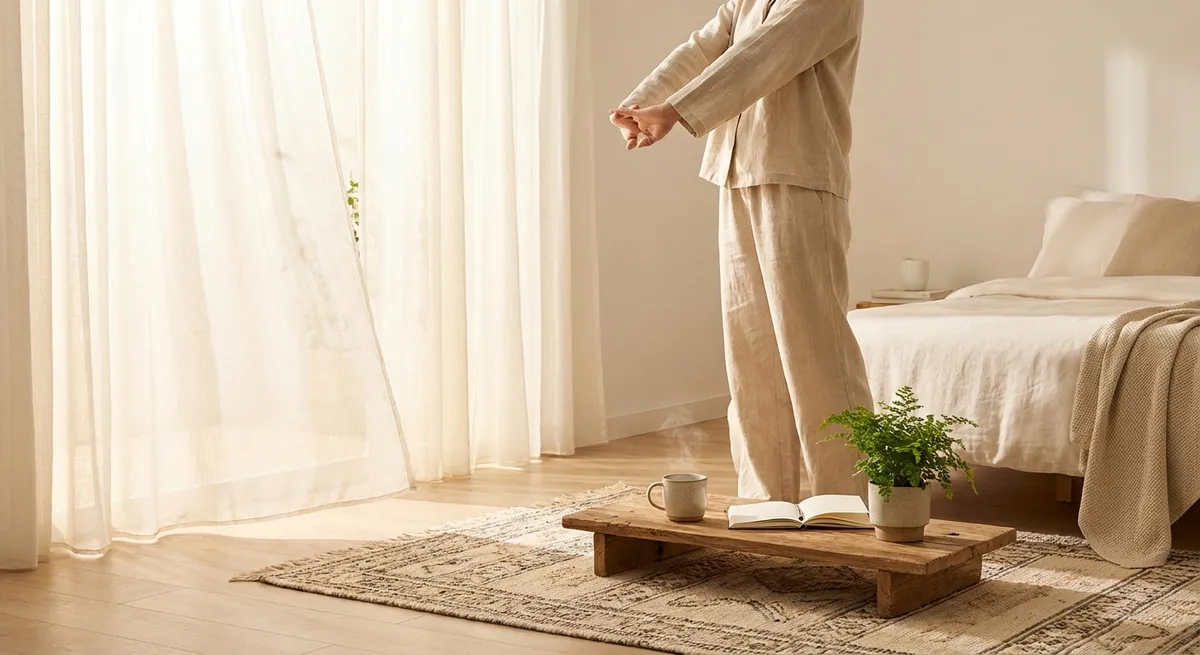
In this article, you’ll find five calming tips that you can weave gently into your everyday routine. Each one is simple, kind, and designed to help you feel just a little more at ease.
1. Begin With a Gentle Arrival, Not an Abrupt Start
How you enter your day can shape its entire tone. Instead of waking and immediately reaching for your phone, experiment with giving yourself a few quiet moments of “gentle arrival.” Let your mind and body remember that you are a person before you are a list of tasks.
You might start by noticing three simple things: the feeling of the sheets against your skin, the sound of the room around you, the sensation of your breath moving in and out. This small pause can signal to your nervous system that it is safe to move slowly rather than launching into urgency.
If you like, place a glass of water by your bed at night and drink it first thing in the morning, taking a few slow breaths between sips. This tiny ritual nourishes your body while reminding you that your needs are worth tending to. Over time, this tender start can soften the edges of your mornings and reduce the sense of rushing that often leads to stress.
2. Invite Your Breath to Be Your Quiet Companion
Your breath is always with you, a steady companion that can help guide you back to calm. When stress rises, your breathing often becomes shallow and quick, feeding a sense of tension. By gently slowing and deepening your breath, you send a message of safety to your body.
You don’t need a complex technique. Try this simple pattern whenever you feel tight or overwhelmed: breathe in slowly through your nose for a count of four, hold for a count of two, then exhale softly through your mouth for a count of six. Repeat this a few times, focusing more on the lengthening of the exhale than on perfection.
If counting feels stressful, simply pay attention to the coolness of the air as you breathe in and the warmth as you breathe out. You can do this at your desk, in the car (while safely parked), or while waiting in line. Over days and weeks, these brief moments of intentional breathing can become natural resting points that ease your nervous system and invite a quieter inner space.
3. Create Small Islands of Stillness in Busy Hours
Many people wait for a long vacation or a free weekend to finally relax, but your body and mind heal in much smaller, more frequent doses of rest. Think of your day as a river, and look for tiny, reachable islands of stillness where you can pause.
An island of stillness might be a minute of closed eyes before you join a video call, three slow stretches before you stand up from your computer, or a quiet moment to sip tea without multitasking. These small practices don’t have to be perfect or lengthy to be meaningful. Their power lies in repetition and gentleness.
You could set a soft reminder on your phone every few hours with a kind message to yourself, like “Pause and breathe” or “Relax your shoulders.” Each reminder is a quiet invitation to step out of autopilot, notice how you feel, and offer yourself a calming touch, a breath, or a stretch. Over time, these tiny pauses help loosen the knot of constant tension and make your day feel more spacious.
4. Let Your Senses Be a Pathway to Calm
Your senses are doorways into the present moment, and the present moment is often far kinder than the stories your stressed mind is spinning. When worry starts to build, gently guide your attention into what you can see, hear, smell, taste, or touch right now.
You might look around and notice three colors in your environment, or the way the light falls on a nearby object. You could listen for a soft sound in the distance—birds, the hum of a fan, a quiet voice in another room. If you have a calming scent you enjoy, such as a favorite tea, fresh air, or a drop of essential oil, let yourself fully experience it for a few breaths.
By intentionally tuning into your senses, you give your mind a break from cycling through worries and what-ifs. This is not about ignoring your problems, but about reminding your nervous system that this exact moment contains points of safety and steadiness. Even in a busy or difficult day, a single sensory anchor can create a pocket of grounding and relief.
5. Close the Day With a Kind Unwinding
Evenings can easily become a blur of screens, unfinished tasks, and quiet restlessness. Offering yourself a gentle winding-down ritual can help signal to your body that it’s time to release the day and lean into rest.
This doesn’t need to be elaborate. You might dim the lights a little earlier, put your phone on “do not disturb,” and choose one simple calming activity: reading a few pages of a comforting book, stretching softly on the floor, or writing down three small moments from the day that you’re grateful for or simply want to remember.
If your mind feels busy at night, keep a small notebook by your bed. Before sleeping, spend a couple of minutes letting your thoughts spill onto the page: worries, to-dos, feelings. You don’t need to solve anything—just gently place the day outside of your mind and onto paper. This simple act can reduce mental clutter and help your body ease more naturally into deeper, more restorative sleep.
Conclusion
Relaxation is not a reward you have to earn; it is a basic human need. By softening the start of your day, breathing with intention, pausing in tiny moments, using your senses as anchors, and unwinding with care each evening, you gradually create a kinder rhythm for your life.
You don’t have to change everything at once. Choose one of these calming tips and let it settle gently into your routine, returning to it whenever you remember. Over time, these quiet choices add up to something powerful: a life that feels less rushed, less tense, and more like a place where you can rest inside yourself.
Sources
- National Institute of Mental Health – Stress and Your Health - Explains what stress does to the body and mind, and basic strategies to reduce it
- American Psychological Association – Mindfulness Meditation: A Research-Proven Way to Reduce Stress - Summarizes scientific findings on how mindfulness and breathing practices support relaxation
- Harvard Health Publishing – Relaxation Techniques: Breath Control Helps Quell Errant Stress Response - Describes how intentional breathing can calm the nervous system
- Cleveland Clinic – How to Create a Bedtime Routine for Better Sleep - Offers guidance on evening rituals that support deeper, more restful sleep