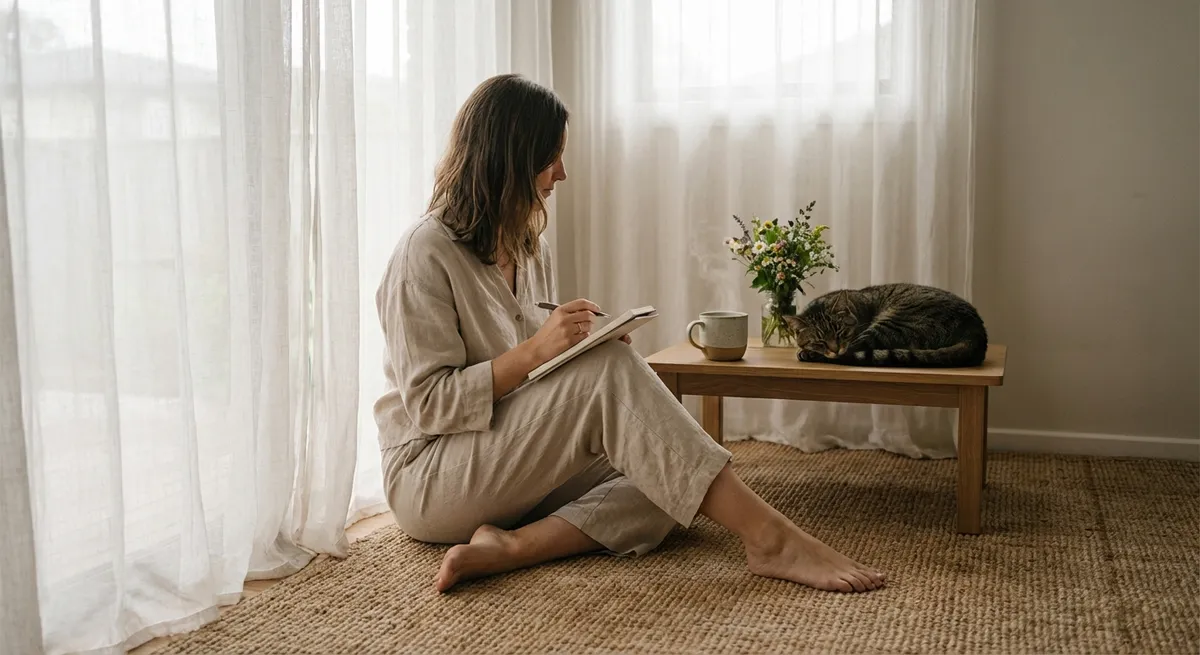
This article offers five calming practices to ease stress, each designed to be simple, slow, and kind. You can try them as they are, or adapt them to fit the shape of your own life. Let them be invitations, not obligations.
1. The Soft Landing: A Gentle Evening Wind-Down
Evenings can easily blur into more “doing”—scrolling, replying, planning one more thing. A soft landing is a simple way to tell your body and mind that the day is allowed to close.
Begin by choosing a small, repeatable ritual you can do most evenings. It might be dimming the lights and turning off overhead bulbs, lighting a single candle, or putting your phone in another room for the final thirty minutes before sleep. As you do this, move a little more slowly than usual, as if you’re walking through water instead of air.
You can add a soothing cue for your senses: gentle music, herbal tea, or a few pages of a calming book. The goal is not productivity, but permission—to let the day be done, even if not everything is finished. Over time, this repeated pattern becomes a signal to your nervous system: “You may soften now.”
Let your evening be a gentle bridge between effort and rest, rather than a frantic sprint toward sleep.
2. Pocket Breaths: A Calm Reset You Can Use Anywhere
Stress tends to pull our breath upward and make it shallow. Relaxation often begins with the simple choice to breathe differently, even for a short moment. You don’t need a quiet room or special posture; only your attention.
Try this soft breathing pattern when you feel tense: slowly inhale through your nose for a count of four, pause briefly, then exhale through your mouth for a count of six. The longer exhale sends a quiet signal of safety to your body. Repeat this pattern five to ten times, letting your shoulders drop and your jaw unclench with each out-breath.
If counting feels stressful, you can simply think the words “soft” on the inhale and “down” on the exhale, encouraging everything inside you to soften downward. These “pocket breaths” can be used between meetings, in the car (while parked), in the bathroom at work, or even while standing in line.
With practice, this becomes less of a technique and more of a reflex—whenever you notice tension, you return gently to your breath, and your breath returns gently to you.
3. A Calm Corner for Your Senses
Our environment quietly shapes how we feel. When everything around us is bright, loud, or cluttered, our minds rarely get a chance to rest. One gentle way to invite relaxation is to create a small “calm corner” for your senses, even if it’s just part of a room.
Choose a place where you can sit or lie down comfortably, even for a few minutes. Clear away visual clutter—extra papers, laundry, or items that demand action. Add one or two grounding elements: a soft blanket, a supportive pillow, a plant, or a simple object you find soothing, such as a stone or wooden item.
When you come to this space, allow yourself to do only restful things there: slow breathing, quiet stretching, reading something gentle, or simply sitting in silence. Over time, your body will begin to associate this space with ease; just entering it can bring your nervous system a small sense of relief.
You don’t need a whole room; one chair by a window or a corner of your bed can be enough. What matters most is the intention to make this space a soft place to land.
4. Kind Boundaries Around Your Time and Energy
Many layers of stress come from saying “yes” when we mean “not now,” or from holding ourselves to a standard that leaves no room to rest. Relaxation isn’t only about what we do to unwind—it’s also about what we gently refuse so we don’t reach the point of complete exhaustion.
Begin by noticing one area where you feel consistently drained: perhaps endless messages, late-night work, or social plans that leave you more tired than nourished. Instead of changing everything at once, experiment with one kind boundary. This might be not checking email after a certain hour, limiting social media to a small window of time, or leaving one night a week unscheduled and protected.
When you set a boundary, speak to yourself gently about it. Instead of “I should do less,” try “I’m giving myself the space I need to breathe.” This shift in language can soften the guilt that often arises when we choose rest.
Healthy boundaries are not walls; they are gentle fences with gates you can open or close with awareness. They make room for the rest and quiet that your body and mind have been asking for.
5. A Brief Body Check-In to Release Hidden Tension
Stress often settles in the body long before we notice it in the mind. A simple body check-in can help you find and release hidden tension, even in a few minutes.
Find a comfortable position—sitting with your feet on the floor or lying down if that’s available. Gently close your eyes or soften your gaze. Start at the top of your head and slowly move your attention downward: forehead, eyes, jaw, neck, shoulders, arms, chest, back, abdomen, hips, legs, and feet.
At each area, silently ask, “What do I feel here?” without judgment. If you find tightness, see if you can soften it by breathing into that place and letting the exhale carry some of the tension away. You don’t need to force relaxation; simply offering your awareness is often enough to ease some of the tightness.
Even a two-minute scan can create a small pocket of relief in your day. Over time, this practice makes it easier to catch tension earlier and respond more kindly to your body’s signals.
Conclusion
Relaxation is not a performance, and it doesn’t have to look the same for everyone. It’s less about doing everything perfectly and more about choosing, again and again, to treat yourself with gentleness. A softer evening, a few slow breaths, a calm corner, a kind boundary, or a brief body check-in—each is a quiet way of saying, “My well-being matters.”
You don’t have to use all five practices at once. You might start with the one that feels smallest and most approachable, and let it slowly weave itself into your days. With time, these simple, steady moments of care can help your life feel less like a race and more like a gentle unfolding.
Sources
- [American Psychological Association – Stress Relief and Relaxation Techniques](https://www.apa.org/topics/stress) – Overview of evidence-based strategies for managing stress and supporting mental well-being
- [Mayo Clinic – Relaxation Techniques: Try These Steps to Reduce Stress](https://www.mayoclinic.org/healthy-lifestyle/stress-management/in-depth/relaxation-technique/art-20045368) – Describes various relaxation practices, including deep breathing and body scans
- [National Institutes of Health (NIH) – Mind and Body Approaches for Stress](https://www.nccih.nih.gov/health/stress) – Summarizes research on mind-body approaches such as meditation and breathing for stress reduction
- [Cleveland Clinic – Why Deep Breathing Exercises Work](https://health.clevelandclinic.org/deep-breathing-exercises) – Explains how slow, controlled breathing can calm the nervous system
- [Harvard Health Publishing – The Importance of Sleep for Mental Health](https://www.health.harvard.edu/newsletter_article/sleep-and-mental-health) – Discusses how evening routines and sleep hygiene support relaxation and stress relief