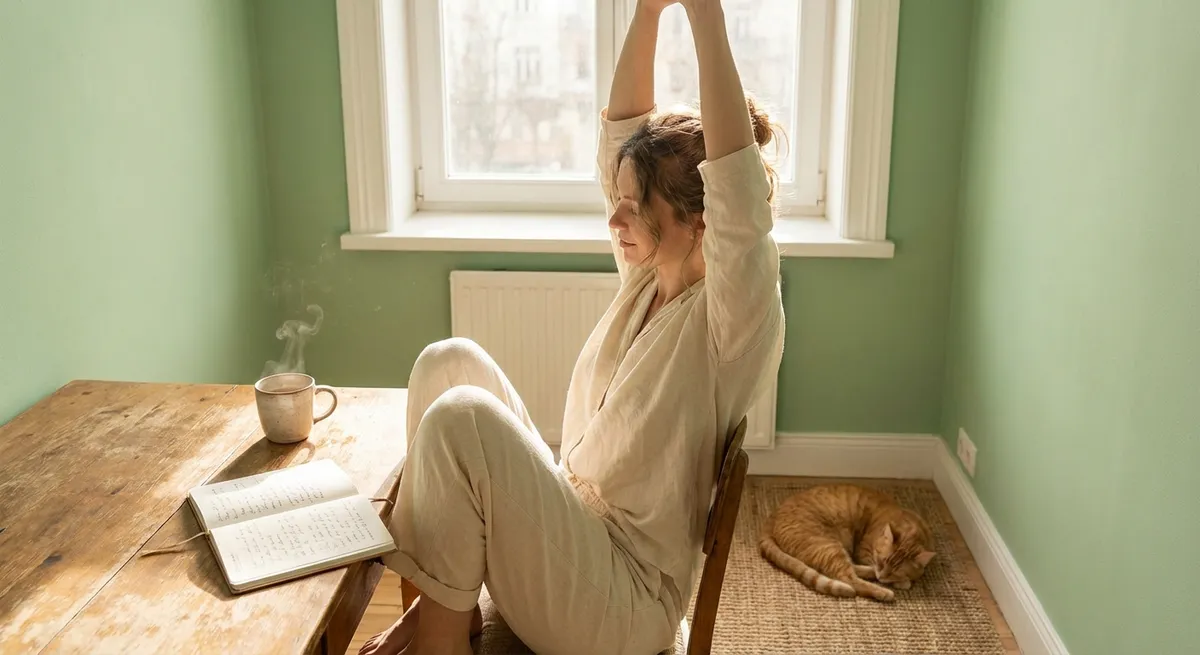
Below are five calming practices you can weave into your life, slowly and kindly. You do not need to do them all at once. Even one small shift, practiced with consistency, can begin to change how stress moves through you.
1. Creating a Soft Pause Between Moments
Our days often blur together: one task ends and another begins before we’ve fully exhaled. A “soft pause” is a small, intentional space between activities—a gentle landing place for your nervous system.
You might try a soft pause when you close your laptop, finish a call, or step into your home. For 30–60 seconds, stop doing and simply notice: your breath, the feeling of your feet, the air on your skin. Let your shoulders drop slightly and unclench your jaw. You can silently say to yourself, “This moment is allowed to be slow.” Over time, these tiny pauses teach your body that it doesn’t have to stay in “go” mode all day. Even a few soft pauses scattered through the day can help lower the overall level of tension you carry.
2. Gentle Grounding Through the Senses
When stress rises, the mind tends to sprint into worries, what‑ifs, and worst‑case scenarios. Grounding through the senses is a simple way to return to the present, where your body actually is.
Choose one sense at a time and rest your attention there. For sight, softly look around the room: notice three colors, the way light touches a surface, something small you’ve never really studied before. For sound, listen for the furthest sound away, then the closest. For touch, feel your hands against each other, or the fabric of your clothing. The goal isn’t to block thoughts, but to gently offer your mind another place to rest. This kind of sensory grounding reminds your nervous system that, in this moment, you are here and you are safe enough.
3. A Calming Rhythm: Slowing the Exhale
You breathe all day without thinking about it, but a small shift in how you breathe can slowly soothe your body’s stress response. One gentle approach is simply to lengthen your exhale.
Find a comfortable position—sitting or lying down, if possible. Inhale slowly through your nose for a count that feels easy (perhaps 3 or 4). Then exhale through your nose or mouth for a slightly longer count (maybe 5 or 6). The key is not to force a big breath, but to allow a smooth, steady rhythm that feels kind to your body. Even 2–3 minutes of slower exhalations can signal your nervous system to settle. You can use this practice before a stressful conversation, after reading a tense message, or at night when your thoughts feel busy.
4. Making a “Kind List” Instead of a To‑Do List
Stress often swells when your to‑do list feels impossible. A “kind list” is a softer way of meeting your responsibilities while also caring for your well‑being.
Start by writing your usual tasks. Then, beside or beneath them, add gentle supports for the human who has to do them—you. For example: “Answer emails” might be paired with “sip water while you type,” or “Close the laptop for one minute after every three emails.” “Make dinner” might include “put on music that calms you” or “ask for help with chopping.” The point is not to erase your responsibilities, but to weave care into the way you carry them. When your brain sees that your day includes small acts of kindness, stress often loosens, even if your schedule remains full.
5. An Evening Unwind Ritual That Takes Five Minutes
You don’t need an elaborate routine to gently close the day. A simple, consistent five‑minute ritual can help your mind understand that it’s time to soften.
Choose a small combination of calming actions you can realistically repeat most evenings. For example: dim one light, put your phone in another room or on “Do Not Disturb,” drink a few sips of water, and place one hand on your chest and one on your belly. You might ask yourself, “What did I carry today that I can set down for now?” You don’t have to solve anything—just acknowledge it. This kind of ritual is less about perfection and more about repetition. Over time, your body begins to associate these few minutes with safety, quiet, and rest.
Conclusion
Stress is not a sign that you are failing; it is a sign that you are human, living in a world that asks a lot of you. Relief doesn’t always arrive in grand, sweeping changes. Often, it comes from small shifts repeated with tenderness—a soft pause, a longer exhale, a kinder way to move through your tasks, a few quiet minutes at night.
You are allowed to move more slowly than the world around you. You are allowed to create small islands of ease in the middle of a busy day. As you experiment with these gentle practices, notice what your body responds to with even the slightest sense of “ah, that feels a bit better.” Let that be your guide. Healing, here, can be as simple and profound as choosing one soft moment at a time.
Sources
- American Psychological Association – Stress: The different kinds of stress – Overview of stress, its effects, and coping strategies from a leading professional organization
- Mayo Clinic – Stress management – Practical information on how stress affects the body and evidence‑based ways to reduce it
- Harvard Health Publishing – Relaxation techniques: Breath control helps quell errant stress response – Explains how slow breathing and relaxation practices calm the nervous system
- National Institute of Mental Health – 5 Things You Should Know About Stress – Government resource outlining key facts about stress and tips for managing it
- Cleveland Clinic – Grounding Techniques: Exercises for Anxiety, PTSD, and More – Describes sensory grounding methods and how they help ease anxiety and stress