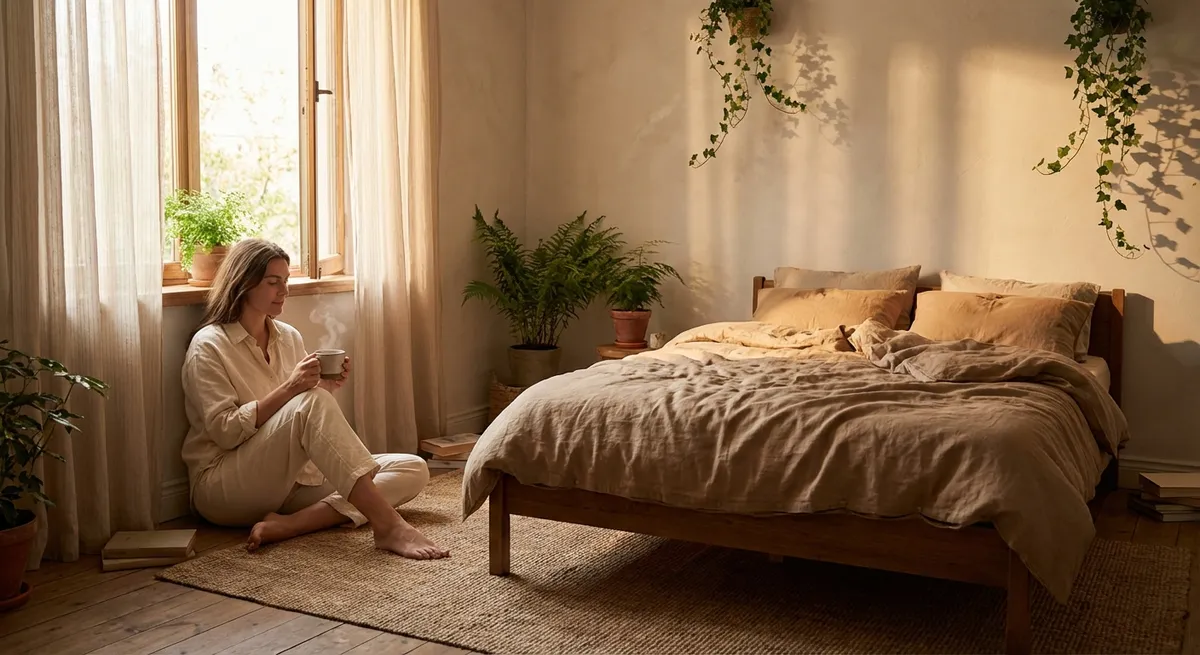
Below are five gentle, practical tips to support a more peaceful, stress‑light way of living. You can take them one at a time, in your own rhythm, and let them gradually weave calm into your daily life.
Tip 1: Create a Soft Landing at the Start of Your Day
How your day begins can color everything that follows. Instead of reaching for your phone right away or rushing into tasks, try giving yourself a soft landing—a small, intentional pause before the world’s noise enters.
You might sit on the edge of your bed and feel your feet resting on the floor, noticing the quiet of the room. Let three slow, natural breaths move in and out, not forcing anything, just noticing. You could add a simple phrase in your mind, such as “I’m allowed to go gently today.” This tiny ritual helps signal to your nervous system that it’s safe to move slowly, and research shows that brief morning mindfulness practices can support focus and emotional balance throughout the day.
If you prefer movement, a short stretch or a gentle walk to the kitchen for a glass of water can be your soft landing. The key is to keep this time unhurried, even if it’s only two or three minutes. Over time, this calm beginning can become a quiet anchor you look forward to each morning.
Tip 2: Practice One-Task Living in a Multi-Task World
Modern life often pulls us in many directions at once—messages, notifications, tasks, conversations. This constant shifting can leave the mind scattered and tense. One gentle antidote is to practice “one‑task living”: deciding, for a short window of time, to do just one thing, with full presence.
It can be as simple as: “For the next ten minutes, I will only make tea,” or “I’ll focus only on this email, slowly and kindly.” As you do this, notice small details: the warmth of the mug in your hands, the feeling of your fingers on the keyboard, the sound of water running. Returning to one task at a time can reduce cognitive overload and give your mind a chance to settle.
When distractions arise—and they will—you don’t need to scold yourself. Just gently guide your attention back, like taking a child’s hand and leading them home. This kind, repeated practice can help calm the nervous system and build a quieter kind of focus in daily life.
Tip 3: Offer Your Body Little Moments of Release
Stress is not only a mental experience; it lives in the body too. Shoulders creep upward, jaws tighten, breath becomes shallow. Learning to notice and soften these patterns is a tender way of caring for yourself.
A few times a day, you might pause and quietly scan your body from head to toe. Are your teeth pressed together? Let your jaw loosen slightly. Are your shoulders lifting toward your ears? Let them drop a little, as if they’re melting down your back. Is your breath caught in your chest? See if you can guide it down into your belly, allowing the abdomen to expand with each inhale and soften with each exhale.
Even thirty seconds of this gentle check‑in can interrupt the build‑up of physical tension. You can pair it with something you already do—like washing your hands, waiting for a webpage to load, or sitting at a red light. Over time, your body learns that it’s allowed to rest a bit more, even in the middle of a busy day.
Tip 4: Speak to Yourself as You Would to Someone You Love
The way we talk to ourselves can either feed stress or soften it. Many people live with a harsh inner narrator that criticizes, compares, and pushes relentlessly. Shifting this voice toward kindness is one of the most powerful steps toward peaceful living.
When you notice self‑criticism—“I’m failing,” “I should be better,” “Everyone else is handling life better than I am”—see if you can pause and ask: “If a dear friend said this about themselves, how would I respond?” Then offer those same words to yourself, quietly and sincerely. It might sound like, “You’re doing the best you can,” or “It makes sense that you’re tired,” or simply, “You are enough for today.”
This isn’t about pretending everything is perfect; it’s about relating to your struggles with warmth instead of judgment. Studies on self‑compassion suggest that people who treat themselves kindly are often more resilient, less anxious, and better able to cope with difficult emotions. Each gentle phrase becomes a small act of inner peace.
Tip 5: End Your Day with a Gentle “Unwinding Ritual”
Just as a soft beginning can shape your day, a gentle closing can signal to your whole system that it’s safe to rest. Many of us carry the entire day into bed—unfinished to‑dos, conversations, worries. A simple unwinding ritual can help you set these down for the night.
Choose a short practice that feels comforting and repeatable. You might write down three small moments from the day you’re grateful for or simply glad to have lived through, even if the day was hard. You might dim the lights and stretch slowly for a few minutes, letting your body know that effort is done for now. Or you could sit quietly and place a hand on your heart or belly, feeling the movement of each breath, and gently tell yourself, “It’s okay to rest.”
The ritual doesn’t need to be perfect or long. What matters most is the intention: to draw a soft boundary between “doing” and “being,” between the demands of the day and the tenderness of rest. Over time, this nightly practice can become a comforting path that leads you back to yourself.
Conclusion
Peaceful living is not about escaping life, but about meeting it with a softer, steadier heart. These five calming tips—a gentle start to the day, one‑task living, releasing physical tension, kinder self‑talk, and an unwinding ritual—are small invitations to loosen the grip of stress and invite more ease into your everyday moments.
You don’t have to adopt them all at once. You might choose just one that feels approachable and let it become part of your rhythm, then slowly add another when you’re ready. With each quiet choice in favor of gentleness, you are building a life that feels a little more spacious, a little more kind, and a little more peaceful from the inside out.
Sources
- National Institutes of Health – Meditation: In Depth – Overview of how mindfulness and meditation practices can support stress reduction and emotional well‑being
- American Psychological Association – Stress Effects on the Body – Explains how stress shows up physically and why practices that release bodily tension can be helpful
- Mayo Clinic – Positive Thinking: Stop Negative Self‑Talk to Reduce Stress – Describes the impact of inner dialogue on stress and offers guidance for more supportive self‑talk
- Greater Good Science Center, UC Berkeley – What Is Self‑Compassion? – Research‑based overview of self‑compassion and how it promotes resilience and emotional balance
- Harvard Health Publishing – Mindfulness Meditation May Ease Anxiety, Mental Stress – Summarizes research on mindfulness practices and their role in reducing stress and anxiety