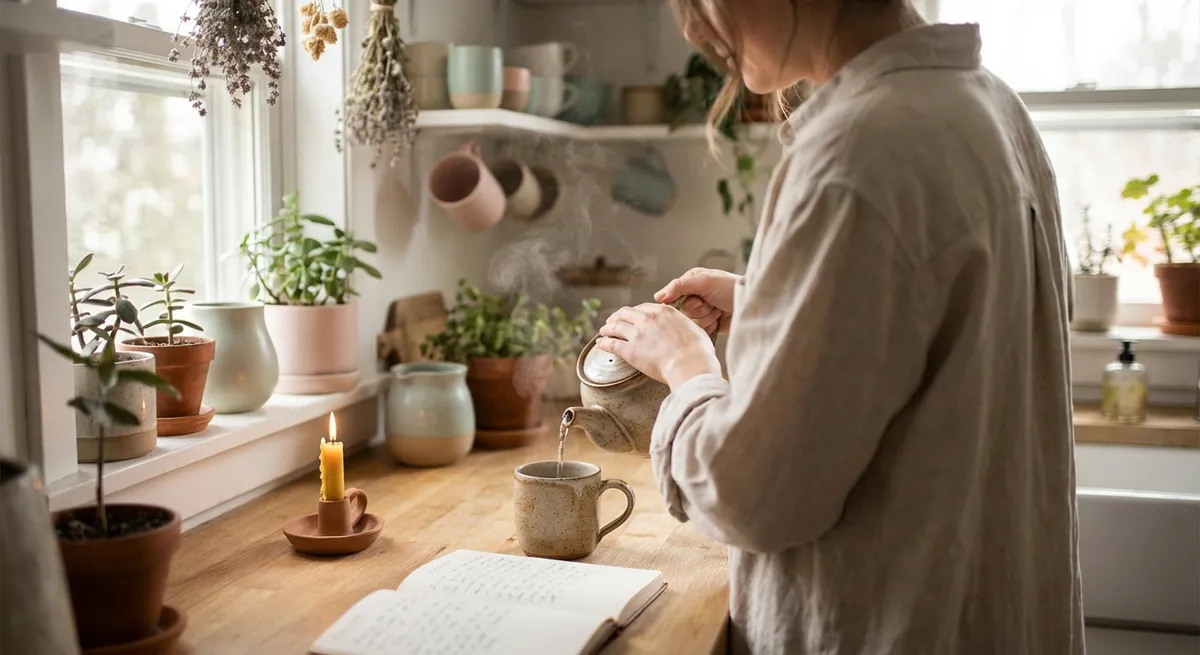
This guide offers five calm techniques for stress‑free living—each simple, flexible, and kind. You don’t need special tools or large stretches of time; only a willingness to pause and meet yourself with tenderness.
1. The Three-Breath Reset
When stress rises, it can be hard to think clearly or choose what to do next. Your breath is one of the simplest ways to signal safety to your nervous system. A short, intentional breathing pause can gently interrupt the cycle of tension and help your body remember what calm feels like.
Begin by noticing where you are—sitting, standing, or lying down is all fine. Let your shoulders soften a little, even if only by a small degree. Inhale slowly through your nose for a gentle count of four, feeling your chest and belly expand. Then exhale through your mouth for a count of six, as if you’re slowly blowing out a candle. Repeat this for just three full breaths.
Rather than trying to “do it perfectly,” simply notice: the air moving in and out, the slight rise and fall of your body. If your mind wanders, let it, and then come back to the feeling of your breath. Even three slow, lengthened exhalations can help lower stress hormones and ease your heart rate. The beauty of this technique is its simplicity: you can use it before a meeting, while waiting in line, or whenever you notice tension beginning to build.
2. Grounding Through the Five Senses
Stress can pull you up into your thoughts—into worries, what-ifs, and future conversations. Grounding through your senses gently invites you back into the present moment, where your body is. It gives your nervous system something steady and real to hold onto.
Begin by pausing and lightly anchoring your feet on the floor or your body against a chair or bed. Slowly scan your surroundings and name, either aloud or silently, what your senses are noticing. For example, you might try a gentle sequence like this:
- Notice five things you can see (shapes, colors, light, or shadows).
- Notice four things you can feel (your clothing, the chair beneath you, air on your skin).
- Notice three things you can hear (nearby sounds, distant hums, subtle noises).
- Notice two things you can smell (or remember a favorite comforting scent if none are obvious).
- Notice one thing you can taste (or sip water and notice its temperature and texture).
Move through this slowly, without rushing or judging your experience. The goal isn’t to feel instantly peaceful; it’s to come home to this moment with a little more gentleness. This kind of sensory grounding can be especially helpful when anxiety feels strong or your mind feels overfull.
3. Softening Your Inner Voice
Stress is not only a physical experience; it can also show up in how we speak to ourselves. When things feel overwhelming, it’s common for an inner critic to grow louder: “You’re behind,” “You should be doing more,” “You’re not handling this well.” That inner harshness can quietly amplify tension, making it harder to rest or think clearly.
Notice the tone of your inner voice when you feel under pressure. You don’t need to fight it or push it away; simply become aware of what it’s saying. Then, gently experiment with shifting that tone, as if you were speaking to a close friend or a younger version of yourself. You might try soft phrases like:
- “This is a lot. It makes sense that you’re feeling stressed.”
- “You’re doing the best you can with what you have today.”
- “One small step is enough for right now.”
You can place a hand over your heart or on your chest as you do this, to give your body a physical cue of care. Over time, practicing a kinder inner voice can reduce emotional strain, lower feelings of shame, and help you move through challenges with more steadiness. Calm grows more easily in a space where you feel understood, even by yourself.
4. Tiny Transitions Between Tasks
Modern life often pulls us from one task to the next with no pause in between: finish an email, open another; end a call, start a new one; leave work, scroll through messages. When we skip transitions, stress quietly accumulates. Our minds don’t have time to “put down” the last thing before picking up the next.
Instead, try adding tiny transition rituals as you move through your day. These can be as short as 30–60 seconds. For example, when you complete a task, you might:
- Close your eyes and take one slow, full breath in and out.
- Stretch your arms above your head and roll your shoulders a few times.
- Stand up, feel your feet on the ground, and take three slow steps.
- Gently say to yourself, “That’s done. Now I’m arriving at the next thing.”
These simple transitions help your nervous system reset, instead of living in a constant state of “on.” Over time, they can reduce the sense of mental clutter and make your day feel more like a series of manageable moments rather than one unbroken rush. Calm doesn’t always require more time; often, it asks only for a bit more space between things.
5. Evening Unwind: A Gentle “Release” Check-In
As the day goes on, the body often stores small pockets of tension—tight shoulders, clenched jaw, furrowed brow, a stomach held too tightly. A short evening practice can invite your whole system to release what it no longer needs to hold, preparing you for deeper rest.
Find a comfortable position: lying down, sitting on your bed, or resting in a chair. Close your eyes if that feels safe, or soften your gaze. Slowly scan your body from the top of your head to the tips of your toes. As you move through each area, quietly ask, “Is there a little bit of ease available here?” You’re not forcing relaxation, only inviting it.
You might notice your forehead easing, your jaw unclenching slightly, your shoulders dropping a bit lower. If some areas stay tense, that’s perfectly okay; just acknowledge them with kindness. You can even silently say, “Thank you for getting me through today.” End with a few slow breaths, imagining that each exhale is helping to carry the weight of the day away from your body.
This gentle “release” check-in can signal to your mind and nervous system that it’s safe to downshift. Practiced regularly, it can support better sleep, reduce lingering stress, and help you close your day with a sense of quiet care.
Conclusion
Calm doesn’t have to be grand or dramatic. Often, it lives in the smallest choices: three intentional breaths, a moment of sensory noticing, a kinder inner phrase, a brief pause between tasks, or a soft evening check-in with your body. These practices won’t remove every challenge, but they can help you meet each one with a steadier heart and a quieter nervous system.
You are allowed to move gently, even in a busy world. Experiment with one or two of these techniques this week, and notice how your days feel when you give yourself just a little more room to breathe, to arrive, and to rest inside your own life.
Sources
- American Psychological Association – Stress Effects on the Body – Overview of how stress impacts different body systems and why calming practices matter
- Harvard Health Publishing – Relaxation Techniques: Breath Control Helps Quell Errant Stress Response – Explains how slow, controlled breathing supports the nervous system
- Cleveland Clinic – Grounding Techniques – Describes sensory grounding methods for easing anxiety and returning to the present moment
- National Institute of Mental Health – 5 Things You Should Know About Stress – Provides research-based information on stress and coping strategies
- Mayo Clinic – Relaxation Techniques: Try These Steps to Reduce Stress – Outlines evidence-supported relaxation practices that can be adapted into daily life