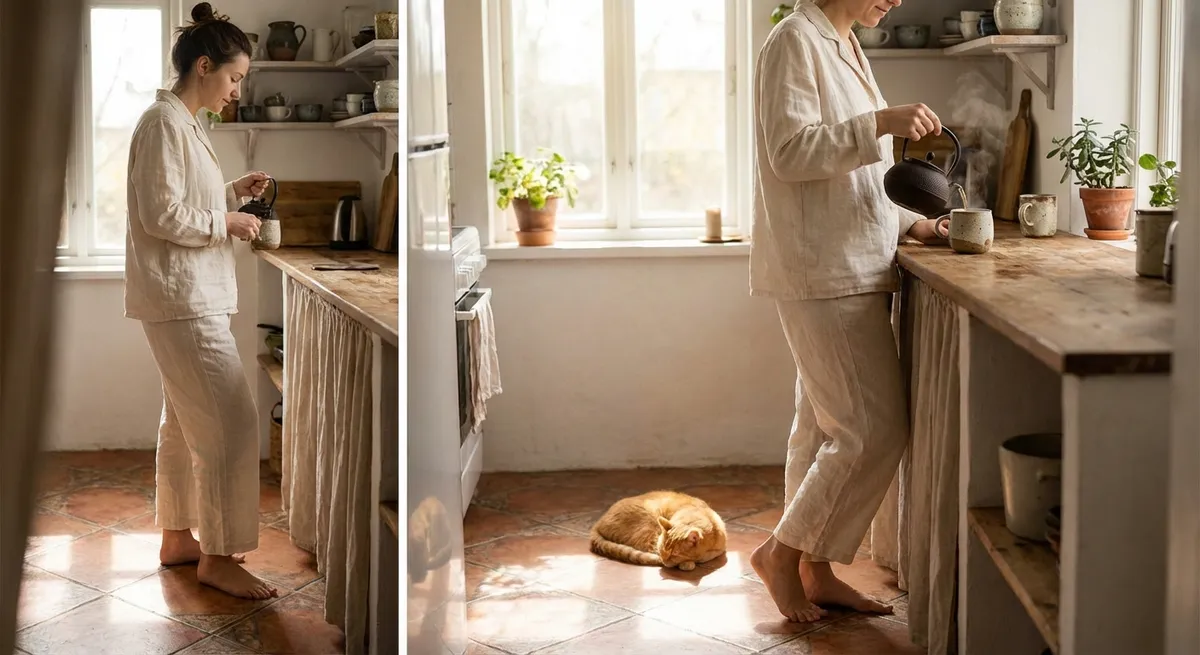
These five calming techniques are simple, kind, and designed to weave ease into your everyday life—where you actually live, work, and care for others.
1. The Softened Breath: A Quiet Reset for Your Nervous System
Your breath is a built-in calm button you carry everywhere. When stress rises, your breathing often becomes shallow and quick, sending “alert” signals through your body. By consciously softening and slowing your breath, you can send a different message: it’s safe to ease.
Find a comfortable position—sitting, standing, or lying down. Let your shoulders drop slightly, as if they are melting away from your ears. Gently inhale through your nose for a slow count of four, feeling your ribs widen like a quiet opening door. Hold that breath softly for a moment—just a gentle pause, not a strain. Then exhale through your mouth or nose for a count of six, as if you are fogging up a window on a cold day. Repeat this for a few rounds, letting the exhale be a fraction longer than the inhale.
You don’t need perfection—some days your breath may feel tight or uneven, and that is all right. Simply noticing and tending to your breath is enough. Over time, this practice can help your body remember what ease feels like, so you can return to it more quickly when life feels overwhelming.
2. One-Task Moments: Bringing Your Mind Back from Overwhelm
Stress often grows louder when your attention is pulled in many directions at once. Your mind starts juggling future worries, past conversations, and current responsibilities, all at the same time. A simple antidote is to choose just one thing and give it your full, gentle presence.
Pick a small, ordinary activity—washing a cup, making tea, brushing your hair, or walking down the hallway. For this brief moment, let this be the only thing you are doing. Feel the temperature of the water on your skin, notice the weight of the mug in your hand, or listen to the soft sound of your footsteps. When your mind drifts (and it will), kindly lead it back to the single, quiet act in front of you.
This is not about productivity or doing the task “perfectly.” It is about offering your nervous system a break from multitasking. One-task moments can be as short as 30 seconds, and yet they gently teach your mind that it is allowed to rest in the present—no fixing, no rushing, just being here.
3. Gentle Grounding with the Senses
When your thoughts spiral or anxiety rises, it can feel like you’re floating away from yourself. Grounding through your senses helps you return to the steady, simple reality of this moment. Your body is always here, even when your mind feels far away.
Take a slow look around the space you’re in. Silently name a few things you can see—colors, shapes, or light patterns. Next, notice what you can feel: the chair beneath you, your feet on the floor, the fabric on your skin, the air on your face. Then, invite in your other senses—sounds in the distance, any subtle scents, or even the lingering taste in your mouth.
There is no need to analyze or judge what you notice. You’re simply acknowledging: “This is here. And I am here too.” This practice can be especially soothing during moments of high stress, worry, or emotional overwhelm. It reminds you that you are not just your thoughts; you are also a body resting in the present moment.
4. Soft Boundaries for a Quieter Inner World
Stress doesn’t only come from what happens outside—it also grows when we say “yes” to more than we can gently hold. Soft boundaries are not harsh walls; they are kind edges that protect your energy and peace. They allow you to care for others without abandoning yourself.
Begin by noticing where you often feel overloaded: Is it constant notifications, last-minute favors, or conversations that leave you drained? Choose one small boundary to experiment with, something that feels doable rather than drastic. This might be silencing non-urgent alerts for an hour, pausing before agreeing to new commitments, or carving out a quiet 10-minute window in your day that is just for you.
When you practice a boundary, speak to yourself kindly: “It’s okay to protect my peace. It’s okay to need rest.” Some discomfort or guilt may appear at first, especially if you’re used to always saying yes. Over time, soft boundaries create more room inside you for calm, clarity, and genuine connection, instead of exhaustion.
5. Tiny Rituals of Comfort to Close the Day
Even if your day has been busy or rough, you can offer your nervous system a gentle landing as evening approaches. Tiny rituals act like soft signals to your body that it is safe to unwind. They don’t need to be elaborate; what matters is consistency and kindness.
You might dim the lights a little earlier, light a candle, or play slow, comforting music. Perhaps you place your phone in another room for a short while and rest your eyes from screens. You could stretch slowly, write three simple sentences about your day, or place a hand over your heart and notice its steady rhythm.
These small practices help your body transition from “doing” to “resting.” Over time, your mind begins to recognize these cues as a gentle invitation: we are shifting into quiet now. Even on difficult days, a tiny ritual is a way of telling yourself, “I am worthy of calm, even in small doses.”
Conclusion
Calm does not require a perfect life, a silent house, or an empty calendar. It can live quietly inside the small choices you make: one softened breath, one single task, one grounded moment, one kind boundary, one tiny evening ritual.
You do not have to transform everything at once. Allow yourself to begin softly—choosing just one of these techniques to explore today. With time and gentle repetition, these practices can form a quiet foundation beneath your busy days, reminding you that a calm heart is always within reach, even in a busy world.
Sources
- [American Psychological Association – Stress Effects on the Body](https://www.apa.org/topics/stress/body) - Explains how stress impacts different body systems and why calming techniques support overall health
- [National Institutes of Health – Relaxation Techniques: What You Need To Know](https://www.nccih.nih.gov/health/relaxation-techniques-what-you-need-to-know) - Overview of evidence-based relaxation methods such as deep breathing and mindfulness
- [Harvard Medical School – Relaxation Techniques: Breath Control Helps Quell Errant Stress Response](https://www.health.harvard.edu/mind-and-mood/relaxation-techniques-breath-control-helps-quell-errant-stress-response) - Describes how slow, controlled breathing can calm the nervous system
- [Cleveland Clinic – Grounding Techniques to Quiet Distressing Thoughts](https://health.clevelandclinic.org/grounding-techniques) - Provides practical sensory grounding strategies for moments of anxiety
- [Mayo Clinic – Stress Management](https://www.mayoclinic.org/healthy-lifestyle/stress-management/basics/stress-basics/hlv-20049495) - Discusses lifestyle changes and coping approaches that help reduce daily stress