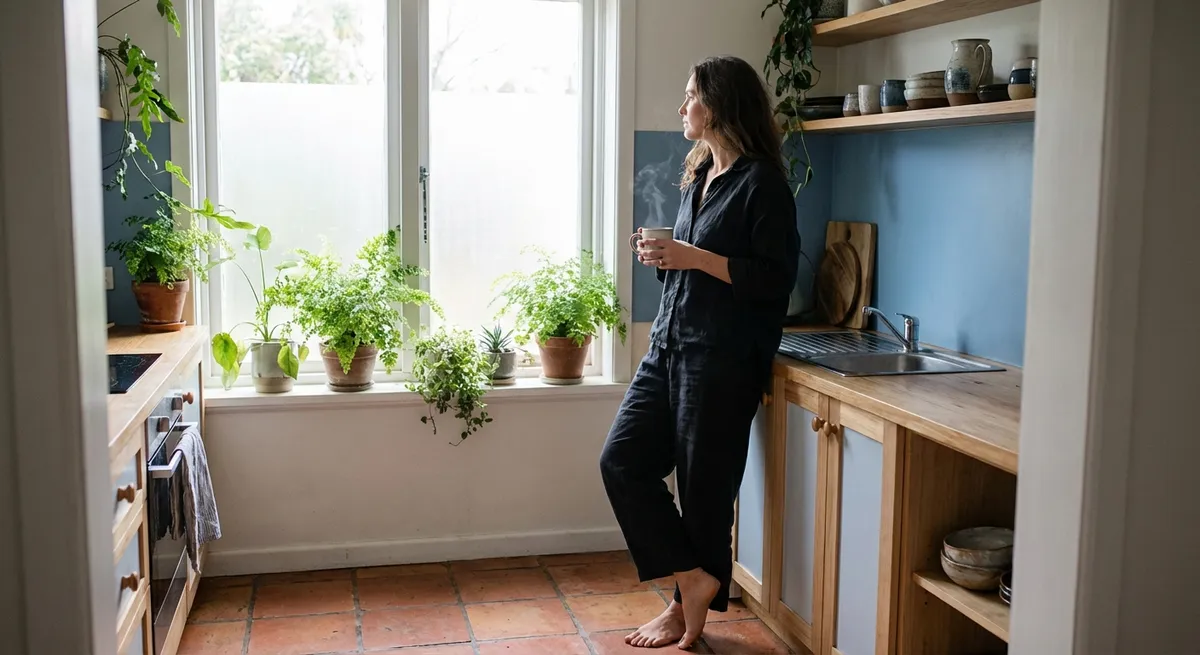
This article is a soft invitation to pause. Here, we’ll explore five gentle, realistic ways to ease stress in the middle of ordinary life—no elaborate routines, no pressure to be perfectly calm. Just small, kind moments you can return to whenever you need a quiet exhale.
1. Let Your Breath Lead the Way
When stress rises, the breath is often the first thing to change—becoming shallow, quick, or tight. The gentle act of noticing and softening your breath can signal safety to your body and ease your mind.
Begin by simply feeling where your breath naturally lands today. Is it high in your chest, low in your belly, or somewhere in between? There’s no “wrong” place—only observation.
If it feels comforting, place one hand over your heart and one over your abdomen. Inhale slowly through your nose, letting the air expand your belly just a little. Exhale through your mouth as if blowing out a candle, long and smooth.
You might silently count: inhale for 4, exhale for 6. Longer exhales can gently calm your nervous system and help release some of the day’s tension. Stay with this for a minute or two, not as a task to complete, but as a soft landing space you can return to anytime.
2. Create a Tiny “Pause Corner” in Your Day
Stress often thrives in nonstop motion. You may move from one responsibility to another without a clear moment of rest. A tiny, intentional pause—just a few minutes—can act like a quiet room inside a busy day.
Choose a simple cue that will remind you to pause: pouring your morning drink, finishing an email, or stepping outside. Each time that cue appears, give yourself a brief moment of stillness.
During your pause, you might:
- Look out a window and notice the light and shadows.
- Take three slow breaths, feeling your feet resting on the floor.
- Gently stretch your neck and shoulders, noticing any areas of tightness.
This doesn’t need to be a formal “practice.” Think of it as a friendly check-in with yourself. Over time, these small pauses can help prevent stress from building into overwhelm, like slowly releasing steam from a kettle before it whistles.
3. Soften Your Inner Voice
Stress is rarely just about what’s happening outside of you. Often, it’s also fueled by the way you speak to yourself inside your own mind. You might notice thoughts like “I should be handling this better” or “Why can’t I keep up?”
Instead of trying to push those thoughts away, try gently meeting them with kindness. When you notice a harsh inner voice, pause and ask: What would I say to a friend who felt this way? Then offer those same words to yourself.
You might whisper inwardly:
- “This is a lot. It makes sense that I feel stressed.”
- “I’m doing the best I can with what I have right now.”
- “It’s okay to be human. It’s okay to be tired.”
Softening your inner voice doesn’t erase the stressor, but it changes the way you carry it. You’re no longer facing it alone; you’re meeting it with a gentle ally—yourself.
4. Anchor Yourself in One Gentle Sensation
When your mind is racing, it can feel scattered and untethered. Grounding yourself in a single, soothing sensation brings you back into the present moment, where stress is often more manageable.
Choose one sensory anchor:
- Touch: Wrap yourself in a soft blanket, hold a warm mug, or rest a hand on your heart.
- Sound: Listen to the hum of a fan, quiet music, or distant outdoor sounds.
- Sight: Gaze at a plant, a candle flame, or the sky for a few steady breaths.
Let your attention rest lightly on this one sensation. Each time your thoughts wander—which they will—gently guide them back, the way you might softly redirect a child without scolding.
This isn’t about blocking out life, but about giving your nervous system a simple, calm focal point. Even one or two minutes can offer a feeling of steadiness when the day feels unsteady.
5. End the Day with a Gentle Release Ritual
How you close your day can shape how you carry stress into tomorrow. A small evening ritual can help you gently set down what you’ve been holding, even if just for the night.
Your ritual can be very simple. For example:
- Light a candle, take three slow breaths, and mentally say, “Today is complete.”
- Write down three things you’re grateful for or moments that felt peaceful, however small.
- List what’s on your mind for tomorrow, so you don’t have to keep it all in your head.
- Slowly stretch your body in bed, thanking it for carrying you through the day.
The goal isn’t to “fix” everything before sleep. It’s to offer your mind and body a signal: For now, I can rest. Over time, this repeated signal can help your system associate nighttime with winding down instead of replaying the day’s worries.
Conclusion
Stress may be a part of modern life, but it doesn’t have to define your days. You’re allowed to move gently, even in a hurried world. Through soft breaths, tiny pauses, kind inner words, sensory anchors, and simple end-of-day rituals, you can create little islands of calm in the middle of everything else.
You don’t need to use every suggestion at once. Perhaps choose one that feels most approachable and let it become a quiet companion for the next few days. When life feels heavy, remember that even a single slow breath, a single soft thought, can be a doorway back to yourself.
You are allowed to rest. You are allowed to go gently.
Sources
- [National Institute of Mental Health – 5 Things You Should Know About Stress](https://www.nimh.nih.gov/health/publications/stress) - Overview of what stress is, how it affects the body, and basic coping strategies
- [American Psychological Association – Stress Management](https://www.apa.org/topics/stress) - Research-based information on how stress impacts health and evidence-based approaches to relief
- [Mayo Clinic – Relaxation Techniques: Try These Steps to Reduce Stress](https://www.mayoclinic.org/healthy-lifestyle/stress-management/in-depth/relaxation-technique/art-20045368) - Practical guidance on breathing, relaxation, and calming practices
- [Harvard Health Publishing – Understanding the Stress Response](https://www.health.harvard.edu/staying-healthy/understanding-the-stress-response) - Explains the body’s stress response and how relaxation techniques help
- [Cleveland Clinic – Deep Breathing](https://my.clevelandclinic.org/health/articles/9445-deep-breathing) - Details on how deep breathing supports the nervous system and reduces stress