Meeting Yourself Where You Are
Relaxation begins with a simple act: noticing how you are, without trying to fix yourself all at once. Take a quiet moment, even just a minute, to gently scan your body from head to toe. Notice any tightness in your forehead, your neck, your chest, your hands. See if you can soften each place by just a few degrees, as though you are loosening a knot rather than pulling it apart.
This kind of kind awareness is not about doing relaxation “correctly.” It’s about saying, “This is where I am right now, and it’s okay.” When your mind wanders to what you “should” be doing, bring it back softly, the way you might guide a small child by the hand. Over time, this gentle noticing creates a sense of inner safety, and from that safety, relaxation becomes less of a task and more of a natural settling.
Tip 1: A Softened Breath to Steady Your Day
Your breath is always with you, quietly available no matter where you are or how your day is unfolding. Even a few intentional breaths can signal to your body that it is safe to release some tension. Try this simple rhythm whenever you feel tight or rushed: breathe in slowly through your nose to a count of four, pause gently for a count of two, then exhale through your mouth for a count of six.
Allow your exhale to be just a little longer than your inhale, as though you’re slowly letting out a sigh of relief. You don’t need to force anything; if counting feels stressful, simply notice the coolness of the air as it enters, and the warmth as it leaves. With each breath, imagine a little more space opening in your chest and shoulders. Even one minute of this soft attention can create a noticeable shift in how you feel.
Tip 2: Creating a Quiet Pocket in Your Environment
The world around you influences the world inside you. You don’t need a perfect home or a dedicated meditation room to create a feeling of calm; a single “gentle pocket” is enough. This could be a favorite chair near a window, a small spot on the floor with a pillow, or just a corner of your desk cleared of clutter. Think of it as a tiny sanctuary where your nervous system learns to associate that space with slowing down.
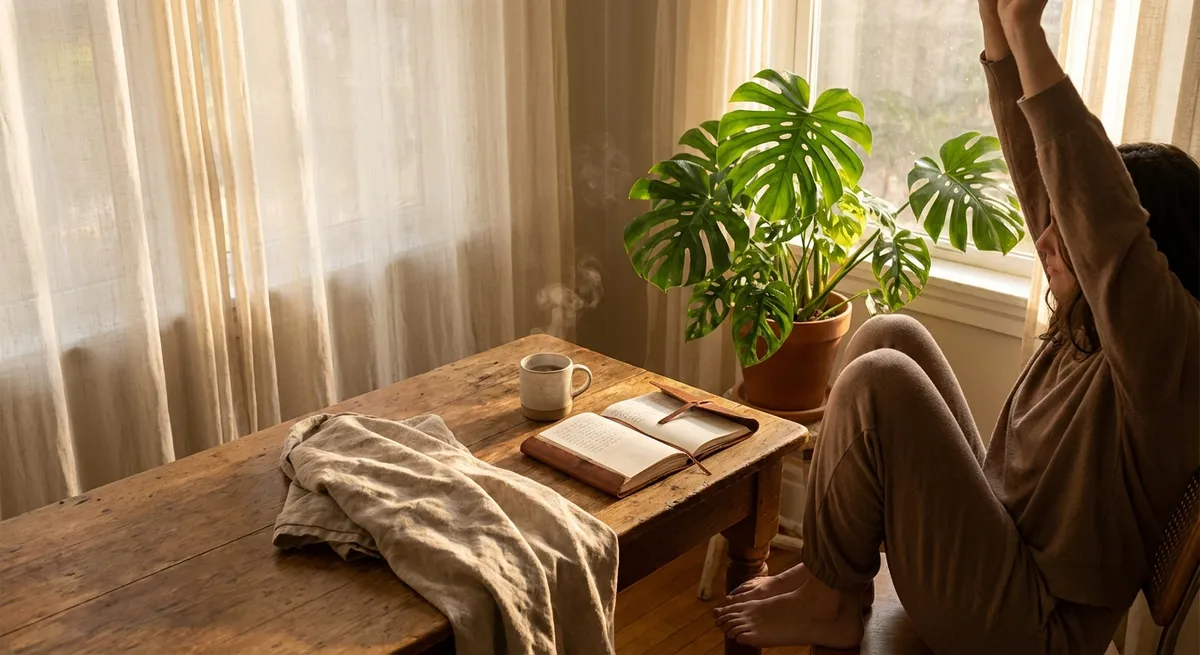
Add one or two simple, soothing elements: a soft blanket, a plant, a candle, or a photo that makes your heart feel warm. When the day feels heavy, sit or stand in this spot for a few moments. Let your eyes rest on something comforting. Notice the way the light falls, the quiet textures around you, the feeling of support beneath your body. By returning to this little haven again and again, you quietly teach your body that calm is not far away; it lives in places you can return to whenever you need.
Tip 3: Gentle Movement to Unwind Hidden Tension
Stress often settles into the body where we least notice it: in the curve of our back, the set of our shoulders, the way we hold our hips. Relaxation does not always mean stillness; sometimes it means moving in slow, caring ways. Try rolling your shoulders in soft circles, stretching your arms overhead as if waking from a long, safe sleep, or slowly turning your head from side to side with your jaw unclenched.
You don’t need special clothes, equipment, or a long block of time. A few minutes of unhurried stretching, even at your desk or in your kitchen, can remind your body what ease feels like. Pay attention to sensations rather than how it looks—warmth spreading through a muscle, the pleasant pull of a stretch, the relief when you release. Let each movement be an act of kindness, not performance. In this way, movement becomes a quiet conversation with your body: “I see you. Thank you. Let’s soften a little together.”
Tip 4: A Calming Ritual to Bookend Your Day
Our minds often carry the rhythm of one part of the day into the next: work thoughts spill into the evening, and unfinished tasks echo into the night. A simple calming ritual at the beginning or end of your day can act like a gentle doorway, helping you step out of one space and into another with more peace. This ritual doesn’t need to be long or elaborate; what matters most is that you repeat it with care.
You might light a candle for a few minutes in the evening and take three slow breaths while watching the flame. You could write down one thing you’re grateful for in the morning before you look at your phone. Maybe you wash your hands slowly after work, imagining the stress of the day rinsing away with the water. Over time, these small, repeated gestures signal to your body and mind: “We are entering a softer time now.” The predictability of your ritual becomes a comfort, a tiny anchor of calm even on unsettled days.
Tip 5: Speaking to Yourself in a Kinder Voice
The way you speak to yourself shapes how safe you feel in your own mind. Harsh inner commentary—“I’m not doing enough,” “I should be stronger,” “Why am I like this?”—keeps your nervous system on alert, even when your body is still. Relaxation deepens when the voice inside your head becomes more gentle and understanding.
You don’t have to instantly love yourself or silence all criticism; that would be another form of pressure. Instead, start by slightly softening your inner language. When you notice tension or worry, you might say, “Of course I’m feeling this way—it’s been a lot,” or “I’m doing the best I can with what I have today.” Imagine how you would speak to a dear friend who is tired and overwhelmed, and try offering yourself the same tone, even if the words feel awkward at first. With practice, this kinder inner voice becomes a quiet cushion, making it easier to rest, breathe, and let go.
Letting Relaxation Be a Gentle Practice, Not a Perfect One
Relaxation is not a destination you arrive at once and for all; it is a series of small, compassionate choices you make throughout the day. Some days, your shoulders will drop easily, your breath will slow, and calm will feel close. Other days, your mind will race and your body will feel restless, even when you’re doing “all the right things.” Both kinds of days are part of being human.
Instead of measuring how “relaxed” you are, notice the care you’re offering yourself: a softer breath, a quiet corner, a gentle stretch, a tiny ritual, a kinder thought. These are acts of inner hospitality—ways of making your own life feel a little safer, a little more spacious. Each time you practice, even for a moment, you are reminding yourself: I am allowed to rest. I am allowed to move slowly. I am allowed to feel at ease, right here, in this ordinary moment.
Sources
- [National Institutes of Health – Relaxation Techniques](https://www.nccih.nih.gov/health/relaxation-techniques-for-health) – Overview of evidence-based relaxation practices and their benefits for stress and health
- [American Psychological Association – Stress Management](https://www.apa.org/topics/stress) – Explains how stress affects the body and mind, and offers research-backed coping strategies
- [Harvard Health Publishing – Take a Breath for Better Health](https://www.health.harvard.edu/mind-and-mood/take-a-breath-for-better-health) – Describes how breathing exercises can calm the nervous system and support relaxation
- [Mayo Clinic – Mindfulness Exercises](https://www.mayoclinic.org/tests-procedures/mindfulness-exercises/in-depth/mindfulness-exercises/art-20046356) – Practical mindfulness suggestions that align with gentle awareness and self-kindness
- [Cleveland Clinic – Progressive Muscle Relaxation](https://health.clevelandclinic.org/progressive-muscle-relaxation) – Details a simple body-based technique for releasing physical tension and promoting calm