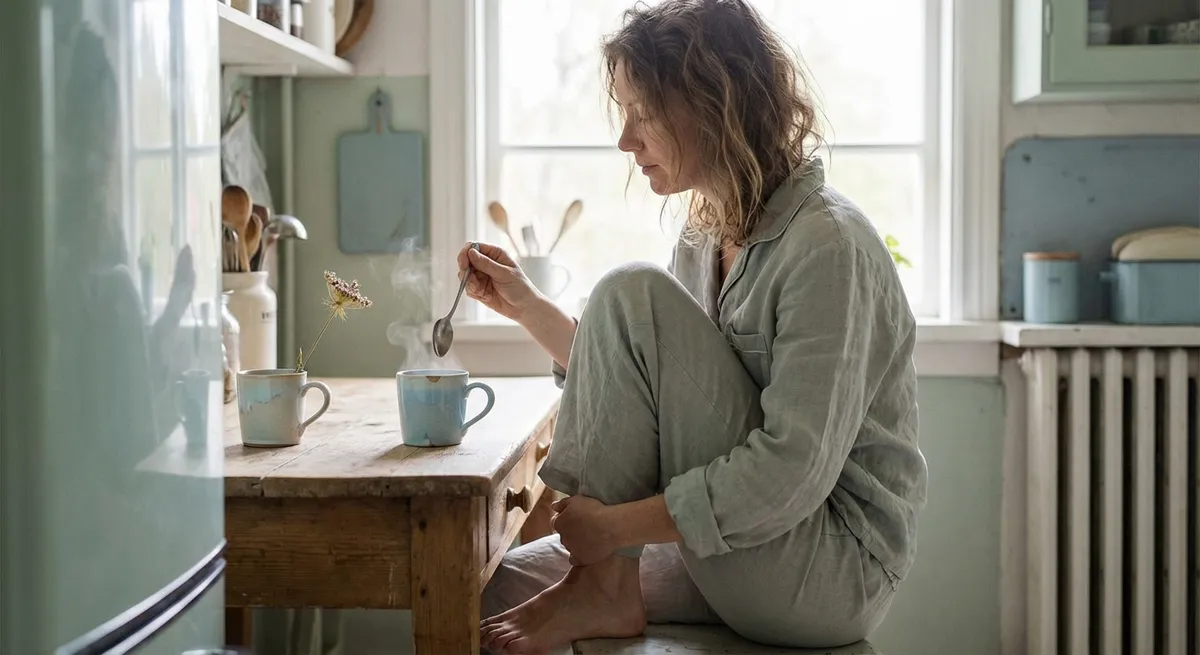
In this softly unfolding guide, you’ll find five calming tips that don’t demand much time or energy—only a little willingness to slow down and listen to yourself with care.
Softening the Edges of Your Day
Many of us move through our hours with a sense of tightness—shoulders lifted, jaw clenched, thoughts speeding ahead. Peaceful living is less about fixing everything, and more about gently softening these edges. It is the practice of meeting each moment with just a bit more space, a touch more compassion, and a slower, steadier breath.
You do not have to change your entire life to invite in more peace. Instead, you can weave small threads of calm into what already exists: your morning routine, your commute, your lunch break, your evening wind-down. Over time, these threads begin to form a softer, kinder fabric around your days.
Allow yourself to approach these suggestions with gentleness. There is no “right way” to be calm—only many small ways to be a little kinder to your nervous system, your thoughts, and your heart.
Calming Tip 1: Breathe in a Shape
When the mind feels busy, it can be hard to simply “take a deep breath.” Giving the breath a gentle shape can help. Imagine drawing a soft rectangle with your breath: inhale up one side, pause across the top, exhale down the other side, pause along the bottom. This quiet rhythm can calm the nervous system and offer your body a sense of safety.
To practice, picture the rectangle in your mind or trace it slowly in the air with your finger. Inhale for a slow count of four, pause for four, exhale for four, pause for four. Repeat for two or three rounds, or longer if it feels soothing. Let your shoulders drop away from your ears and your jaw loosen just a little.
There is no need to force anything. If counting feels like too much, simply imagine the shape, allowing your breath to rise, float, fall, and rest. You are offering yourself a structured, yet gentle, way to step out of worry and into presence.
Calming Tip 2: Find One Quiet Sound
Peaceful living is not about silencing every noise around you; it is about choosing where your attention lands. Even in busy environments, there is often at least one softer sound—a bird outside, the faint hum of a fan, the rustle of leaves, or your own breathing. Pausing to notice that sound can create a small, steady island of calm.
Take a moment and close your eyes, if that feels safe. Let your hearing expand gently in all directions. Without straining, see if you can pick up one sound that feels neutral or comforting. Rest your attention there for a few breaths, as if you are quietly listening to a friend.
If your mind wanders, that is natural. Simply guide your awareness back to the chosen sound, over and over, without judgment. This tiny act of returning is itself a peaceful practice. It reminds you that even in chaos, you can choose a gentler focus.
Calming Tip 3: Offer Your Body One Kind Gesture
Stress often settles into the body as tension, tightness, or heaviness. One simple, kind physical gesture can send a message of safety and care to your whole system. It doesn’t have to be a long stretch or a full workout—just one moment of tenderness toward your body.
You might place a hand over your heart, feeling the warmth of your palm and the rhythm of your heartbeat. You could gently massage your temples or the back of your neck, or stretch your arms overhead and then let them fall softly to your sides. You might roll your shoulders in slow circles, noticing the release as they settle.
While you do this, you can silently say something reassuring to yourself: “I am here with you,” or “It’s okay to slow down.” By pairing a soothing gesture with kind words, you create a quiet loop of comfort that your body can learn to recognize and trust.
Calming Tip 4: Create a Tiny Island of Stillness
You do not need a full hour of solitude to experience peace. Sometimes just a single, protected minute can make your day feel more breathable. Consider choosing one small moment—a pause before turning on your phone, a short break before you eat, or a quiet pause before sleep—and softly naming it your “island of stillness.”
During this minute, set aside the urge to plan, scroll, or respond. Instead, simply be with yourself. You might watch the way light falls in the room, feel the texture of the chair beneath you, or notice the subtle rise and fall of your chest. There is nothing to achieve here; your only task is to gently arrive where you already are.
Even on very crowded days, this tiny island can offer your nervous system a chance to reset. Over time, you may find yourself naturally lengthening these moments or sprinkling them throughout your day—stepping onto these little islands again and again whenever you need to feel more grounded.
Calming Tip 5: End the Day With One Soft Sentence
The way you close the day can color how your body and mind enter rest. Instead of replaying everything that went wrong or everything left undone, try ending the day with one gentle sentence of acknowledgment or gratitude. It does not need to be grand or poetic; it only needs to be sincere.
As you settle into bed, you might say to yourself, “I did the best I could with what I had today,” or “I am grateful for one small thing,” and then name it—a warm cup of tea, a smile from a stranger, a moment of laughter, a patch of sunlight. This simple practice can gently shift your focus from tension to tenderness.
You are not ignoring your challenges; you are choosing to also notice what held you. Over time, this nightly sentence can become a quiet ritual that signals to your body: it is safe to soften now; you are allowed to rest.
Conclusion
Peaceful living is not a distant goal reserved for quiet lives. It is a series of small, kind choices made in the middle of real, imperfect days. A shaped breath. A single sound. One kind gesture to your body. A tiny island of stillness. A soft sentence before sleep.
You do not need to use all of these practices at once. Even choosing just one and returning to it gently, again and again, can begin to change the tone of your days. Let peace arrive not as a sudden transformation, but as a slow, steady drift toward ease—one calm moment at a time.
Sources
- National Center for Complementary and Integrative Health (NCCIH) – Relaxation Techniques - Overview of evidence-based relaxation practices and their effects on stress and health
- American Psychological Association – Stress Management - Explains how stress affects the body and mind, and outlines healthy coping strategies
- Harvard Health Publishing – Breath Focus for Stress Relief - Describes how focused breathing helps calm the nervous system and provides simple techniques
- Cleveland Clinic – Progressive Muscle Relaxation - Details how gentle physical relaxation practices can reduce tension and support mental calm
- Mayo Clinic – Mindfulness Exercises - Offers practical, everyday mindfulness exercises that align with creating small moments of stillness